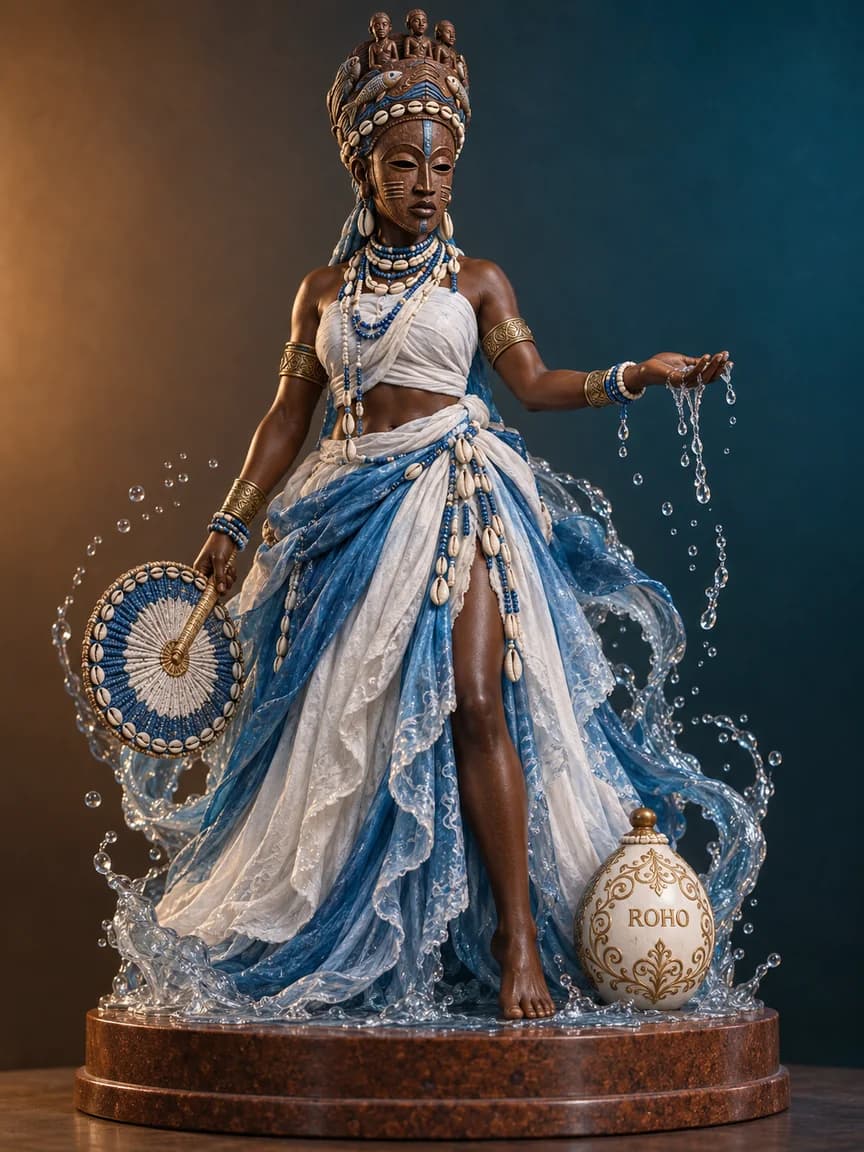
Yemoja
allyOrisha
Yemoja is the orisha of the waters, of motherhood and of the protection of children in the Yoruba religion. Her name comes from the Yoruba expression Yeye omo eja, the mother whose children are fish, an image of her inexhaustible fecundity. In Yoruba country, in the south-west of present-day Nigeria, she is associated with the Ogun river, and her historical cult is particularly alive at Abeokuta, where a festival is consecrated to her. Mother of many orishas according to several traditions, she watches over women, pregnancy, the newborn and the secrets of the waters. Her attributes are fresh water then, in the diaspora, the sea, the colours white and blue, shells and the round fan. The Atlantic slave trade transformed her cult: become the deity of the ocean in the Americas, she is one of the most beloved figures of the Afro-diasporic religions. In Cuba, Santería honours her under the name of Yemayá, associated with the Virgin of Regla, protector of the bay of Havana. In Brazil, Iemanjá is celebrated on 2 February at Salvador de Bahia, where thousands of the faithful carry flowers and offerings to the sea, as well as at the New Year in Rio de Janeiro. Her cult remains a living religious practice on both sides of the Atlantic.
Powers & Attributes
Role in the ROHO universe
Weaver of the currents. YEMOJA watches over the flow of the waters and the fluid memory that binds the worlds within the Mabioni. Bound to the Yoruba pantheon.
Sacred Mask
An ancient ritual mask of polished ebony, mother-of-pearl and shells, engraved with symbols of ocean, motherhood and river, embodiment of the power of Yemoja
Era
Ancient cycle
Frequently asked questions
Who is Yemoja?
Yemoja is the orisha of the waters, of motherhood and of the protection of children in the Yoruba religion. Associated with the Ogun river in Nigeria, she became in the diaspora the great deity of the sea, venerated under the names of Yemayá in Cuba and Iemanjá in Brazil.
What is the difference between Yemoja, Yemayá and Iemanjá?
They are the same deity under three names. Yemoja is the original Yoruba form, bound to the Ogun river in Nigeria. Yemayá is her name in Cuban Santería, where she is associated with the Virgin of Regla. Iemanjá is her Brazilian form in Candomblé and Umbanda, celebrated on 2 February at Salvador de Bahia and at the New Year in Rio de Janeiro.
What are Yemoja's attributes and symbols?
Her colours are white and blue; her emblems, shells, the round fan and the waters, a river in Africa, the ocean in the Americas. Mother of many orishas according to several traditions, she protects pregnant women, children and fishermen. Her name comes from the Yoruba Yeye omo eja, the mother whose children are fish.
Related spirits
Further reading
Sources and references
- Pierre Fatumbi Verger, Notes sur le culte des Orisa et Vodun à Bahia, la Baie de tous les Saints, au Brésil et à l'ancienne Côte des Esclaves en Afrique (1957)
- Pierre Fatumbi Verger, Orisha, les dieux yorouba en Afrique et au Nouveau Monde (1982)
- Robert Farris Thompson, Flash of the Spirit: African and Afro-American Art and Philosophy (1983)