Ògún
allyIron, war, technology
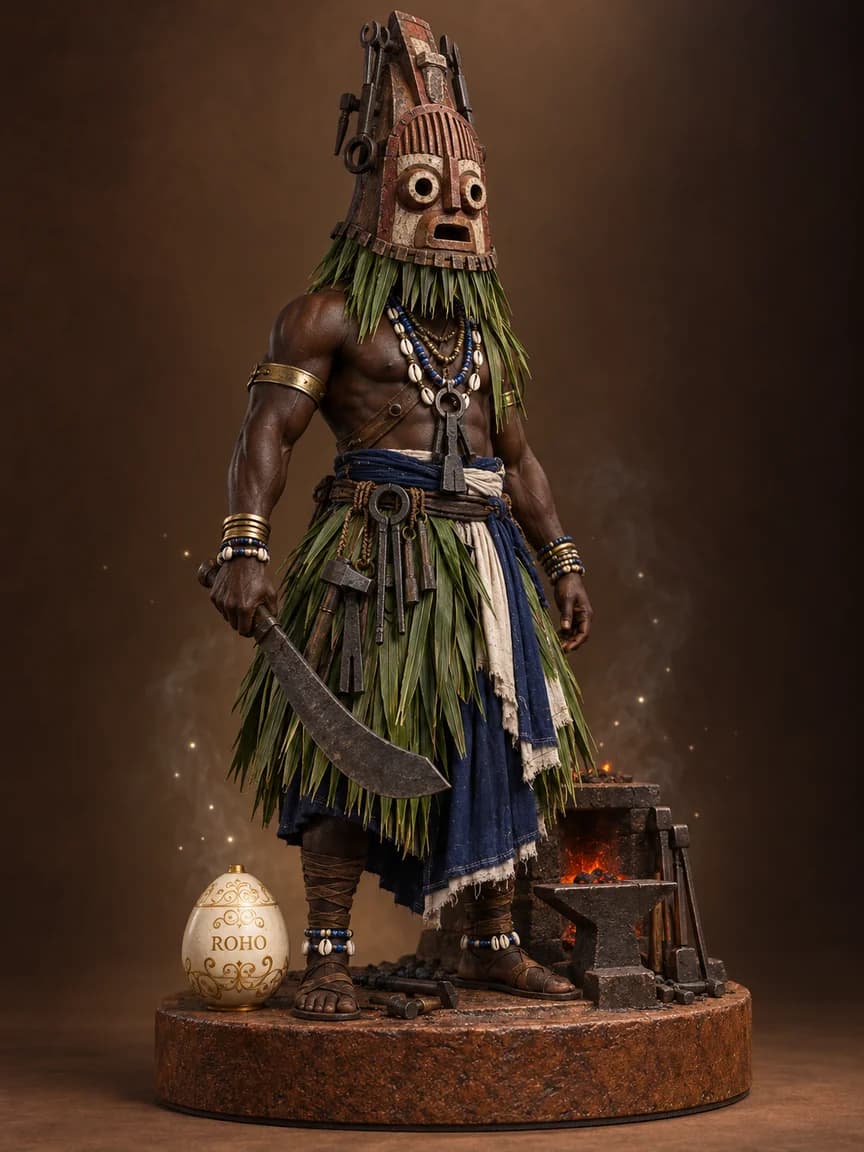
Ògún is the orisha of iron, war, hunting and technology in Yoruba religion. One of the most ancient deities of the pantheon, he is the patron of blacksmiths, hunters, warriors and all who work metal. Yoruba narratives tell that he opened the way of the gods to the earth with his iron machete, making him the pioneer and pathfinder par excellence. His attributes are iron in all its forms, the machete, the dog, and the young palm fronds called mariwo. In Nigeria his presence remains concrete: the courts have accepted oaths sworn on iron for followers of the traditional religion, and drivers, mechanics and welders still invoke him as patron of their trades. The town of Ondo, in the south-west of the country, celebrates a major Ogun festival every year. In the diaspora born of the Atlantic slave trade, his worship survived and prospered: Ogún in Cuban Santería, Ogum in Brazilian Candomblé, Ogou among the lwa of Haitian Vodou. A figure of civilising energy, he embodies labour, the force that clears the way, technique, and the given word, sealed upon metal.
Powers & Attributes
Role in the ROHO universe
A fragment of Onionkupón's Breath, bound to one of the five elements of the cosmic balance.
Sacred Mask
A mask carved of ancient energy: a symbol of the cosmic force proper to its pantheon.
Era
3,000 to 1,000 BCE: Cycle of Elemental Powers
Spiritual Lesson
To understand the nature of one's own balance and the wisdom hidden behind every trial.
Words of the Spirit
“Iron remembers every hand that forged it.”
Frequently asked questions
Who is Ògún?
Ògún is the orisha of iron, war and technology in Yoruba religion. Patron of blacksmiths, hunters and all the trades of metal, he is venerated in Nigeria and Benin, and then in the diaspora, from Cuban Santería to Brazilian Candomblé and Haitian Vodou.
Does Ògún also exist in Haitian Vodou?
Yes. The figure of Ògún travelled with the captives of the Atlantic slave trade and took root in several Afro-American religions: Ogún in Cuban Santería, Ogum in Brazilian Candomblé and Ogou in Haitian Vodou, where he forms a family of warrior lwa. Everywhere he remains bound to iron, strength and courage.
What are Ògún's attributes and symbols?
Ògún is inseparable from iron and metal tools: machete, hoe, anvil, weapons. The dog is associated with him, as are the young palm fronds called mariwo. Patron of blacksmiths and hunters, he has become that of drivers, mechanics and welders. In Nigeria, an oath sworn on iron is binding for followers of the traditional religion.
Related spirits
Further reading
Sources and references
- Pierre Fatumbi Verger, Orisha, les dieux yorouba en Afrique et au Nouveau Monde (1982)
- Robert Farris Thompson, Flash of the Spirit: African and Afro-American Art and Philosophy (1983)
- E. Bolaji Idowu, Olodumare: God in Yoruba Belief (1962)