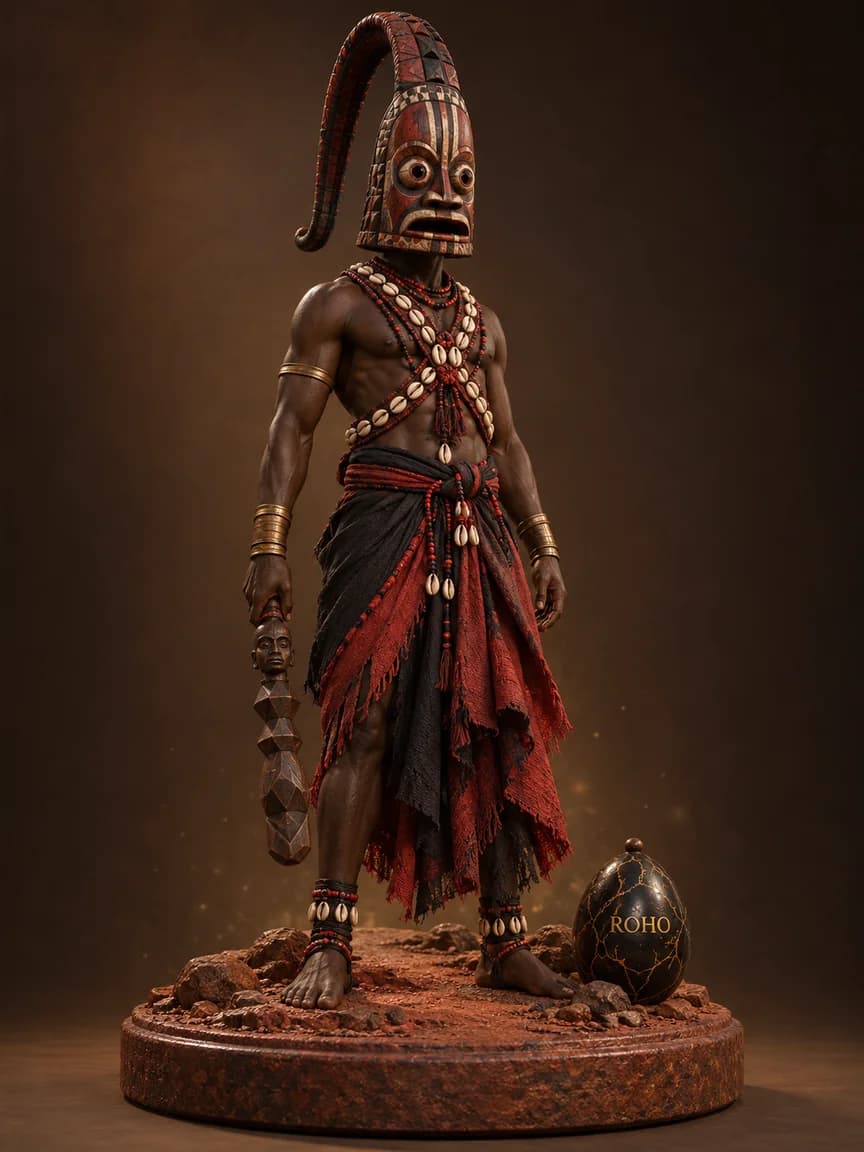
Èṣù (eshu)
antagonistMessenger, crossroads, chance
Èṣù (Eshu) is the messenger orisha and keeper of the crossroads in Yoruba religion. An indispensable intermediary between humans and the deities, he conveys offerings and prayers to the spirit world and sees to it that sacrifices are honoured; for this he receives the first share of every offering and is greeted first in most rituals. Companion of Orunmila, he holds a central place in Ifa divination. An ambivalent figure, at once ordering and unpredictable, he tests human beings, opens or closes the roads, and embodies the principle of choice and consequence. Nineteenth-century Christian missionaries wrongly assimilated him to the devil in their translations: a misreading that specialists of Yoruba religion have long since corrected: Èṣù is not a figure of evil but a principle of circulation and balance. His attributes are the crossroads, the laterite stone called yangi, the carved staff, cowries, and the colours black and red. In the diaspora he remains the first to be honoured: Eleguá in Cuban Santería, where he keeps the doors and the roads, Exu in Brazilian Candomblé, saluted at the opening of every ceremony. His worship remains alive in Nigeria, in Benin and across the Americas.
Powers & Attributes
Role in the ROHO universe
Born of the fracture between order and chaos, messenger between the worlds, keeper of human choices.
Sacred Mask
A black and red mask of volcanic stone: a symbol of the crossroads, of chance and of free will.
Era
3,000 to 1,000 BCE: Cycle of Elemental Powers
Spiritual Lesson
To accept the duality of choice and the responsibility that comes with freedom.
Words of the Spirit
“At the crossroads, every road leads to a different truth.”
Frequently asked questions
Who is Èṣù (Eshu)?
Èṣù (Eshu) is the messenger orisha and keeper of the crossroads in Yoruba religion. Intermediary between humans and the deities, he carries offerings and prayers, opens or closes the roads, and enforces the rules of exchange. He is honoured first in most Yoruba rituals.
Is Èṣù a devil or a demon?
No. The assimilation of Èṣù to the devil comes from nineteenth-century Christian missionary translations and is a misreading acknowledged by specialists of Yoruba religion. Èṣù is a messenger and a mediator, guarantor of sacrifices and of exchanges between humans and deities. An ambivalent figure, he tests human beings and opens the roads, but he does not embody evil.
What are Èṣù's attributes and symbols?
Èṣù is bound to the crossroads, places of choice and passage, to the laterite stone called yangi, to the carved staff, to cowries and to the colours black and red. He receives the first share of every offering and is greeted first in rituals. In Santería, Eleguá keeps the doors; in Candomblé, Exu opens every ceremony.
Related spirits
Further reading
Sources and references
- E. Bolaji Idowu, Olodumare: God in Yoruba Belief (1962)
- Robert Farris Thompson, Flash of the Spirit: African and Afro-American Art and Philosophy (1983)
- Pierre Fatumbi Verger, Notes sur le culte des Orisa et Vodun à Bahia, la Baie de tous les Saints, au Brésil et à l'ancienne Côte des Esclaves en Afrique (1957)