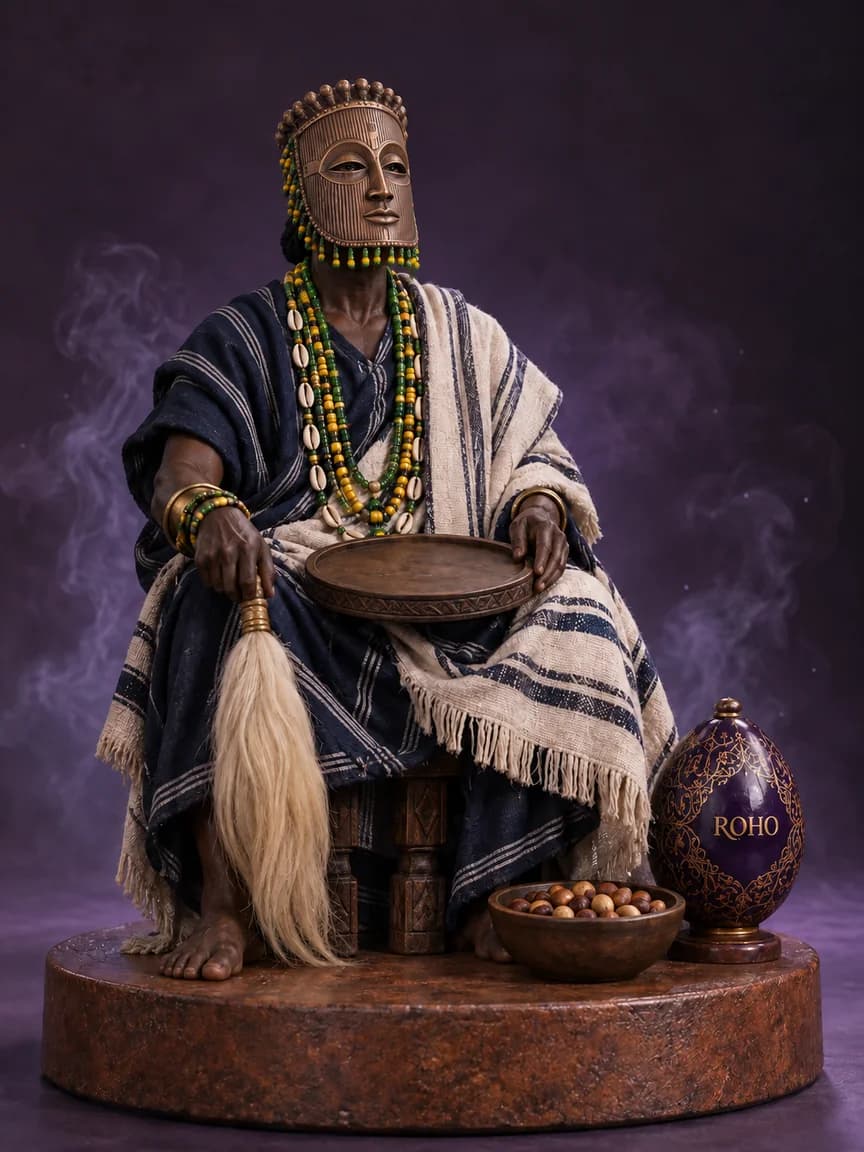
Orúnmìlà
allyGod
Orunmila is the orisha of wisdom, knowledge and divination in Yoruba religion. A primordial deity present at the origins of the world, he bears the title Eleri Ipin, witness of destiny: he attends the moment when each soul chooses its destiny before Olodumare, and can therefore light the road of humans. It is in this capacity that he presides over the divinatory system of Ifa, which he transmitted to humanity. The Ifa corpus is organised into 256 signs, the odu, including 16 major signs, each associated with a vast body of oral poems, the ese Ifa, memorised by the diviner-priests, the babalawo, and in certain lineages by priestesses, the iyanifa. The Yoruba scholar Wande Abimbola devoted the reference study to this literary corpus. Orunmila works in close relation with Eshu, the messenger who carries the sacrifices and sees to the execution of the oracle's prescriptions. His cult, bound to Ile-Ife, the holy city of the Yoruba, was transmitted to the Americas with the Atlantic slave trade: Cuban Santería venerates him under the names Orula or Orunla, associated with Saint Francis of Assisi, and its babalawos perpetuate divination by Ifa, while in Brazil Candomblé honours his figure alongside the divinatory practice. The Ifa divination system is inscribed by UNESCO on the representative list of the intangible cultural heritage of humanity.
Powers & Attributes
Role in the ROHO universe
Oracle of the Mabioni. ORÚNMÌLÀ reads the threads of destiny and counsels those who must decide. Bound to the Yoruba pantheon.
Sacred Mask
A mask carved of ancient energy: a symbol of the cosmic force proper to its pantheon.
Era
3,000 to 1,000 BCE: Cycle of Elemental Powers
Frequently asked questions
Who is Orunmila in Yoruba religion?
Orunmila is the orisha of wisdom, knowledge and divination in Yoruba religion. Witness of every human being's destiny, he presides over the divinatory system of Ifa, which he transmitted to humans and whose priests, the babalawo, interpret the 256 signs, called odu, to light the lives of the faithful.
What is the difference between Orunmila and Ifa?
Orunmila is the deity, the orisha of wisdom who knows the destiny of beings. Ifa designates the divinatory system over which he presides and, by extension, the corpus of the 256 odu and their oral poems. In common usage the two names are often interchanged: to consult Ifa or to consult Orunmila designates the same approach to the diviner.
Who are the babalawo?
The babalawo, literally fathers of the secret, are the diviner-priests of Orunmila. At the end of a long initiation, they memorise the odu of Ifa and their poems, handle the sixteen sacred palm nuts or the divining chain, opele, and prescribe the offerings. In certain lineages, women, the iyanifa, also hold this priesthood. Cuban Santería perpetuates the institution.
Related spirits
Further reading
Sources and references
- Wande Abimbola, Ifá: An Exposition of Ifá Literary Corpus (1976)
- E. Bolaji Idowu, Olodumare: God in Yoruba Belief (1962)
- Pierre Fatumbi Verger, Notes sur le culte des Orisa et Vodun à Bahia, la Baie de tous les Saints, au Brésil et à l'ancienne Côte des Esclaves en Afrique (1957)