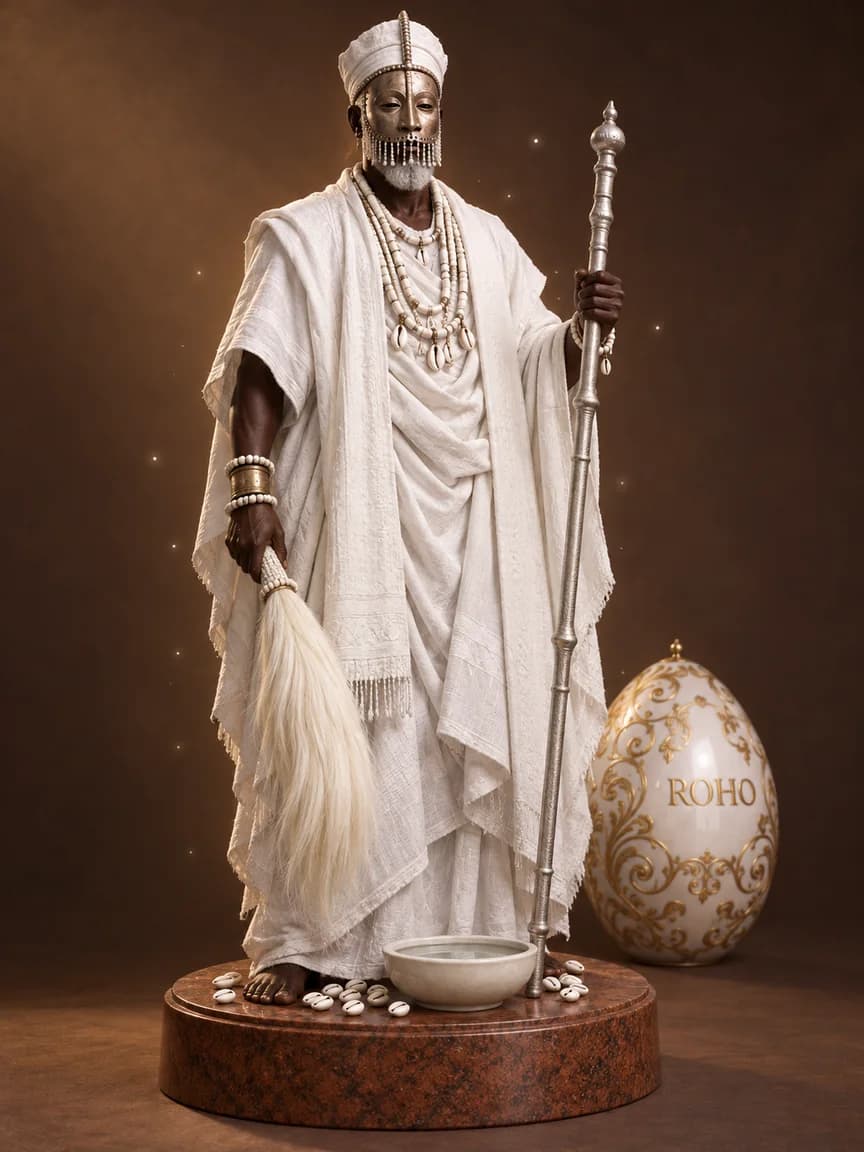
Obàtálá
allyCreation of bodies, purity
Obàtálá is the orisha of the creation of human bodies, of purity and of wisdom in Yoruba religion. His name means king of the white cloth. Chief of the orishas funfun, the deities of whiteness, he receives from Olodumare, the supreme god, the charge of shaping the bodies of human beings, into whom Olodumare then breathes the breath of life. According to some narratives, bodies shaped on a day when he had drunk palm wine were born with infirmities: Obàtálá thus became the protector of people with disabilities, and his devotees abstain from palm wine. His historic cult centre is Ile-Ife, the holy city of the Yoruba in the south-west of present-day Nigeria, where an annual festival is dedicated to him. His attributes are white cloth, efun chalk, pale metals such as silver and lead, the snail and pure water; his devotees dress in white. In the diaspora his worship remains alive: Cuban Santería honours him under the name Obatalá, associated with the Virgin of Las Mercedes, and Brazilian Candomblé under that of Oxalá, to whom the famous washing of the Bonfim church in Salvador de Bahia is attached. He embodies patience, moral rectitude and the light of wisdom.
Powers & Attributes
Role in the ROHO universe
Shaped by the Will of Onionkupón, giver of form to earthly creations.
Sacred Mask
A polished white mask with a central staff: a symbol of purity and of the creation of human flesh.
Era
9,000 to 7,000 BCE: Cycle of Human Formation
Spiritual Lesson
To accept that purity is born of forgiveness, not of control, and that creation implies imperfection.
Words of the Spirit
“Before the first word, there was already the breath.”
Frequently asked questions
Who is Obàtálá?
Obàtálá is the orisha of the creation of human bodies, of purity and of wisdom in Yoruba religion. Called king of the white cloth, he shapes human beings before Olodumare breathes life into them. He is venerated at Ile-Ife, in Nigeria, and throughout the diaspora.
What is Obàtálá's role in creation according to the Yoruba?
In Yoruba theology, Olodumare, the supreme god, entrusts Obàtálá with the shaping of human bodies, then breathes the breath of life into them. Some narratives tell that bodies shaped under the effect of palm wine were born infirm: this is why Obàtálá protects people with disabilities, and why his devotees abstain from palm wine.
What are Obàtálá's attributes and symbols?
White dominates his whole cult: white cloth, efun chalk, pale metals such as silver and lead, the snail and pure water. His devotees dress in white as a sign of purity. In Cuban Santería, Obatalá is associated with the Virgin of Las Mercedes; in Brazil, Oxalá is honoured at the washing of the Bonfim church in Salvador de Bahia.
Related spirits
Further reading
Sources and references
- E. Bolaji Idowu, Olodumare: God in Yoruba Belief (1962)
- Pierre Fatumbi Verger, Orisha, les dieux yorouba en Afrique et au Nouveau Monde (1982)
- Pierre Fatumbi Verger, Notes sur le culte des Orisa et Vodun à Bahia, la Baie de tous les Saints, au Brésil et à l'ancienne Côte des Esclaves en Afrique (1957)