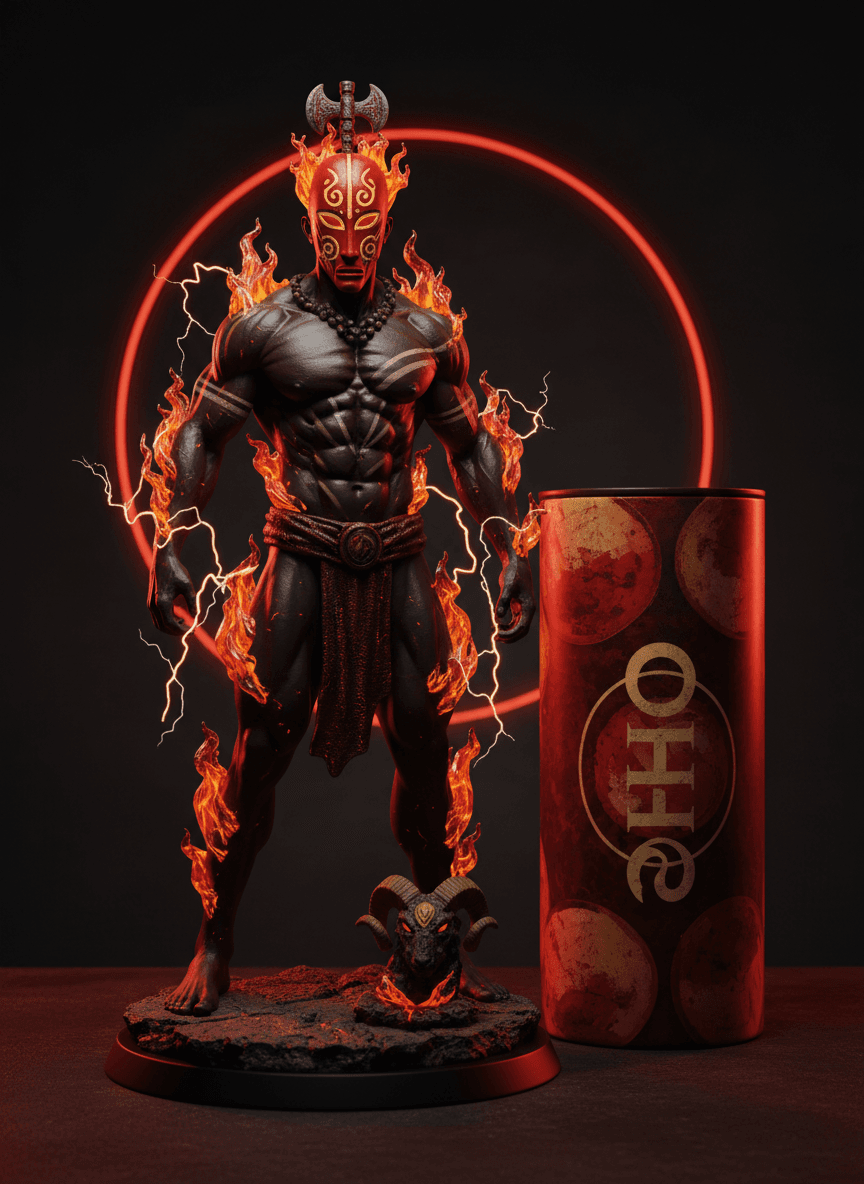
Ṣàngó (shango)
allyThunder, royal justice
Ṣàngó (Shango) is the orisha of thunder, lightning and justice in Yoruba religion. A figure at once historical and divine, tradition makes him one of the first kings, alaafin, of the Oyo empire in the south-west of present-day Nigeria, deified after his death. His cult, closely bound to the kingship of Oyo, spread throughout the Yoruba world. His attributes are the double axe called oshe Sango, the colours red and white, the thunderstones, edun ara, kept in his sanctuaries, and the bata drums that give rhythm to his possession ceremonies. His priests and priestesses played an important religious and political role in the old Oyo empire. The Atlantic slave trade carried his cult to the Americas, where he became one of the most popular figures of the Afro-diasporic religions: Changó in Cuban Santería, where he is associated with Saint Barbara, Xangô in Brazilian Candomblé, which gave its name to the xangô cults of Recife, and Shango in Trinidad, where his name long designated the orisha religion itself. Still venerated today in Nigeria as in the diaspora, he embodies virile power, dance, celestial fire, and a justice that strikes down falsehood.
Powers & Attributes
Role in the ROHO universe
Son of Onionkupón's celestial Fire, symbol of ordered power and divine judgement.
Sacred Mask
A scarlet mask with a double blade: a symbol of justice, thunder and royal power.
Era
3,000 to 1,000 BCE: Cycle of Elemental Powers
Spiritual Lesson
To discover that justice lies not in vengeance but in self-mastery.
Words of the Spirit
“Lightning does not strike at random.”
Frequently asked questions
Who is Ṣàngó (Shango)?
Ṣàngó (Shango) is the orisha of thunder, lightning and justice in Yoruba religion. Tradition makes him a former king, alaafin, of the Oyo empire, deified after his death. Venerated in Nigeria and in the diaspora, he embodies royal power, celestial fire and righteousness.
How is Ṣàngó venerated in Santería and Candomblé?
In Cuban Santería, Ṣàngó is venerated under the name Changó, associated with Saint Barbara, and counts among the island's most popular orishas. In Brazil, Candomblé honours him as Xangô, which gave its name to the xangô cults of Recife. In Trinidad, his name long designated the entire orisha religion.
What are Ṣàngó's attributes and symbols?
His emblems are the double axe called oshe Sango, the colours red and white, the thunderstones, edun ara, kept in his sanctuaries, and the bata drums that accompany his possession dances. The ram is consecrated to him. A deified former king of Oyo, he embodies thunder, justice and royal power.
Related spirits
Further reading
Sources and references
- Pierre Fatumbi Verger, Notes sur le culte des Orisa et Vodun à Bahia, la Baie de tous les Saints, au Brésil et à l'ancienne Côte des Esclaves en Afrique (1957)
- Robert Farris Thompson, Flash of the Spirit: African and Afro-American Art and Philosophy (1983)
- E. Bolaji Idowu, Olodumare: God in Yoruba Belief (1962)