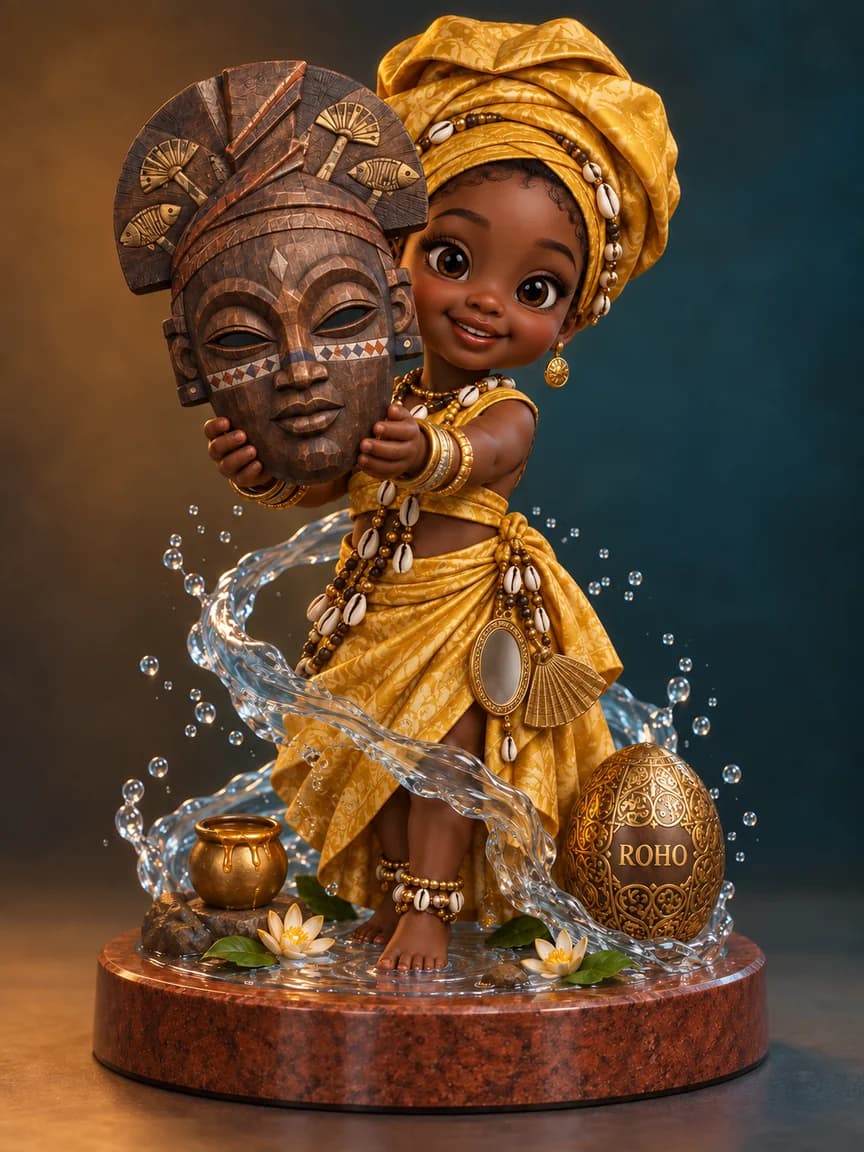
Òṣun (oshun)
allyRiver, love, wealth
Òṣun (Oshun) is the orisha of rivers, love, fertility and prosperity in Yoruba religion. Her cult was born in Yorubaland, in the south-west of present-day Nigeria, around the Osun River that bears her name. The town of Osogbo is its historic centre: the sacred grove of Osun-Osogbo, inscribed on the UNESCO World Heritage List in 2005, hosts every year a great festival that gathers devotees and visitors from around the world. In the Ifa narratives, Òṣun figures among the rare feminine deities present at the origins of the world, and the male orishas fail in their mission so long as they exclude her: a reminder of the place of feminine power in Yoruba thought. Her attributes are honey, brass and yellow copper, the fan, the mirror and the colour gold. Deported with the captives of the Atlantic slave trade, her figure survived in the Americas: in Cuba, Santería honours her under the name Ochún, associated with the Virgin of La Caridad del Cobre, patroness of the island; in Brazil, Candomblé celebrates her as Oxum, mistress of the fresh waters. A living religion, her cult is practised today from the banks of the Osun River to the communities of Havana, Salvador de Bahia and the worldwide diaspora.
Powers & Attributes
Role in the ROHO universe
A fragment of Onionkupón's Breath, bound to one of the five elements of the cosmic balance.
Sacred Mask
A mask carved of ancient energy: a symbol of the cosmic force proper to its pantheon.
Era
3,000 to 1,000 BCE: Cycle of Elemental Powers
Spiritual Lesson
To understand the nature of one's own balance and the wisdom hidden behind every trial.
Words of the Spirit
“The waters keep the memory of what the earth forgets.”
Frequently asked questions
Who is Òṣun (Oshun)?
Òṣun (Oshun) is the orisha of rivers, love, fertility and prosperity in Yoruba religion, venerated in Nigeria and throughout the Afro-American diaspora. Associated with the Osun River and the town of Osogbo, she embodies gentleness, beauty and the power of the fresh waters.
What is the difference between Òṣun and Yemoja?
Both are feminine orishas of the waters, but Òṣun reigns over rivers and fresh waters, in particular the Osun River in Nigeria, while Yemoja, first bound to the Ogun River, became in the diaspora the great deity of the sea and of motherhood. Òṣun embodies love, beauty and prosperity; Yemoja, maternal protection.
What are Òṣun's attributes and symbols?
Òṣun is associated with honey, brass and yellow copper, the fan, the mirror and the colour gold. Her principal sanctuary is the sacred grove of Osun-Osogbo in Nigeria, a UNESCO World Heritage site, where an annual festival is dedicated to her. In Cuban Santería, Ochún is associated with the Virgin of La Caridad del Cobre, patroness of Cuba.
Related spirits
Further reading
Sources and references
- Pierre Fatumbi Verger, Notes sur le culte des Orisa et Vodun à Bahia, la Baie de tous les Saints, au Brésil et à l'ancienne Côte des Esclaves en Afrique (1957)
- Pierre Fatumbi Verger, Orisha, les dieux yorouba en Afrique et au Nouveau Monde (1982)
- Robert Farris Thompson, Flash of the Spirit: African and Afro-American Art and Philosophy (1983)