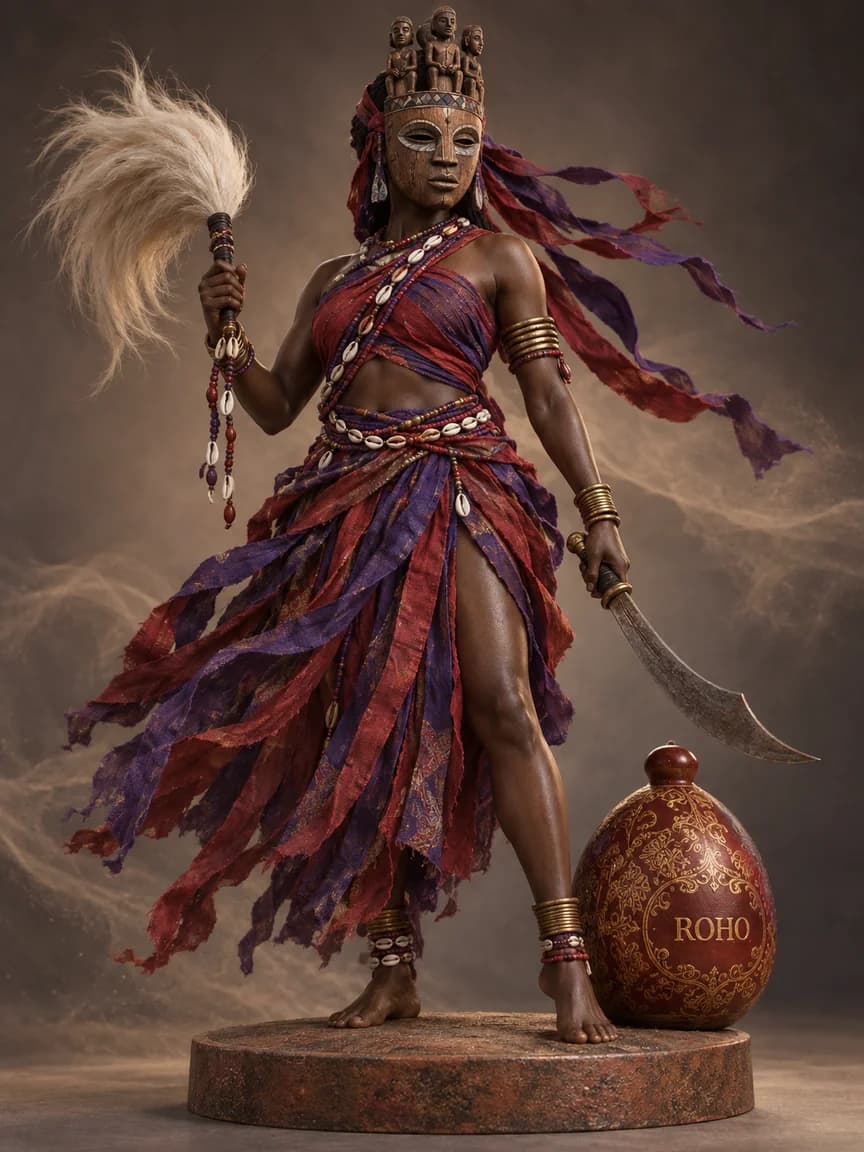
Yansan
allyOrisha
Yansan, better known under the name of Oya and called Iansa in Brazil, is one of the great feminine deities of the Yoruba pantheon. The orisha of winds, lightning and storms, she is also the only one to command the Egun, the spirits of the dead. Nicknamed the mother of nine, she is the patron of the river Niger, called Odo-Oya, whose tributaries evoke her motherhood. Tradition reports that she first lived as a woman of the city of Ira, in the present-day State of Kwara in Nigeria, and that she was the wife of Shango, the god of thunder, after having been bound to Ogun and to the orisha of agriculture. Her name is said to come from the expression o ya, she tore, in reference to the violence of the winds. A fierce warrior, she embodies transformation and passage. Carried by the Atlantic slave trade, her devotion spread in Candomblé, Santería and Umbanda. Her colours are red and purple.
Powers & Attributes
Role in the ROHO universe
Voice of its pantheon. YANSAN carries the memory of its tradition and weaves a thread into the Mabioni. Bound to the Yoruba pantheon.
Sacred Mask
An ancient ritual mask of feathers, carved bone and crystal, engraved with symbols of wind, embodiment of the power of Yansan
Era
Ancient cycle
Frequently asked questions
Are Yansan and Oya the same goddess?
Yes. Yansan, or Iansa in Brazilian Candomblé, is a name of the orisha Oya, the Yoruba deity of winds and storms.
What does Oya govern?
She reigns over winds, lightning and storms, and commands the spirits of the dead. She is also the patron of the river Niger and a warrior associated with transformation.
What are her bonds and her symbols?
Wife of Shango, she was also bound to Ogun and to the orisha of agriculture. Her colours are red and purple, and her symbols include the lightning bolt, the sword and the buffalo.
Related spirits
Further reading
Sources and references
- Judith Gleason, Oya: In Praise of the Goddess, 1987
- Pierre Verger, Notes sur le culte des Orisa et Vodun à Bahia, la Baie de Tous les Saints, au Brésil et à l'ancienne Côte des Esclaves en Afrique, Mémoires de l'IFAN n° 51, Dakar (1957)
- Peter McKenzie, Hail Orisha! A Phenomenology of a West African Religion in the Mid-Nineteenth Century, Brill, Leiden (1997)