Orisha Oko
allyOrisha
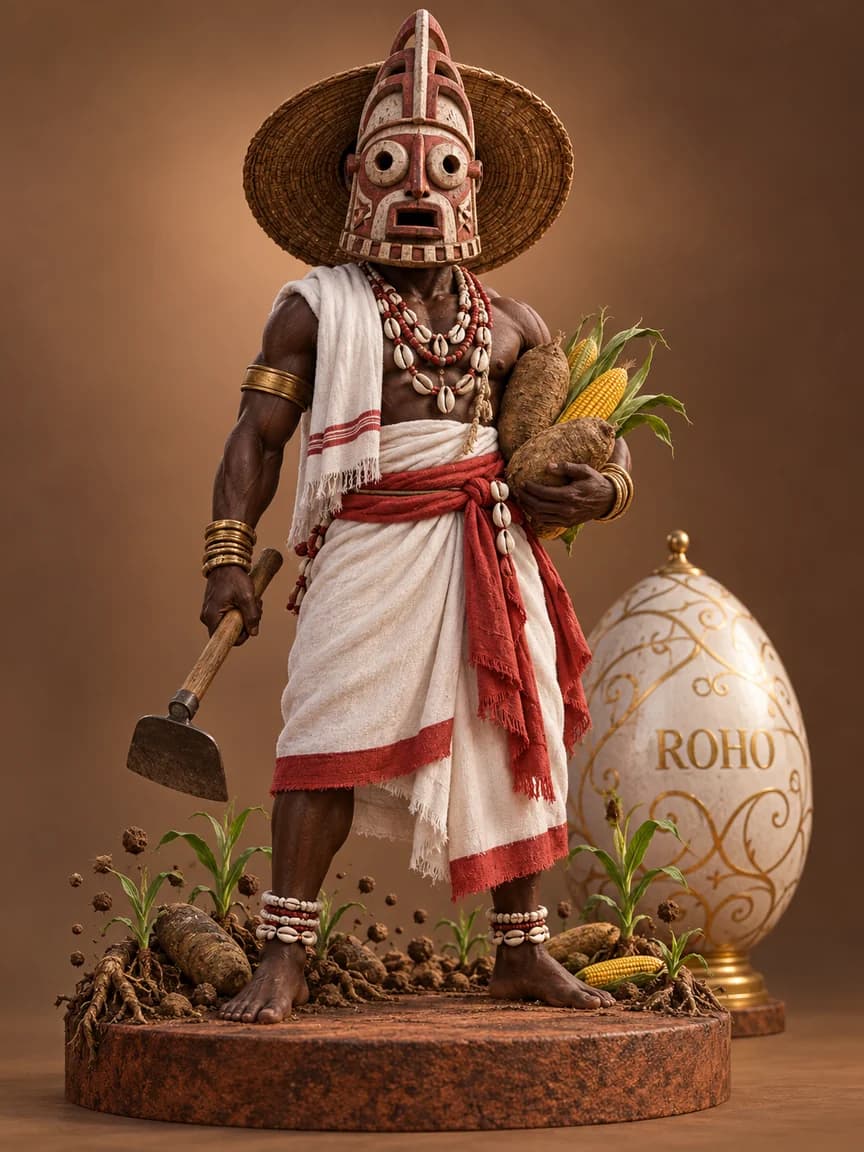
Orisha Oko, also spelt Oko, is the Yoruba orisha of agriculture, harvests and fertility, honoured in the south-west of Nigeria, in Benin and in the Afro-diasporic traditions such as Cuban Santería and Brazilian Candomblé. According to tradition, he is said to have been first a hunter then a prosperous farmer of the city of Irawo. At his death, his body is said to have disappeared leaving a staff planted in his field, revealing his divine nature. A deity of the nourishing soil, he presides over the preparation of the land, the seeds and the abundance of the harvests, notably during the yam festivals. He is also invoked for human fecundity and as judge of land disputes. His colours are white and red, and his principal emblem is a staff associated with fertility. Bees pass for his messengers. In Santería, he is syncretised with Saint Isidore the Labourer.
Powers & Attributes
Role in the ROHO universe
Mother of the soil. ORISHA holds the fertility of the earth and blesses wombs and seeds. Bound to the Yoruba pantheon.
Sacred Mask
An ancient ritual mask of fired clay, bronze and fossilised roots, engraved with symbols of agriculture, embodiment of the power of Orisha Oko
Era
Ancient cycle
Frequently asked questions
What is the domain of Orisha Oko?
He governs agriculture, the working of the land, the harvests and fertility, human as well as agricultural. He is invoked for abundant harvests and for the resolution of conflicts bound to the land.
Where is Orisha Oko venerated?
In Yoruba country (south-west Nigeria), in Benin, as well as in the Afro-diasporic traditions of the Americas, notably Cuban Santería, where he is associated with Saint Isidore the Labourer, and Brazilian Candomblé.
What are his symbols?
His ritual colours are white and red. His principal emblem is a staff bound to fertility, and bees are considered his messengers.
Related spirits
Further reading
Sources and references
- A. B. Ellis, The Yoruba-Speaking Peoples of the Slave Coast of West Africa, 1894
- C. L. Adeoye, Ìgbàgbọ́ àti ẹ̀sìn Yorùbá (1989)
- William Bascom, The Yoruba of Southwestern Nigeria (1969)