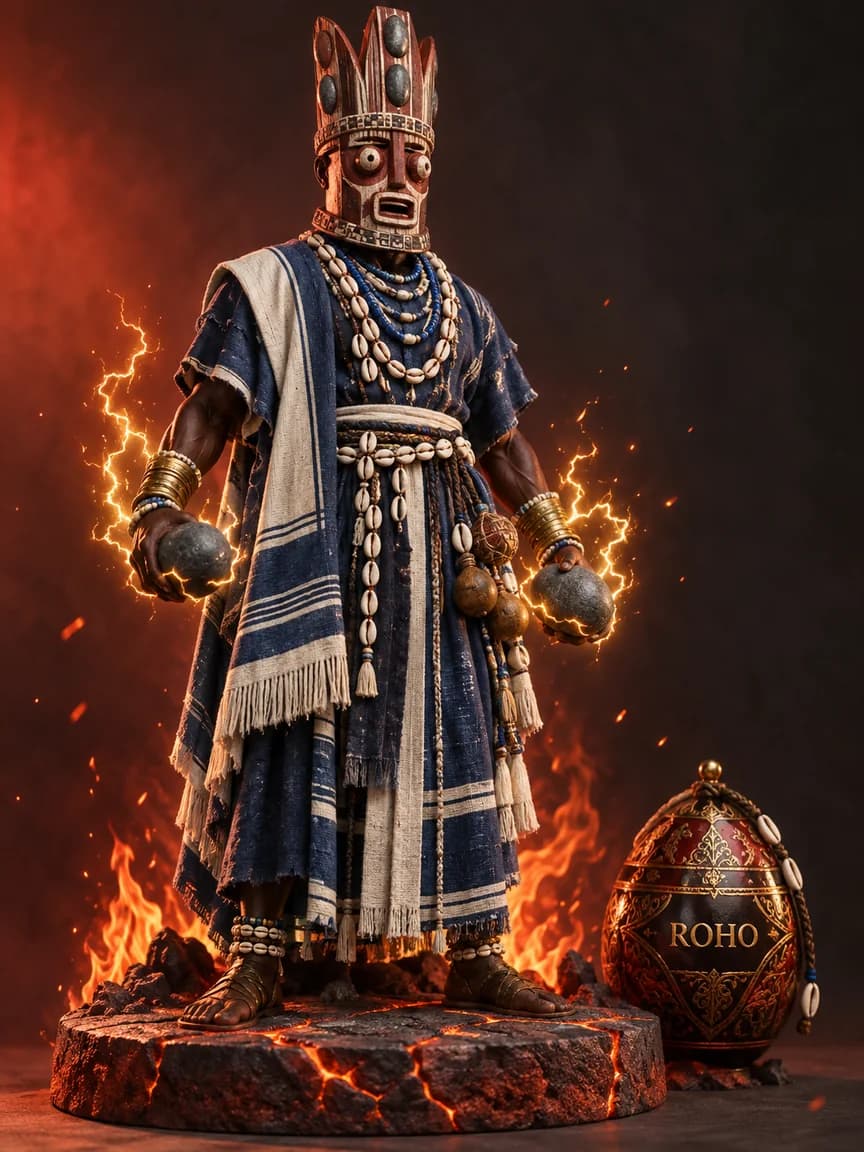
Jakuta
allyOrisha
Jàkúta, whose name means the one who hurls stones or fights with stones, is an ancient orisha of thunder in the Yoruba religion of the south-west of present-day Nigeria. A celestial deity, he is held to be the executor of the wrath of Olodumare, the supreme god, striking the earth with his thunderbolts. His weapons are the thunder stones, those polished stone axes that tradition associates with the spots where lightning falls and that the faithful keep in the sanctuaries. His cult is reputed older than that of Shango, the divinised king of Oyo become the great figure of thunder. After the deification of Shango, the latter took over the attributes of Jàkúta, so that the two are commonly conflated: Shango bears the praise name Oba Jàkúta, and one of the days of the Yoruba week, Ojó Jàkúta, is consecrated to him. Early observers nevertheless noted a difference, Jàkúta designating rather the hurled stone, the thunderbolt that falls, while Shango embodies the storm and the lightning. His memory survives in the cult of Shango, in Nigeria as in the diaspora.
Powers & Attributes
Role in the ROHO universe
Voice of the thunder. JAKUTA calls humankind back to justice through the lightning and marks the beginnings. Bound to the Yoruba pantheon.
Sacred Mask
An ancient ritual mask of obsidian, forged metal and cooled lava, engraved with symbols of thunder and lightning, embodiment of the power of Jakuta
Era
Ancient cycle
Frequently asked questions
Who is Jàkúta?
Jàkúta, the one who hurls stones, is an ancient Yoruba orisha of thunder, held to be the instrument of the wrath of the supreme god Olodumare. His thunderbolts are figured by thunder stones kept in the sanctuaries. His cult, very ancient, was largely absorbed by that of Shango.
What is the link between Jàkúta and Shango?
Jàkúta is considered a deity of thunder older than Shango. After the deification of Shango, a former king of Oyo, the latter took over the attributes of Jàkúta, to the point that the two figures merge. Shango bears the praise name Oba Jàkúta, and the day Ojó Jàkúta of the Yoruba week is consecrated to him.
What are the thunder stones associated with Jàkúta?
They are polished stone axes, ancient remains that Yoruba tradition interprets as the projectiles hurled from the sky during storms. Found after lightning strikes, they are kept in the sanctuaries and venerated. They directly link Jàkúta, then Shango, to the idea of the stone hurled by the thunder.
Related spirits
Further reading
Sources and references
- A. B. Ellis, The Yoruba-Speaking Peoples of the Slave Coast of West Africa, 1894
- Marc Schiltz, Yoruba Thunder Deities and Sovereignty: Ara versus Ṣango, Anthropos, vol. 80 (1985)
- E. Bolaji Idowu, Olodumare: God in Yoruba Belief (1962)