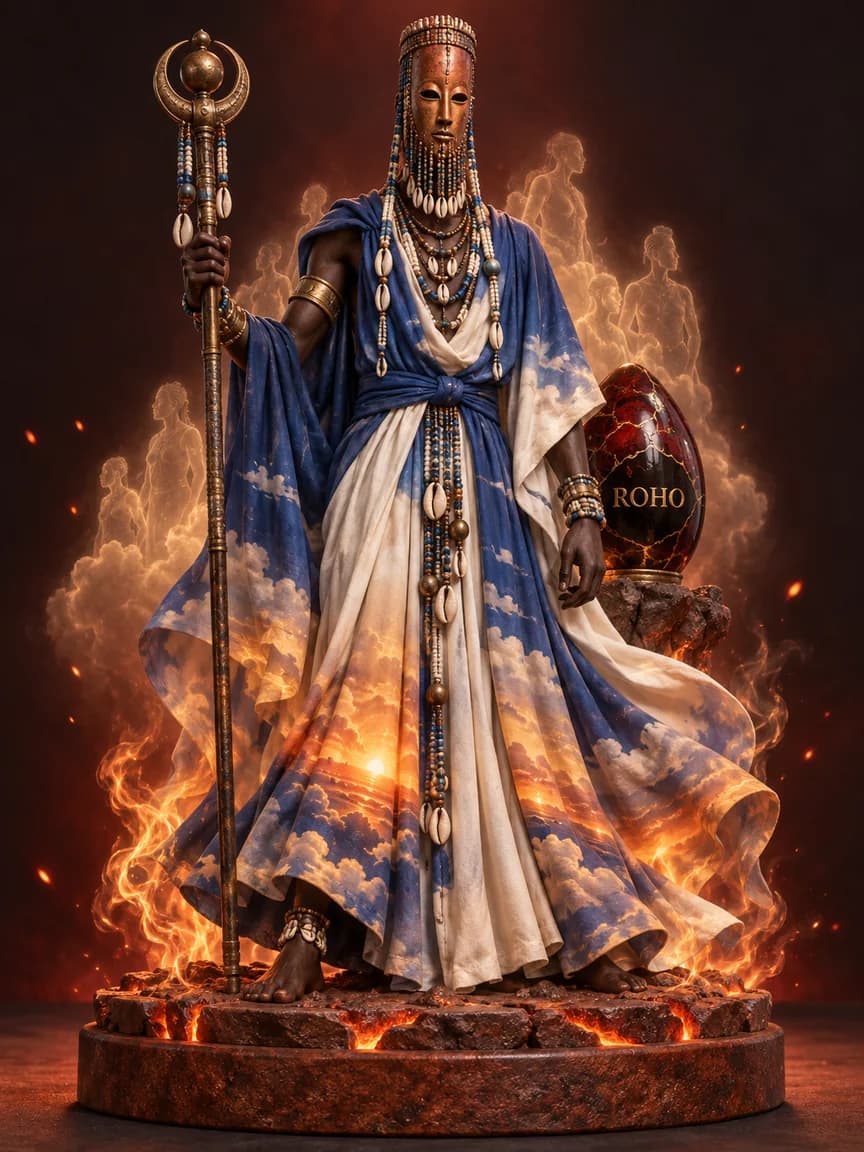
Orun
allyGod
Orun designates, in Yoruba cosmology, the spiritual and celestial world, at once the dwelling of the deities and the beyond where the souls reside. The term derives from a root evoking origin: Orun is the place from which the souls come and to which humans return after death. Yoruba thought represents the universe as a calabash whose upper half, Orun, the invisible world, is opposed to the lower half, Aye, the visible world of the living. Created and governed by Olodumare, the supreme Being, Orun shelters the orishas, the ancestors and the ori, the spiritual principle of each person before incarnation. The visible sky is sometimes called oju orun, the face of Orun. It is a cosmological concept and not a personified deity, and the sources attribute to it no particular solar function.
Powers & Attributes
Role in the ROHO universe
Bearer of dawn. ORUN opens the passage of day and holds the warmth of the beginning. Bound to the Yoruba pantheon.
Sacred Mask
An ancient ritual mask of obsidian, forged metal and cooled lava, engraved with symbols of sun, embodiment of the power of Orun
Era
Ancient cycle
Frequently asked questions
Is Orun a deity?
No. Orun is a Yoruba cosmological concept: the spiritual and celestial world, dwelling of the orishas and the ancestors, and not a personified god.
What does Orun mean in Yoruba cosmology?
It designates the invisible half of the universe, opposed to Aye, the visible world. It is the place of origin of the souls, to which they return after death, governed by Olodumare.
Is Orun bound to the sun?
The sources do not attach Orun to the sun. The visible sky is called oju orun, the face of Orun, but Orun designates first of all the spiritual realm and the beyond.
Related spirits
Further reading
Sources and references
- E. Bolaji Idowu, Olodumare: God in Yoruba Belief, 1962
- Peter Morton-Williams, An Outline of the Cosmology and Cult Organization of the Oyo Yoruba, Africa: Journal of the International African Institute, vol. 34, n° 3 (1964)
- J. Omosade Awolalu, Yoruba Beliefs and Sacrificial Rites (1979)