Marinette
neutralRevolt, night, birds of prey
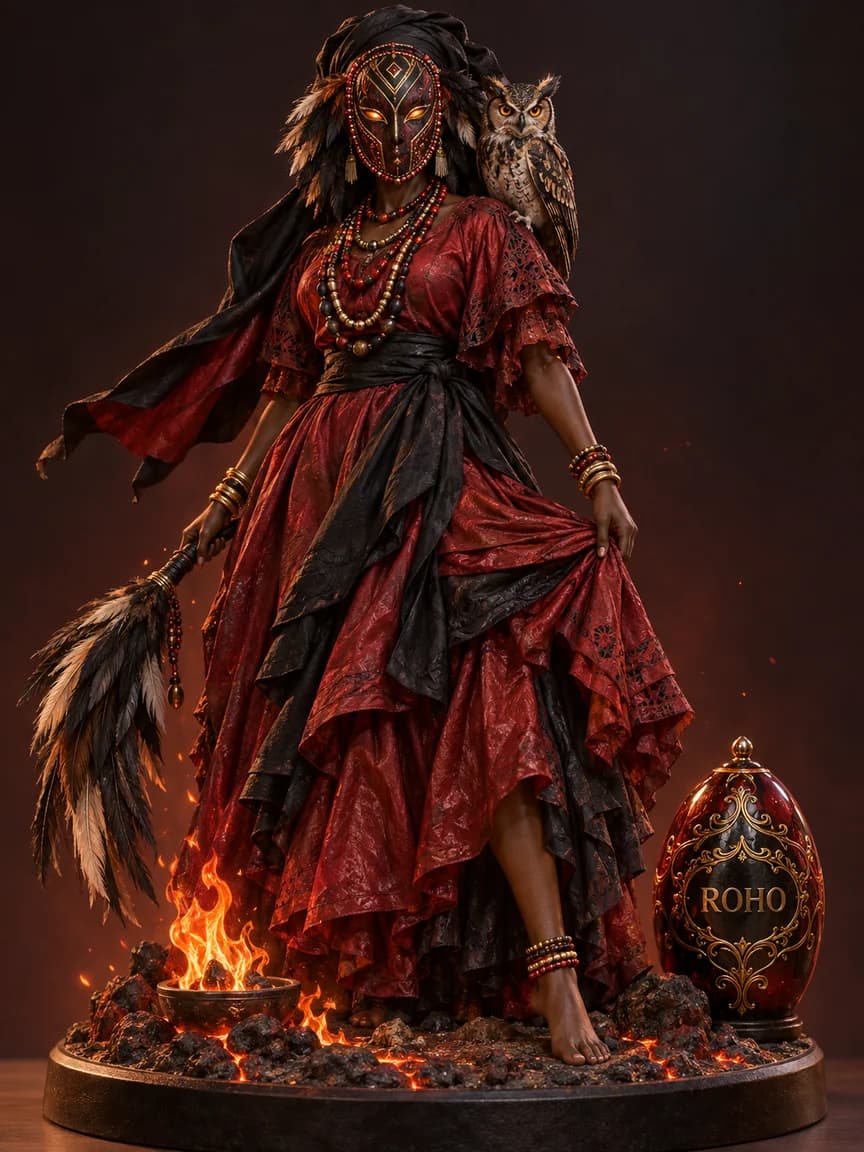
Marinette, often called Marinette Bwa Chèch, is one of the most feared lwa of the Petro rite. She is associated with night, fire and nocturnal birds of prey, the owl in particular, and her ceremonies are brief and intense. A tradition widespread in Haiti links her to the Bois-Caïman ceremony of August 1791, which opened the Haitian Revolution: she is said to have been the mambo who led it, or the spirit who possessed her. Historians debate the details of this event and the sources that report it, so this link must be presented for what it is, a living tradition and not an established fact. What this tradition does say clearly is the place that Haitian memory gives to Marinette: that of a spirit of rupture, hard because the circumstances were hard. Her servants do not describe her as malevolent but as uncompromising, and one does not commit to her without weighing what one promises.
Powers & Attributes
Role in the ROHO universe
Bound to one of the five elements of the cosmic balance. Its power springs from the energy proper to its tradition, and from no other.
Sacred Mask
A mask carved of ancient energy, a symbol of the cosmic force proper to its pantheon.
Era
1500 to 1900: Cycle of the Rebels
Words of the Spirit
“What gentleness cannot obtain, necessity tears away.”
Frequently asked questions
Who is Marinette in Haitian Vodou?
Marinette Bwa Chèch is one of the most feared lwa of the Petro rite, associated with night, fire and nocturnal birds of prey. Her servants describe her as uncompromising rather than malevolent.
Is Marinette linked to Bois-Caïman?
A tradition widespread in Haiti links her to the ceremony of August 1791 that opened the revolution, as the officiating mambo or as the possessing spirit. Historians debate the details of this event: it is a living tradition, not an established fact.
Related spirits
Further reading
Sources and references
- Alfred Métraux, Le Vaudou haïtien (1958)
- Laënnec Hurbon, Les Mystères du vaudou (1993)
- Leslie G. Desmangles, The Faces of the Gods: Vodou and Roman Catholicism in Haiti (1992)