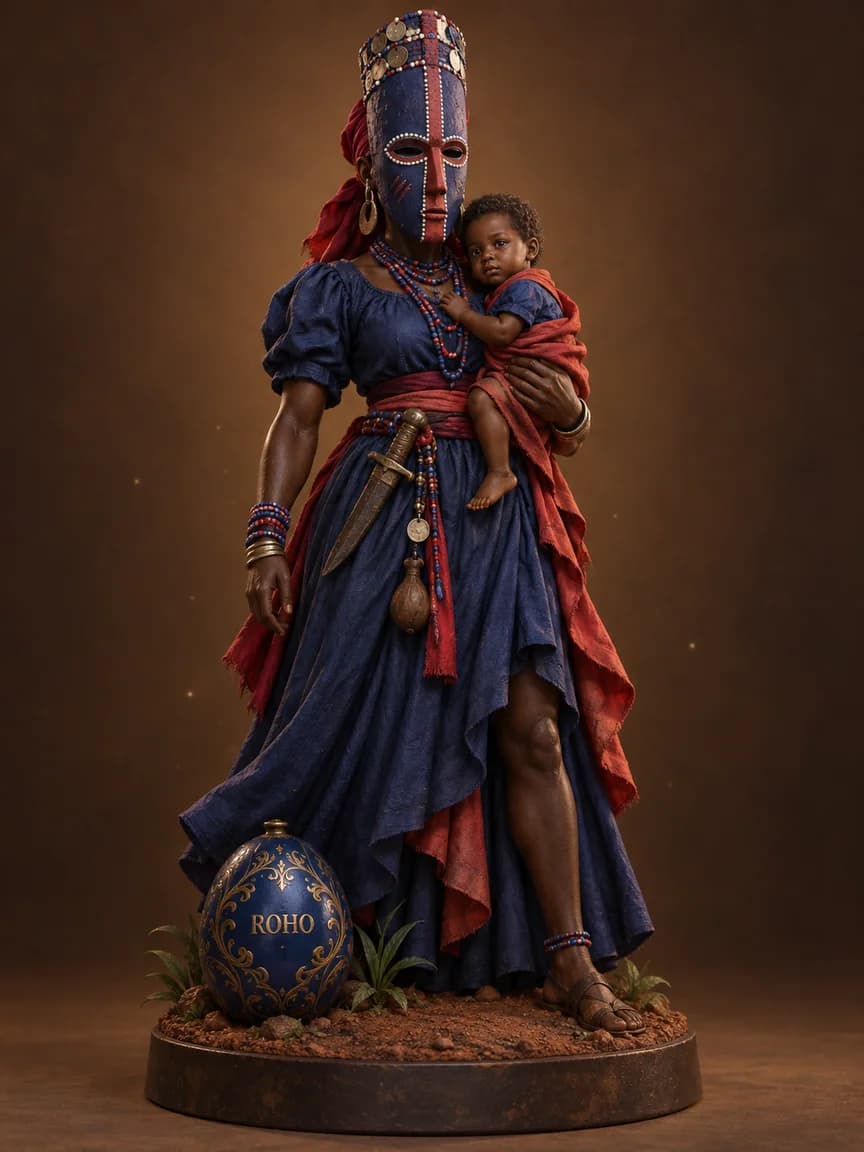
Erzulie Dantor
allyMaternal protection, wrath
Erzulie Dantor, also written Ezili Dantò, is one of the major figures of Haitian Vodou, served principally in the Petro rite. Mother courage of the Afro-diasporic pantheons, she embodies the woman who works hard and defends her children at any price. She protects single mothers, battered women and children in danger. Haitian tradition associates her with the Bois Caïman ceremony of 1791 and tells that she fought beside the insurgents during the war of independence: her tongue is said to have been cut out, which is why she expresses herself with a guttural sound, ke ke ke, when she mounts her servants. Her image merged with the Black Madonna of Częstochowa, a Polish icon that reached Haiti with the Polish legionnaires: a dark-skinned madonna, her cheek marked with scars, carrying a child whom Vodou practitioners name Anaïs, her daughter and interpreter. Her attribute is the knife; her colours are blue and red, and some descriptions add black. She is offered griot of pork, kleren and crème de cacao. Her rivalry with her sister Erzulie Freda, sweet and coquettish, illustrates two faces of love. She carries on the group of the Ezili, spirits bound to the waters honoured in Dahomey, present-day Benin.
Powers & Attributes
Role in the ROHO universe
A fragment of Onionkupón's Breath, bound to one of the five elements of the cosmic balance.
Sacred Mask
A mask carved of ancient energy: a symbol of the cosmic force proper to its pantheon.
Era
3,000 to 1,000 BCE: Cycle of Elemental Powers
Spiritual Lesson
To understand the nature of one's own balance and the wisdom hidden behind every trial.
Words of the Spirit
“The one who protects carries the world on their shoulders.”
Frequently asked questions
Who is Erzulie Dantor?
Erzulie Dantor is a major lwa of Haitian Vodou, a fierce mother and protector of women and children. Honoured in the Petro rite, she is recognised by the scars that mark her cheek and the knife she carries. Her image is associated with the Black Madonna of Częstochowa, and her daughter Anaïs serves as her interpreter.
Why is Erzulie Dantor represented by the Black Madonna of Częstochowa?
The Polish icon of the Black Madonna of Częstochowa reached Haiti with the Polish legionnaires sent by Napoleon, some of whom rallied to the insurgents. Vodou practitioners recognised in this dark-skinned madonna with the scarred cheek the face of Erzulie Dantor carrying her daughter Anaïs. This image remains today the most widespread representation of the lwa.
What is the difference between Erzulie Dantor and Erzulie Freda?
The two are sisters and rivals in Haitian Vodou. Erzulie Freda, served in the Rada rite, embodies romantic love, luxury and coquetry. Erzulie Dantor, served in the Petro rite, embodies the fierce, hard-working, protective mother. The first weeps at never being fulfilled, the second fights for her own: two complementary faces of love and of the feminine condition.
What does Erzulie Dantor represent in Haitian Vodou?
Erzulie Dantor represents the mother who protects and fights. Served in the Petro rite, she watches over single mothers, battered women and children in danger, and defends her own at any price. Her knife and the scars on her cheek speak of that struggle, which Haitian tradition links to the Bois Caïman ceremony and the war of independence.
What are the colours and the vèvè of Erzulie Dantor?
Erzulie Dantor's colours are blue and red, and some descriptions add black. Her vèvè is a heart pierced by a blade, and her attribute is the knife.
What offerings are made to Erzulie Dantor?
Erzulie Dantor is offered griot of pork, kleren, the Haitian white rum, and crème de cacao.
Why does Erzulie Dantor not speak?
According to Haitian tradition, Erzulie Dantor fought beside the insurgents during the war of independence and her tongue is said to have been cut out. When she mounts her servants she expresses herself with a guttural sound, ke ke ke, and her daughter Anaïs serves as her interpreter.
Related spirits
Further reading
Sources and references
- Alfred Métraux, Le Vaudou haïtien (1958)
- Maya Deren, Divine Horsemen: The Living Gods of Haiti (1953)
- Karen McCarthy Brown, Mama Lola: A Vodou Priestess in Brooklyn (1991)
- Laënnec Hurbon, Les Mystères du vaudou (1993)
- Anne M. Platoff, Drapo Vodou: Sacred Standards of Haitian Vodou (Flag Research Quarterly, n° 7, North American Vexillological Association, 2015), p. 4-5
- Anthony Bogues (commissaire), The Art of Haiti: Loas, History, and Memory, guide d'exposition (Colorado Springs Fine Arts Center, Colorado Springs), glossaire