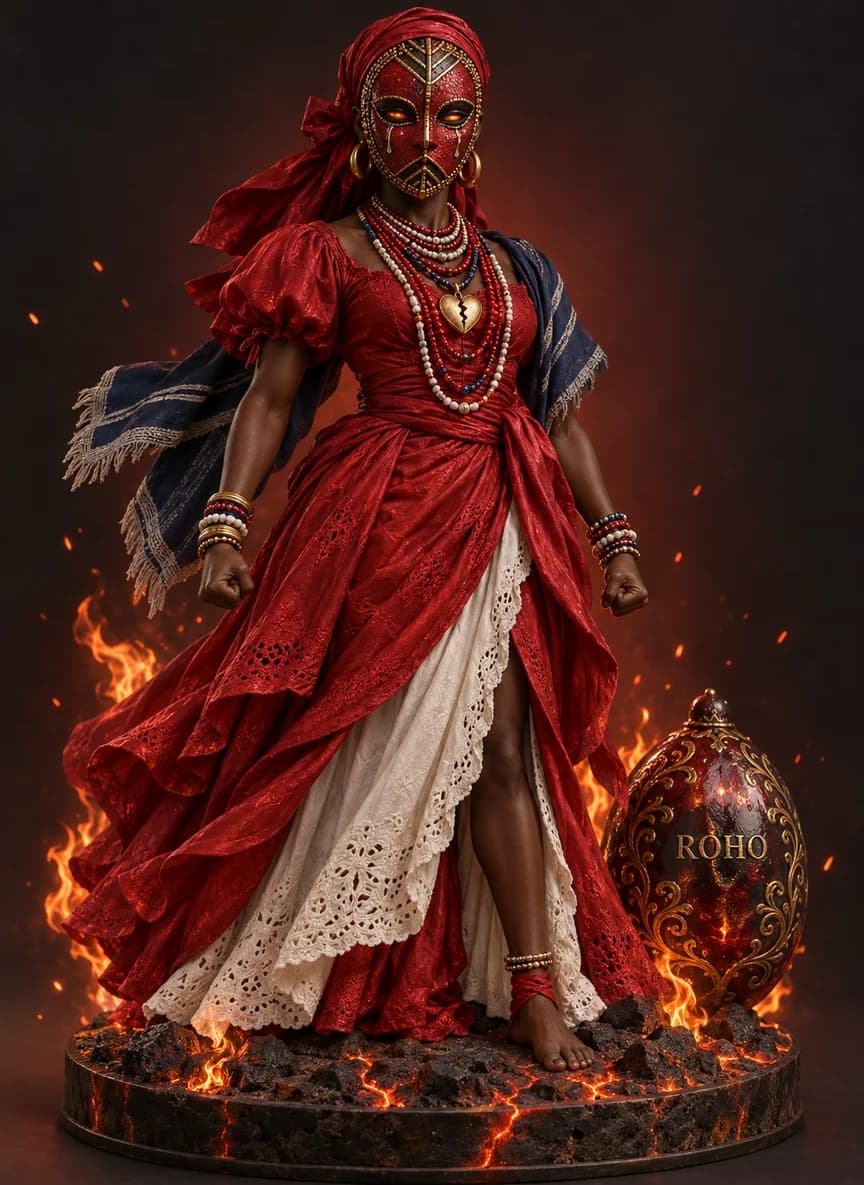
Erzulie Ge-Rouge
neutralAnger, mourning, wounded love
Erzulie Ge-Rouge, in Creole Ezili Je Wouj, is the sorrowful face of the great feminine figure of Haitian Vodou. Served in the Petro rite, she is what Erzulie becomes when love has been betrayed and grief turns to rage. The possessions attributed to her are among the most striking in the cult: the bloodshot eyes that give her her name, the clenched fists, the legs drawn up against the body, a lament that does not subside. Where Freda weeps over the gap between the dream and the world, Ge-Rouge no longer weeps: she demands. Her servants do not see in her an evil lwa but a truth that the other faces of Erzulie do not express, that of the legitimate anger of wounded women, and it is understandable that such a spirit took shape under the conditions of the plantation. She is served with gravity, without perfume or finery: this is not the time for luxury.
Powers & Attributes
Role in the ROHO universe
Bound to one of the five elements of the cosmic balance. Its power springs from the energy proper to its tradition, and from no other.
Sacred Mask
A mask carved of ancient energy, a symbol of the cosmic force proper to its pantheon.
Era
1500 to 1900: Cycle of the Rebels
Words of the Spirit
“Some sorrows do not ask to be consoled, but to be heard.”
Frequently asked questions
Who is Erzulie Ge-Rouge?
Erzulie Ge-Rouge, or Ezili Je Wouj, is the sorrowful face of Erzulie, served in the Petro rite. She embodies betrayed love turned to anger, and her name comes from the bloodshot eyes that mark her possessions.
How does she differ from Erzulie Freda?
Freda weeps over the gap between the dream of a perfect love and the limits of the world. Ge-Rouge no longer weeps: she demands. One belongs to the Rada rite and to gentleness, the other to the Petro rite and to anger.
Related spirits
Further reading
Sources and references
- Maya Deren, Divine Horsemen: The Living Gods of Haiti (1953)
- Alfred Métraux, Le Vaudou haïtien (1958)
- Karen McCarthy Brown, Vodou in Haitian Life and Culture (2006)