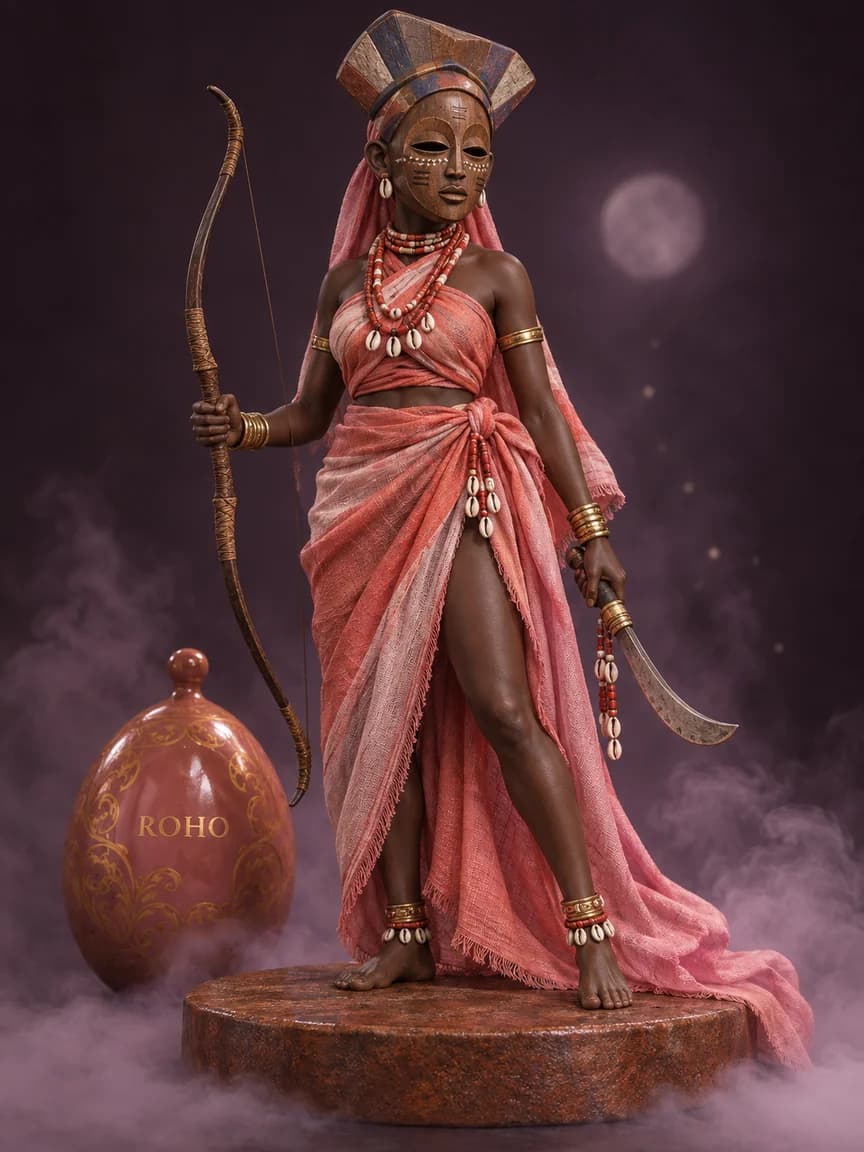
Yewa
neutralGoddess of chastity and cemeteries
Yewá, also written Ewá or Iyewa, is an orisha of the Yoruba religion venerated in south-western Nigeria and in Benin, as well as in the Afro-diasporic traditions such as Candomblé and Santería. Her name is attached to the Yewa river, which crosses the former Egbado territory, in the present-day State of Ogun. She reigns over death, decomposition, dreams, modesty and virginity. Tradition presents her as an orisha who chose chastity and withdrew from the world of the living to devote herself to the spirits of the departed. She is often bound to cemeteries, where she accompanies the souls in the passage from one world to the other, a function she shares with Oya, who commands the spirits of the dead. Her iconography associates weapons such as the bow, the spear and the curved dagger, and colours ranging from pink and coral to red and white. Certain traditions attach her to the former kingdom of Dahomey. A discreet and feared orisha, she embodies the frontier between life and death and the rigour of restraint.
Era
Yoruba traditions, West Africa
Frequently asked questions
What is the domain of the orisha Yewá?
Yewá reigns over death, decomposition, chastity, dreams and modesty. She is associated with the Yewa river and is guardian of the cemeteries, where she accompanies the spirits of the departed.
Why is Yewá bound to virginity?
Tradition tells that she chose chastity early and withdrew from the world of the living into her father's palace. She became the protector of virgins and a symbol of restraint and purity.
Where is Yewá venerated?
She is honoured in south-western Nigeria and in Benin, on the lands of the former Egbado people, as well as in the Afro-diasporic traditions such as Brazilian Candomblé and Cuban Santería.
Related spirits
Further reading
Sources and references
- Baba Ifa Karade, The Handbook of Yoruba Religious Concepts (1994)
- Molefi Kete Asante and Ama Mazama, Encyclopedia of African Religion (2009)
- , Wikipedia (EN)