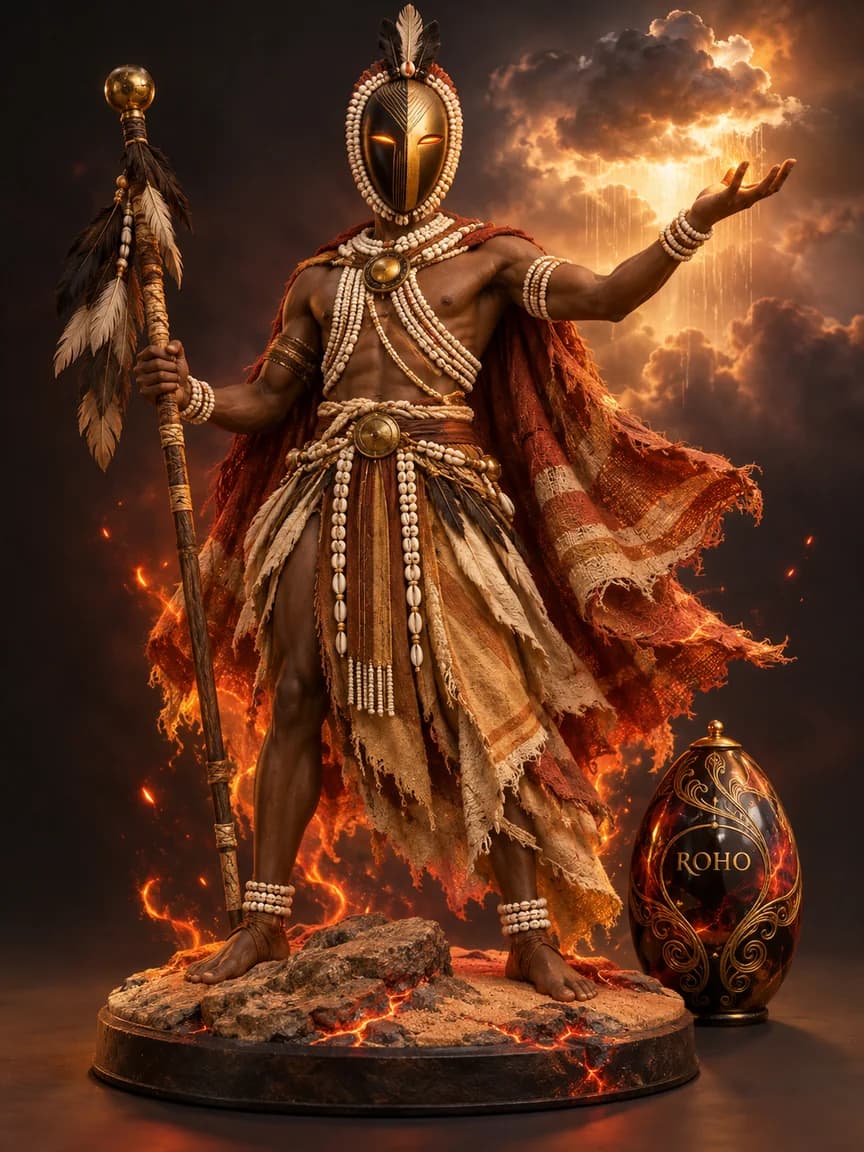
Tsui’Goab
allyThunder, healing
Tsui-Goab, whose name is often translated as "wounded knee", dominates the Khoikhoi pantheon as supreme being and first ancestor. Tradition attributes to him the creation of the world, of humanity and of the natural elements. A sky god, he dwells above the stars and manifests through the beneficent rain, the thunder and the clouds, which binds him to the vital function of rainmaker in a society of nomadic herders. His figure is inseparable from the cosmic duality that structures Nama mythology: Tsui-Goab is the principle of light and life, opposed to Gaunab, principle of darkness and death. The central myth tells of their repeated confrontation. In one battle, Gaunab, the stronger, strikes Tsui-Goab down several times, but each time he rises stronger, until he drives his adversary back toward his dark dwelling, the "Black Sky". In the struggle, Gaunab wounds Tsui-Goab's knee: whence the etymology of his name according to Theophilus Hahn. This battle is replayed every night: the victory of light over darkness explains the return of dawn, without ever being final, since darkness always returns. The Khoikhoi invoked Tsui-Goab at dawn and during ceremonies, asking for rain, health and prosperity. Depending on the group and the source, he is sometimes merged with the hero Heitsi-Eibib, sometimes held to be distinct.
Powers & Attributes
Role in the ROHO universe
A fragment of Onionkupón's Breath, bound to one of the five elements of the cosmic balance.
Sacred Mask
A mask carved of ancient energy: a symbol of the cosmic force proper to its pantheon.
Era
3,000 to 1,000 BCE: Cycle of Elemental Powers
Spiritual Lesson
To understand the nature of one's own balance and the wisdom hidden behind every trial.
Words of the Spirit
“Lightning does not strike at random.”
Frequently asked questions
What does the name Tsui-Goab mean?
According to the ethnographer Theophilus Hahn, the name Tsui-Goab translates as "wounded knee" or "sore knee". This etymology refers to the myth of his battle against Gaunab, in which the god of darkness wounds his knee. Other linguistic interpretations exist, but Hahn's remains the most cited.
What is Tsui-Goab's role in the cycle of day and night?
Tsui-Goab personifies light. Each night he confronts Gaunab, god of darkness and death, and drives him back toward the Black Sky. His victory brings the dawn back to the earth. As darkness always returns, this battle is renewed without end, explaining the alternation of day and night.
Related spirits
Further reading
Sources and references
- Theophilus Hahn, Tsuni-Goam: The Supreme Being of the Khoi-Khoi (1881)
- Isaac Schapera, The Khoisan Peoples of South Africa: Bushmen and Hottentots (1930)