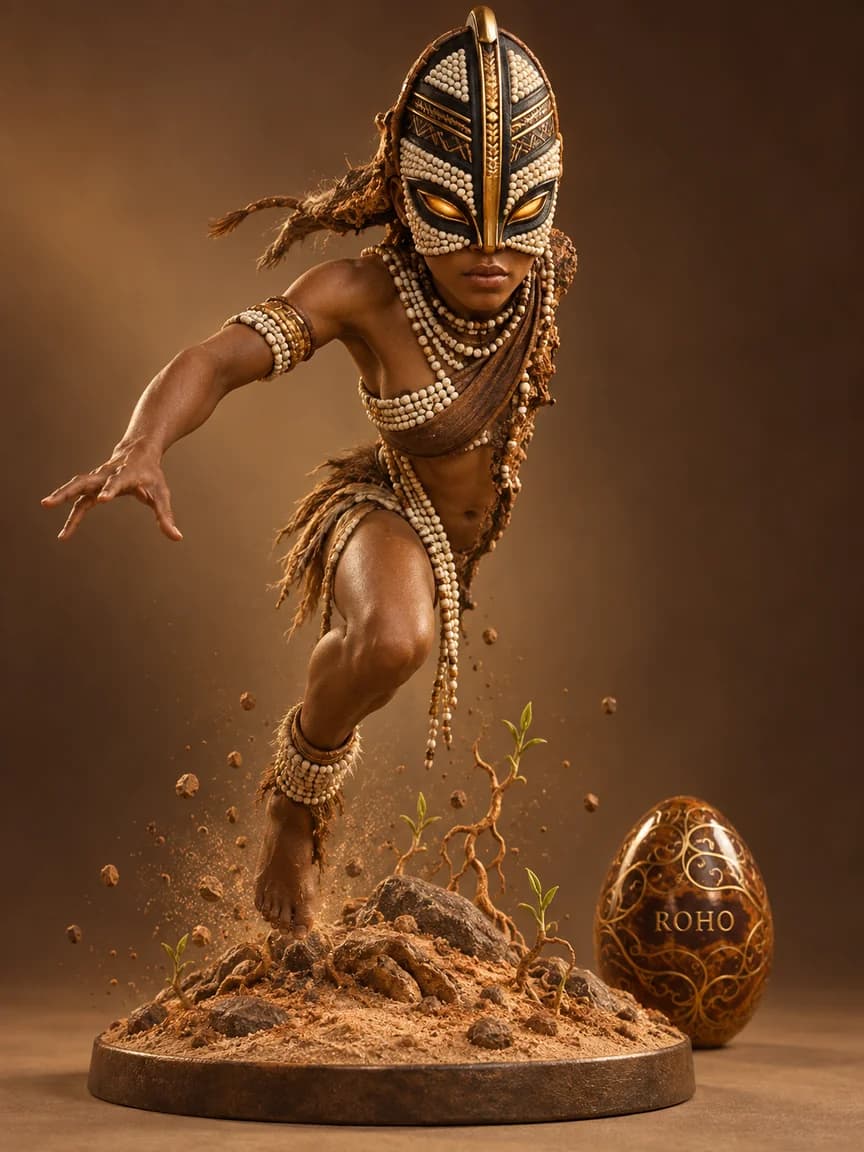
Hai-Uri
neutralMonster
Hai-uri belongs to the bestiary of the fearsome beings of the Khoisan tradition, where it figures among the supernatural predators that threaten humans in the bush. Its most striking characteristic is its incomplete nature: it possesses only half a body: a single arm, a single leg and, according to certain versions, a single eye and a single ear. This incompleteness makes it partially invisible, which increases the danger it represents. Endowed with remarkable agility, it moves by leaping through the bushes and pursues its prey hopping on one leg, seeking to seize and devour them. Its morphology brings it close to other one-sided beings of the folklore of southern and central Africa, such as the Tikdoshe of the Zulu or the Chiruwi of Central Africa, which testifies to a motif shared among several traditions of the region. In Khoisan mythology, Hai-uri illustrates the figure of the liminal monster that haunts the wild spaces and embodies the perils of hunting and travel. An encounter with it is associated with the risk of being carried off to the underworld. Its feminine counterpart, Bi-blouk, presents a comparable physiognomy. These narratives, orally transmitted and recorded by the ethnographers of the Khoisan, feed an imagination in which the borders between the visible and the invisible, the whole and the fragmentary, are ceaselessly questioned.
Powers & Attributes
Role in the ROHO universe
Voice of the forest. HAI-URI watches the spirits of the woods and negotiates with the hunters the respect of the places. Bound to the Khoisan pantheon. Its alignment depends on the invoker's protocol.
Sacred Mask
An ancient ritual mask of fired clay, bronze and fossilised roots, engraved with symbols of hunter, embodiment of the power of Hai-Uri
Era
Ancient cycle
Frequently asked questions
Why does Hai-uri have only half a body?
The one-sidedness of Hai-uri, with a single arm and a single leg, is its distinctive mark in Khoisan folklore. This incomplete nature makes it partially invisible and more unsettling. The motif of the half-bodied being is found in other traditions of southern and central Africa, such as the Zulu Tikdoshe or the Chiruwi.
Who is Bi-blouk in relation to Hai-uri?
Bi-blouk is the feminine version of Hai-uri in Khoisan mythology. She shares the same incomplete physiognomy and the same threatening character. The existence of this feminine counterpart shows that the figure of the one-sided devourer of humans is declined by gender in the oral tradition.
Related spirits
Further reading
Sources and references
- Isaac Schapera, The Khoisan Peoples of South Africa: Bushmen and Hottentots (1930)
- Wilhelm Bleek et Lucy Lloyd, Specimens of Bushman Folklore (1911)