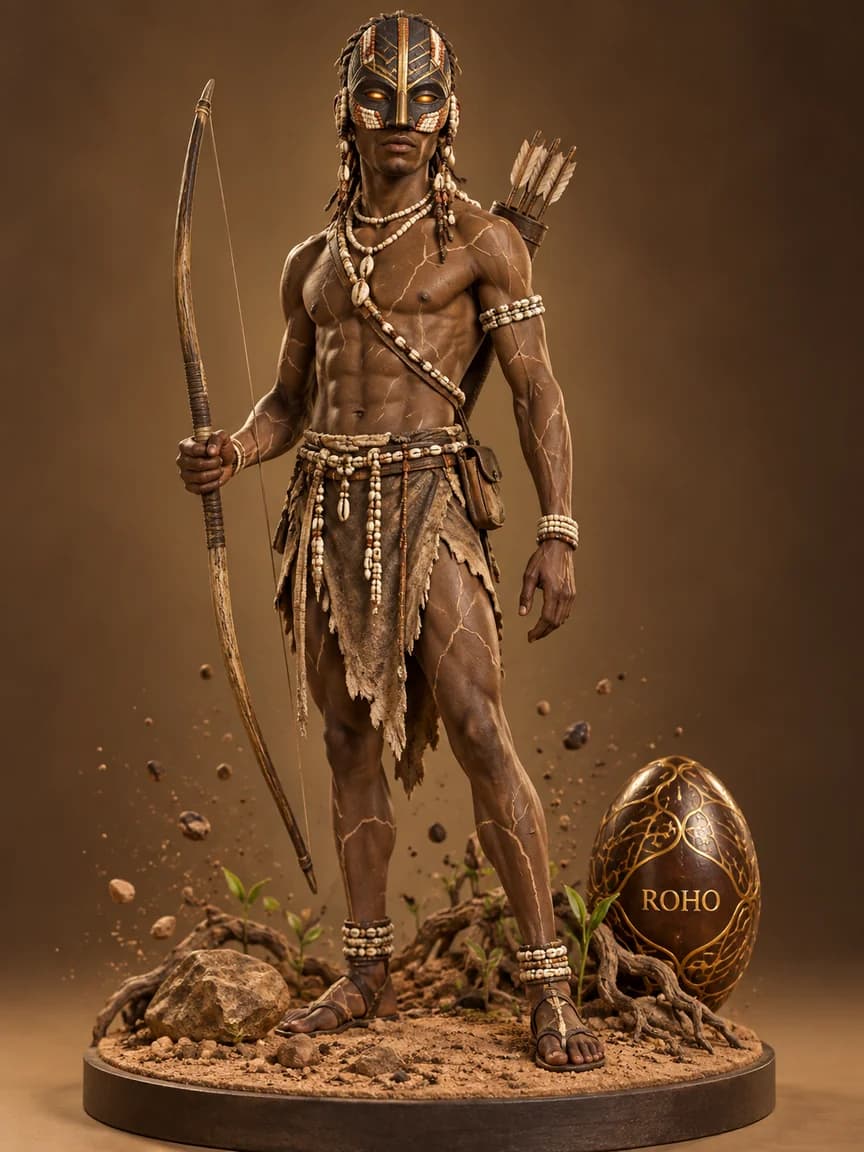
Heitsi-Eibib
allyHero
In Khoikhoi cosmology, Heitsi-Eibib holds a singular place between the founding ancestor and the civilising hero. Born of prodigies, sometimes presented as the son of a cow, or conceived by a magic herb, he embodies the power of transformation: he changes form, ages and then grows young again, and above all dies and is reborn without cease. This capacity for resurrection makes him a figure of life, death and renewal, often attached to the lunar cycle and the heavenly bodies in the Nama narratives. His most famous exploit is the victory over Ga-gorib, the monster of the chasm, whom he hurls into his own pit by striking him by cunning behind the ear, refusing the rigged challenge thrown at him. Other narratives show him cunning, deceitful, at times transgressive: characteristic traits of the trickster. The cult of Heitsi-Eibib was expressed through the cairns, heaps of stones presented as his multiple tombs, scattered across the whole of southern Africa. Every traveller passing one of these mounds added a stone or a branch and offered a prayer, asking for luck in the hunt and protection on the road. This ritual practice, attested by the first European observers, testifies to the figure's at once funerary and propitiatory dimension. Heitsi-Eibib is sometimes identified with Tsui-Goab, sometimes clearly distinguished from him according to the sources and the groups.
Powers & Attributes
Role in the ROHO universe
Voice of the forest. HEITSI-EIBIB watches the spirits of the woods and negotiates with the hunters the respect of the places. Bound to the Khoisan pantheon.
Sacred Mask
An ancient ritual mask of fired clay, bronze and fossilised roots, engraved with symbols of magic and hunting, embodiment of the power of Heitsi-Eibib
Era
Ancient cycle
Frequently asked questions
Why does Heitsi-Eibib possess several tombs?
Because he is a figure of death and rebirth. Khoikhoi tradition tells that he died and resurrected many times over, leaving a tomb at each place of his death. These cairns, heaps of stones scattered across southern Africa, thus materialise his successive deaths and his perpetual return to life.
What ritual accompanied passing a cairn of Heitsi-Eibib?
Every traveller passing near a cairn left a stone or a branch there and offered a prayer to the hero. This gesture of devotion aimed to obtain his protection during the journey and success in the hunt. The practice, observed by the first ethnographers, illustrates the propitiatory function attached to these sacred mounds.
Is Heitsi-Eibib the same character as Tsui-Goab?
The sources diverge. Certain narratives and certain Khoikhoi groups identify Heitsi-Eibib with Tsui-Goab, the supreme being, while others clearly distinguish them as two separate figures. This fluidity reflects the diversity of the oral traditions collected by the ethnographers of the nineteenth and twentieth centuries.
Related spirits
Further reading
Sources and references
- Theophilus Hahn, Tsuni-Goam: The Supreme Being of the Khoi-Khoi (1881)
- Isaac Schapera, The Khoisan Peoples of South Africa: Bushmen and Hottentots (1930)
- Wilhelm Bleek et Lucy Lloyd, Specimens of Bushman Folklore (1911)