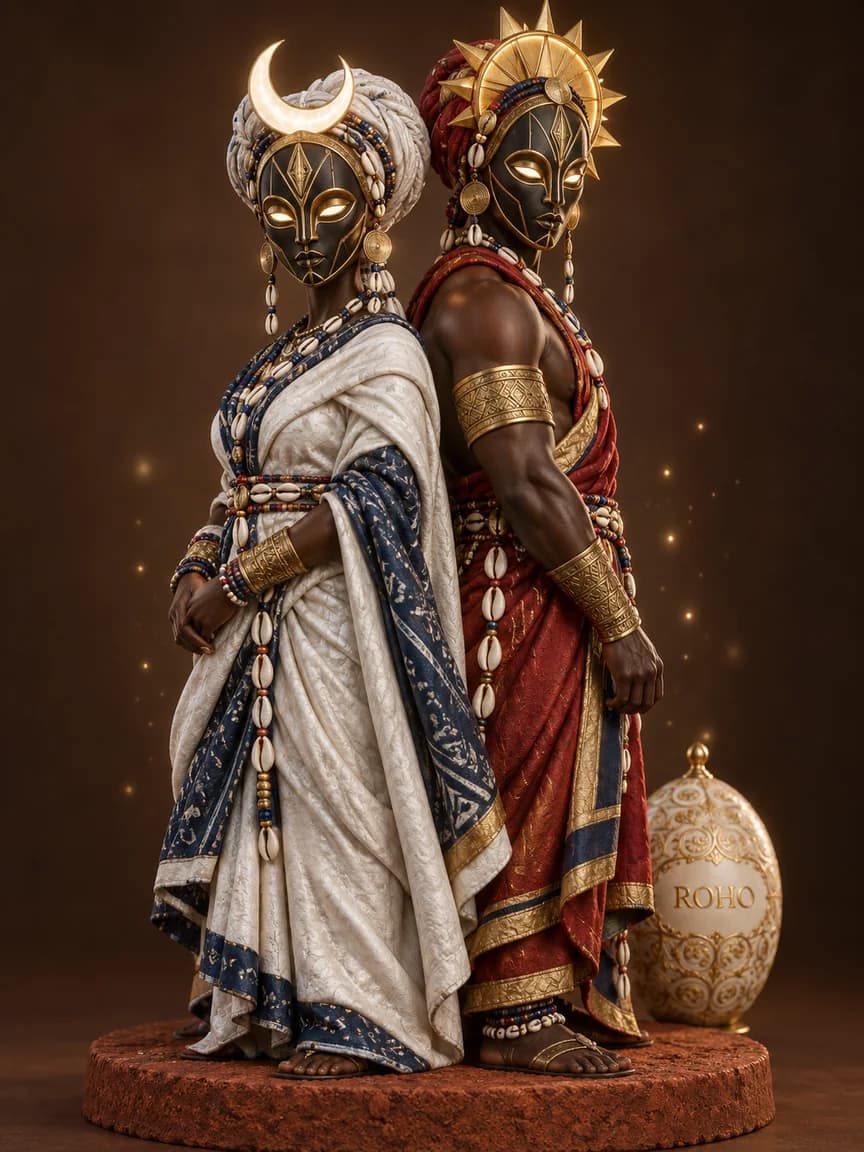
Mawu-Lisa
allyMoon (Mawu) / Sun (Lisa), order
In the Vodun of Benin and Togo, Mawu-Lisa stands at the summit of the pantheon. Born of Nana Buluku, the dyad unites Mawu, the feminine principle associated with the moon, the night, coolness and fecundity, and Lisa, the masculine principle associated with the sun, the day, heat and strength. Together they complete the organisation of the world and apportion its domains among their children: according to the traditions collected at Abomey, Sakpata receives the earth, Hevioso the thunder, Agbé the sea, Gu iron and craft, while Legba, the youngest, becomes messenger between the worlds. The cosmic serpent Aido Hwedo, known in Haiti as Ayida Weddo, sustains their work of creation. Raised to the rank of royal cult in eighteenth-century Dahomey, the worship of Mawu-Lisa had temples and a clergy at Abomey. Mawu still means God today in several Gbe languages, notably among Ewe and Fon Christians. In Haitian Vodou, the idea of a distant creator God, Bondyé, who delegates the government of the world to the lwa, carries on this Dahomean conception of a creator couple withdrawn from human affairs.
Powers & Attributes
Role in the ROHO universe
A fragment of Onionkupón's Breath, bound to one of the five elements of the cosmic balance.
Sacred Mask
A mask carved of ancient energy: a symbol of the cosmic force proper to its pantheon.
Era
3,000 to 1,000 BCE: Cycle of Elemental Powers
Spiritual Lesson
To understand the nature of one's own balance and the wisdom hidden behind every trial.
Words of the Spirit
“What is rooted does not fear the storm.”
Frequently asked questions
Who is Mawu-Lisa?
Mawu-Lisa is the creator deity of Fon and Ewe Vodun. The dyad unites Mawu, the moon, feminine principle of coolness and fecundity, and Lisa, the sun, masculine principle of strength and heat. Daughter of Nana Buluku, she organises the world and begets the great vodun, among them Sakpata, Hevioso, Gu and Legba.
What does the duality of Mawu and Lisa symbolise?
Mawu and Lisa form a complementary couple: night and day, moon and sun, coolness and heat, fecundity and strength. Their union, sometimes represented as an androgynous being or as twins, expresses the idea that the world's balance rests on the accord of opposites: a foundation of the religious thought of the Gulf of Benin.
Related spirits
Further reading
Sources and references
- Melville J. Herskovits, Dahomey: An Ancient West African Kingdom (1938)
- Melville J. Herskovits et Frances S. Herskovits, Dahomean Narrative: A Cross-Cultural Analysis (1958)
- Geoffrey Parrinder, West African Religion (1949)