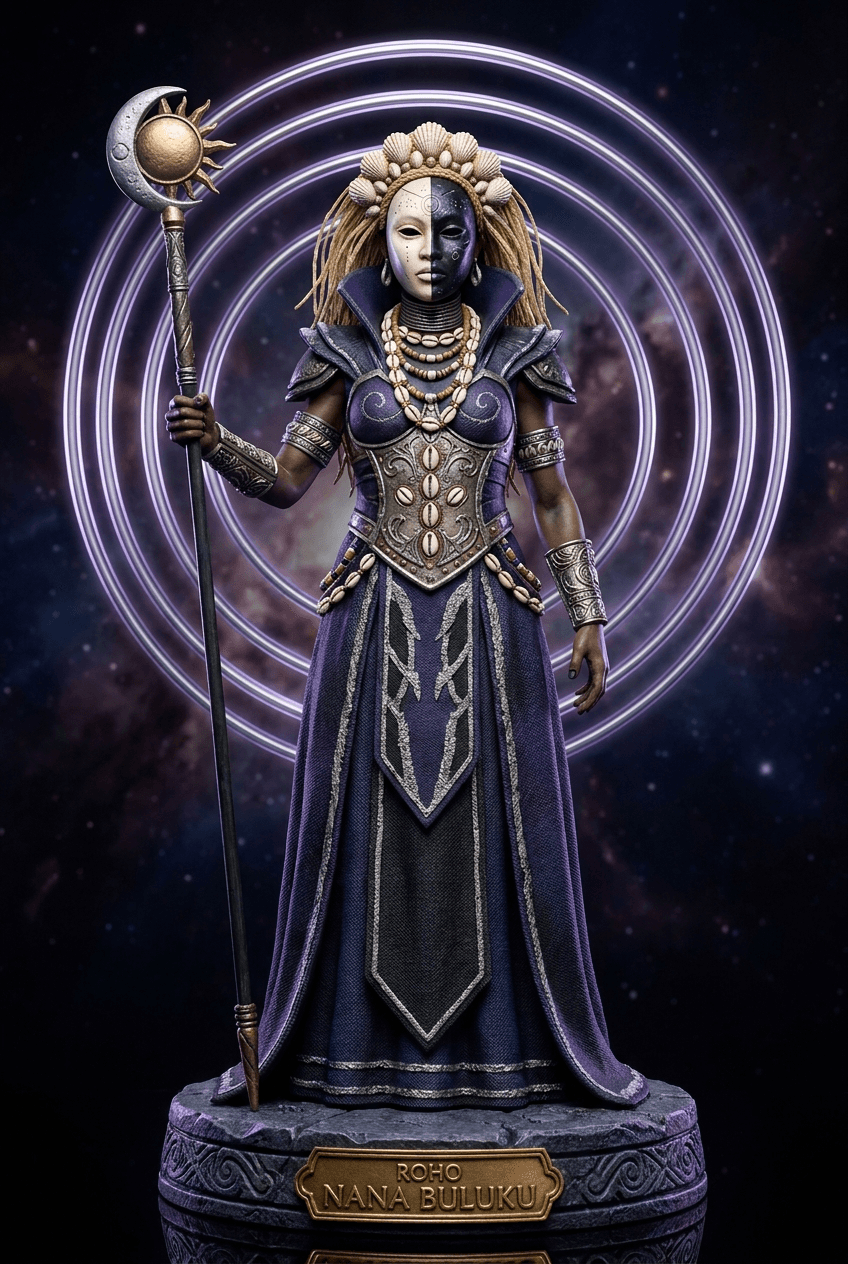
Nana Buluku
allyPrimordial ancestress, creator / Nana Baluku
Nana Buluku is the original supreme being in the Vodun religion of the Fon of Benin and the Ewe of Togo. The traditions collected in Dahomey tell that she creates the world, gives birth to the twins Mawu and Lisa, the moon and the sun, then withdraws, leaving the government of the universe to this dyad. She thus belongs to the figures of the withdrawn creator, honoured yet little solicited in daily worship. Her memory reaches far beyond Fon country: the Yoruba know her as Nana Bukuu and certain Igbo traditions as Olisabuluwa. A figure of great antiquity, she is represented as a woman of immense age, prior to all things. Deported with the captives of the Atlantic slave trade, she remains venerated in the Americas: in Brazil, Candomblé honours her as Nanã or Nanã Buruku, a very old mother associated with the primordial mud and the still waters, held to be the mother of Obaluaiê, the counterpart of the vodun Sakpata. In Haitian Vodou, where Bondyé holds the place of the distant creator, her memory has faded; but from the Gulf of Benin to the Americas she remains the silent root from which the Afro-diasporic pantheons proceed.
Powers & Attributes
Role in the ROHO universe
A fragment of Onionkupón's Breath, bound to one of the five elements of the cosmic balance.
Sacred Mask
A mask carved of ancient energy: a symbol of the cosmic force proper to its pantheon.
Era
3,000 to 1,000 BCE: Cycle of Elemental Powers
Spiritual Lesson
To understand the nature of one's own balance and the wisdom hidden behind every trial.
Words of the Spirit
“The spirit crosses what the body cannot.”
Frequently asked questions
Who is Nana Buluku?
Nana Buluku is the primordial supreme deity of Vodun among the Fon and the Ewe. Mother of the twins Mawu and Lisa, the moon and the sun, she withdraws after the creation and entrusts them with the government of the world. Of immense age, she is honoured as the ancestress from whom all existence proceeds.
Is Nana Buluku still venerated today?
Yes. Beyond the sanctuaries of the Gulf of Benin, her cult crossed the Atlantic with the captives of the slave trade. In Brazil, Candomblé honours her as Nanã or Nanã Buruku, a very old mother associated with the primordial mud and the still waters, held to be the mother of Obaluaiê, the counterpart of the vodun Sakpata.
Related spirits
Further reading
Sources and references
- Melville J. Herskovits, Dahomey: An Ancient West African Kingdom (1938)
- Geoffrey Parrinder, West African Religion (1949)
- Pierre Verger, Notes sur le culte des Orisa et Vodun à Bahia, la Baie de tous les Saints, au Brésil et à l'ancienne Côte des Esclaves en Afrique (1957)