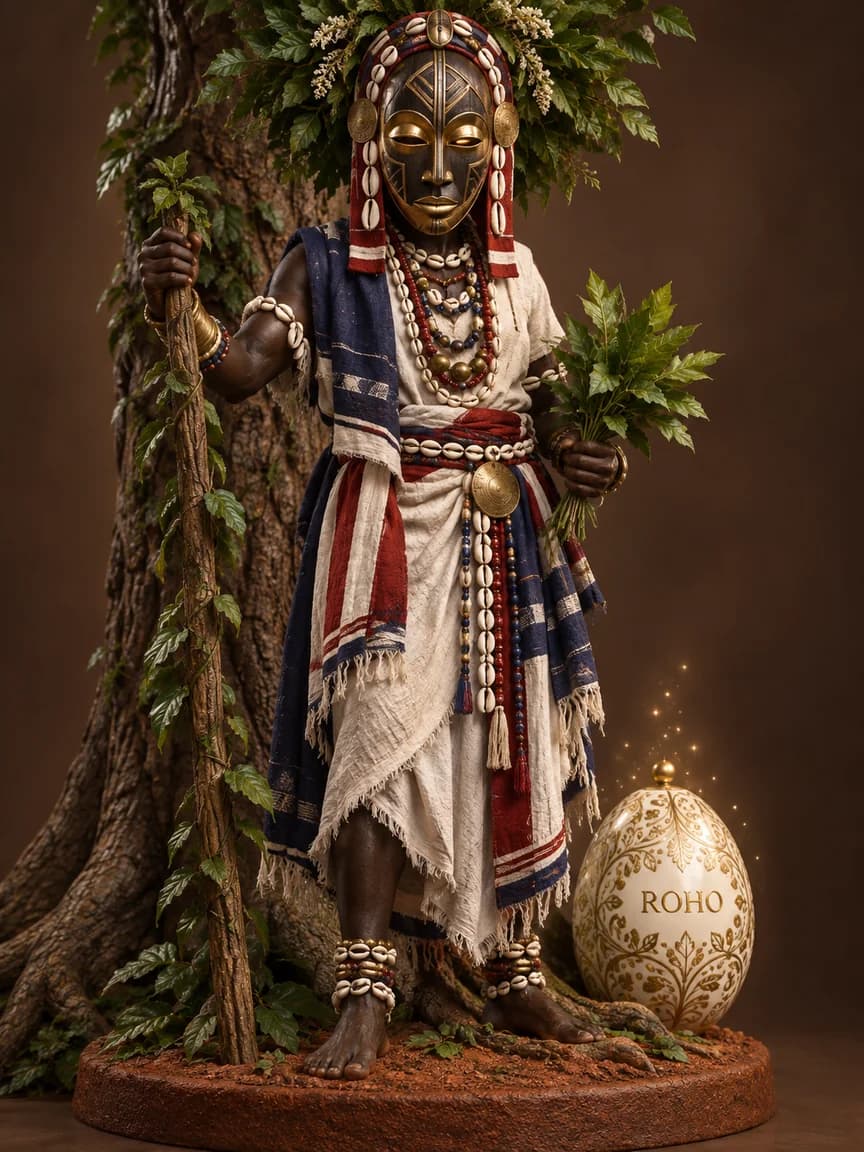
Loko
allyGod
Loko is, in the Fon and Ewe vodun of the Gulf of Benin, the spirit associated with trees, and quite particularly with the iroko (Milicia excelsa), a great sacred tree held to be the dwelling of the spirits. His name comes from the Fon loko, related to the Yoruba terms roko or iroko. Loko belongs to the vodún of the trees, atinmɛ vodún, the tree serving as a link between the world of humans and that of the invisible powers. He is closely associated with the knowledge of plants and with healing, which explains his invocation by herbalists and healers. In the traditions of the diaspora, notably Haitian vodou, Loko, often written Loco, becomes a major lwa, presented as the first priest, guardian of the rites and husband of Ayizan, the first priestess. There he presides over the initiations, called kanzo, in the course of which the new clergy receives the asson, the sacred rattle. Loko thus embodies at once the central post linking sky and earth, medicine through plants and the ritual authority handed down from generation to generation.
Powers & Attributes
Role in the ROHO universe
Keeper of the two hands. LOKO sends the fevers and withdraws them as the measure demands. Bound to the Fon/Eʋe pantheon.
Sacred Mask
An ancient ritual mask of sacred wood, old metal and black stone, engraved with symbols of trees and medicine, embodiment of the power of Loko
Era
Ancient cycle
Frequently asked questions
Of what is Loko the spirit?
Of the trees, and above all of the iroko, the sacred tree of the Gulf of Benin. As such, he is also bound to the knowledge of plants and to healing.
Why do the herbalists invoke Loko?
Because he governs plant knowledge. The iroko and other trees provide remedies, and Loko is their patron, guardian of the curative virtues of plants.
What is Loko's role in the vodou of the diaspora?
In Haitian vodou, Loco is a major lwa, presented as the first priest and the husband of Ayizan. He presides over the initiations and watches over the observance of the rites.
Related spirits
Further reading
Sources and references
- Alfred Métraux, Le Vaudou haïtien, Gallimard, 1958
- Bernard Maupoil, La géomancie à l'ancienne Côte des Esclaves, Institut d'ethnologie, 1943