Heyvoso
allyGod
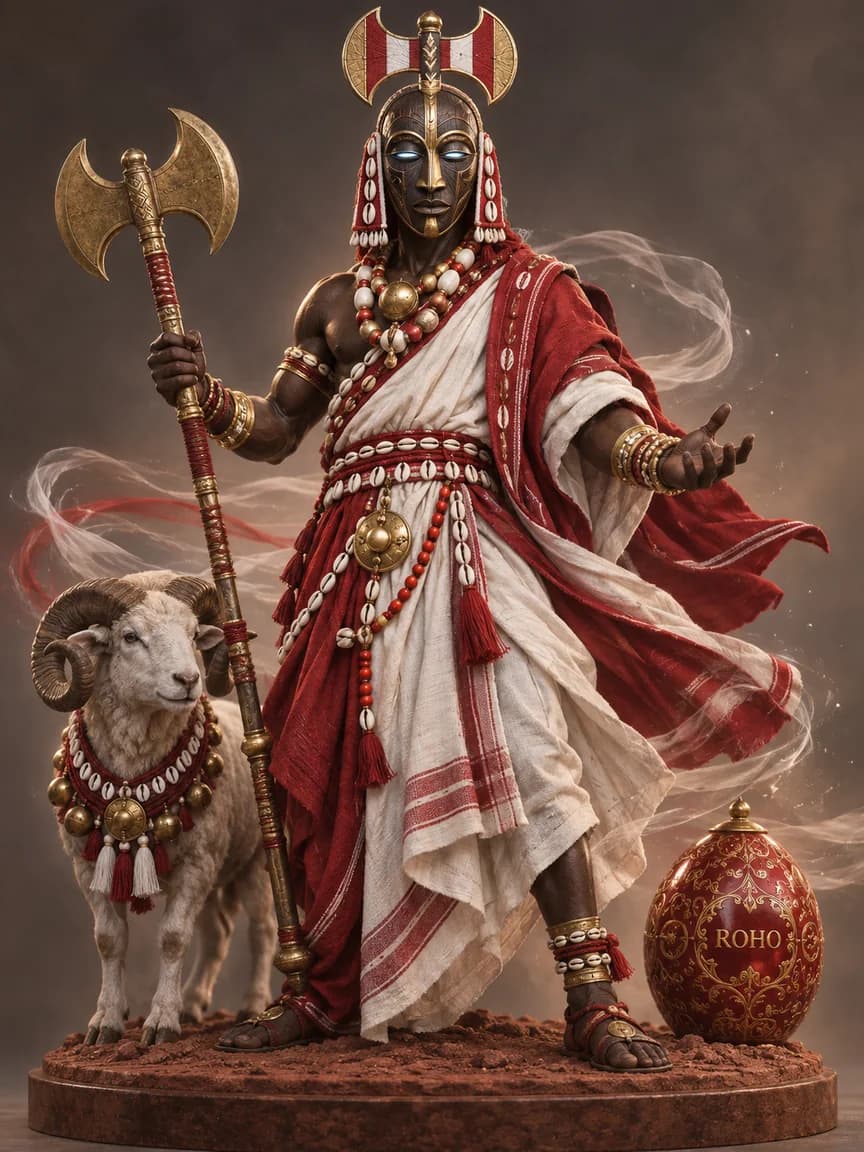
Hevioso, also transcribed Xevioso, Hèviosso or Heviosso, is the great thunder vodun in the religion of the Fon and the Ewe, peoples of the south of present-day Benin, of Togo and of south-eastern Ghana. Son of the creator couple Mawu-Lisa, he commands the lightning, the flash, the thunder and the rain. As such he unites two faces: that of the destructive power of the lightning, and that of the fertilising rain that feeds the crops. Hevioso is above all a deity of justice: tradition sees in the lightning his weapon, which strikes liars, thieves and wrongdoers, so that death by lightning is held to be a punishment. His emblem is the double axe, whose blades figure the polarity of his function: destruction and life. His faithful associate the ram with him and wear red and white. He stands at the head of the pantheon of the sky, beside the pantheon of the earth, around Sakpata, and that of the sea, around Agbe. His cult carries on in the Afro-diasporic religions born of the Atlantic slave trade.
Powers & Attributes
Role in the ROHO universe
Voice of the thunder. HEYVOSO calls humankind back to justice through the lightning and marks the beginnings. Bound to the Fon/Eʋe pantheon.
Sacred Mask
An ancient ritual mask of feathers, carved bone and crystal, engraved with symbols of sky, embodiment of the power of Heyvoso
Era
Ancient cycle
Frequently asked questions
Who is Hevioso?
Hevioso, also written Xevioso, is the great thunder vodun of the Fon and the Ewe, in Benin, Togo and Ghana. Son of the creator couple Mawu-Lisa, he reigns over the lightning, the flash, the thunder and the rain.
Why is Hevioso a deity of justice?
Tradition makes the lightning Hevioso's weapon, which strikes liars, thieves and wrongdoers. Death by lightning is thus understood as a divine punishment, and the places struck demand rites of purification.
What does Hevioso's double axe symbolise?
The double axe is his emblem. Its two blades express the polarity of his function: on one side the destructive power of the lightning, on the other the fertilising rain and life. His faithful associate the ram with him and wear red and white.
Related spirits
Further reading
Sources and references
- Melville J. Herskovits, Dahomey: An Ancient West African Kingdom, 1938
- Pierre Verger, Dieux d'Afrique : culte des Orishas et Vodouns à l'ancienne Côte des Esclaves en Afrique et à Bahia (1954)
- Suzanne Preston Blier, African Vodun: Art, Psychology, and Power (1995)