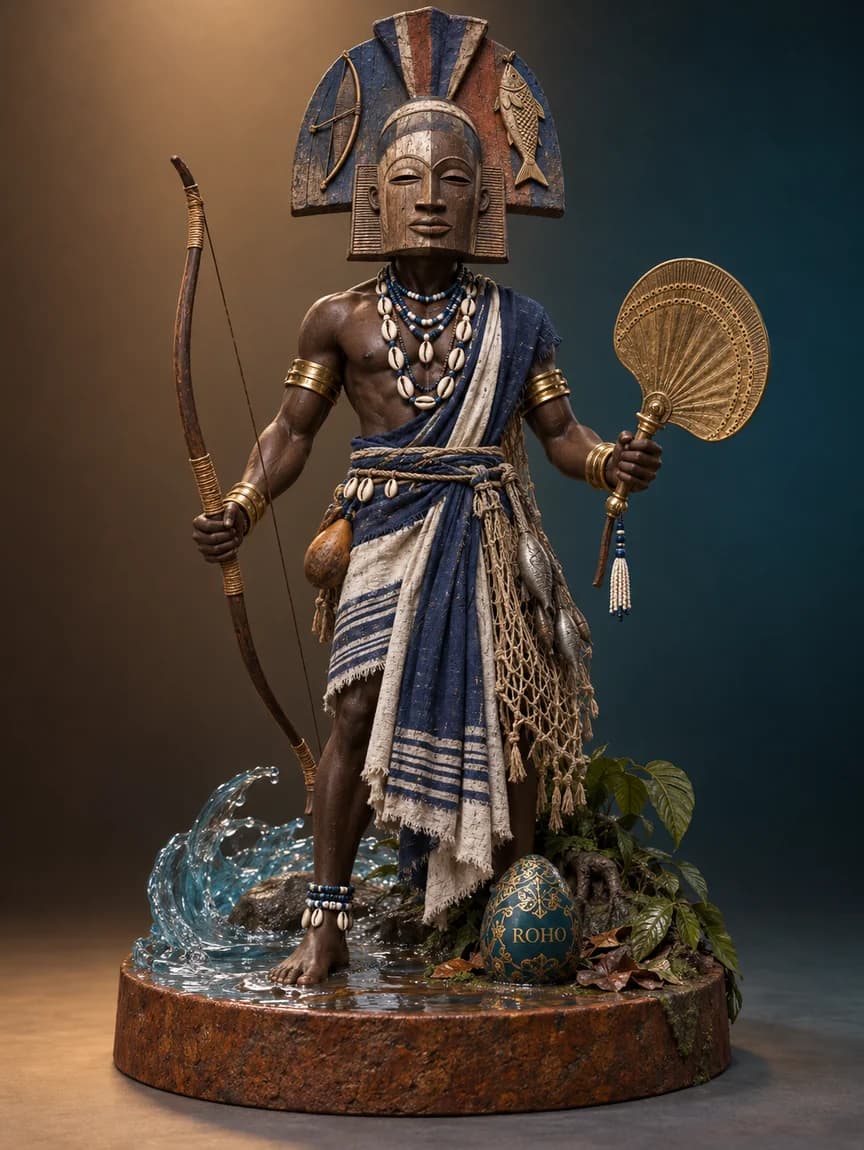
Logun Ede
neutralSpirit of beauty and the hunt
Logun Ede, also written Logunedé or Logum Edé, is an orisha of the Yoruba religion, particularly honoured in Brazilian Candomblé and other Afro-diasporic traditions. Tradition makes him the son of Oxum, orisha of the rivers, and of Erinle, called Oxóssi the hunter in the Brazilian cult. From his parents he inherits the beauty, gentleness and wisdom of the waters as well as the skill and abundance of the hunt. His best-known figure is his double nature. It is told that he lives six months in the river with his mother, feeding on fish, and six months in the forest with his father, feeding on game. Certain oral traditions lend him a nature uniting the masculine and feminine polarities. A prince renowned for his youth and his wealth, he is associated with symbols such as the seahorse, offered by his grandmother Yemanja, the peacock, the mirror abebé, the bow and arrow ofá, and golden adornments. His origin is situated in the region of Ilesa, in Nigeria, where annual festivals are consecrated to him. He embodies the balance between sensitivity and ardour, between the water and the forest.
Era
Yoruba traditions, West Africa
Frequently asked questions
Who are Logun Ede's parents?
He is the son of Oxum, orisha of the rivers and of beauty, and of Erinle, called Oxóssi the hunter in the Brazilian cult. He inherits the gifts of the water and the hunt.
Why does Logun Ede live between the water and the forest?
Tradition tells that he spends six months in the river with his mother, feeding on fish, and six months in the forest with his father, feeding on game, symbolising the balance of opposites.
What are Logun Ede's symbols?
With him are associated the seahorse received from his grandmother Yemanja, the peacock, the mirror abebé, the bow and arrow ofá, as well as golden adornments evoking his beauty and his wealth.
Related spirits
Further reading
Sources and references
- Juana Elbein dos Santos, Os Nàgô e a Morte (1976)
- Molefi Kete Asante and Ama Mazama, Encyclopedia of African Religion (2009)
- , Wikipedia (PT/ES)