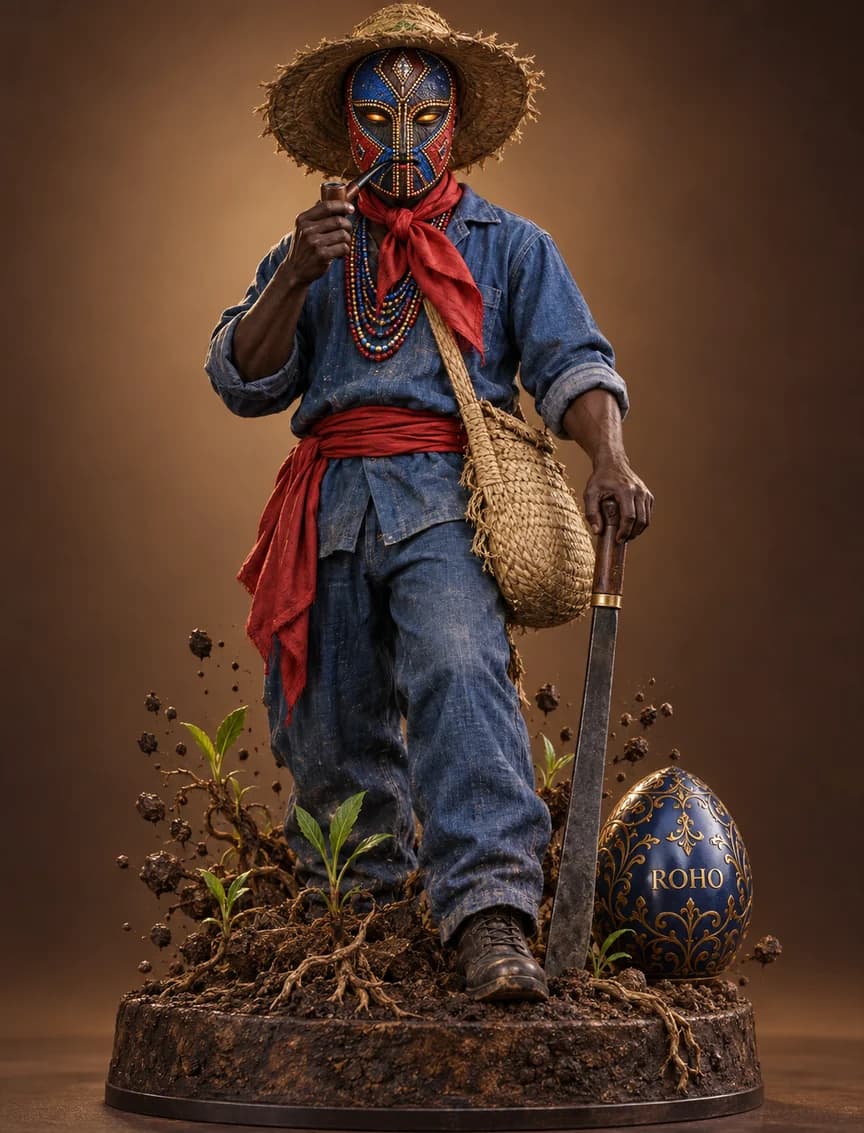
Azaka Medeh
allyAgriculture, peasantry, labour
Azaka Medeh, greeted by the name Kouzen Zaka, is the lwa of agriculture and of the peasantry in Haitian Vodou. He is called cousin, and this familiar form of address says everything about his relationship with his servants: he is one of them. He appears in peasant dress, with a straw hat, clothes of blue cloth, a pipe in his mouth and a macoute slung across his shoulder, the woven straw bag in which the Haitian farmer carries his provisions. His possession is recognisable among all others: he speaks with a country accent, distrusts city people, demands food and haggles hard over the smallest service. This comedy takes nothing away from his dignity, it establishes it. In a country where the peasantry long carried the nation without receiving its regard, Azaka is the lwa who affirms the worth of working the land. His colours are blue and red. His feast falls around the first of May, Agriculture Day in Haiti, and Catholic imagery has linked him to Saint Isidore the Farmer.
Powers & Attributes
Role in the ROHO universe
Bound to one of the five elements of the cosmic balance. Its power springs from the energy proper to its tradition, and from no other.
Sacred Mask
A mask carved of ancient energy, a symbol of the cosmic force proper to its pantheon.
Era
1500 to 1800: Cycle of the Diaspora and Remembrance
Words of the Spirit
“What the earth gives back, it first received.”
Frequently asked questions
Who is Azaka in Haitian Vodou?
Azaka Medeh, called Kouzen Zaka, is the lwa of agriculture and of the peasantry. He is greeted as a cousin, and he appears in peasant dress with a straw hat, a pipe and a macoute, the woven straw bag of the Haitian farmer.
Why is Azaka called “cousin”?
Because he is one of them. This familiar form of address speaks of his relationship with his servants: in a country where the peasantry long carried the nation without receiving its regard, Azaka affirms the worth of working the land.
Related spirits
Further reading
Sources and references
- Alfred Métraux, Le Vaudou haïtien (1958)
- Maya Deren, Divine Horsemen: The Living Gods of Haiti (1953)
- Karen McCarthy Brown, Mama Lola: A Vodou Priestess in Brooklyn (1991)
- Anne M. Platoff, Drapo Vodou: Sacred Standards of Haitian Vodou (Flag Research Quarterly, n° 7, North American Vexillological Association, 2015), p. 4