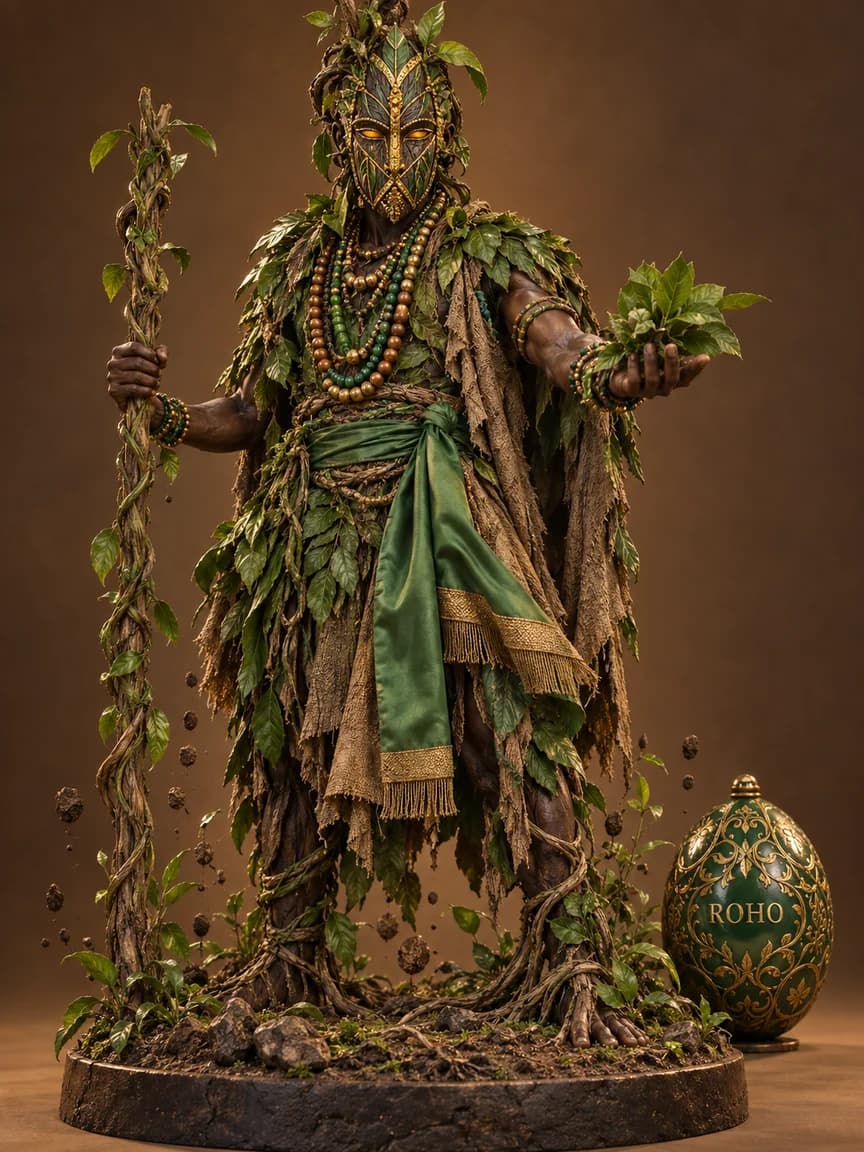
Gran Bwa
allyForest, plants, initiation
Gran Bwa, whose name means Great Wood, is the lwa of the forest and of wild plants in Haitian Vodou. He rules over untamed space, the space that begins where the gardens end, and this sovereignty makes him a lwa of initiation: it is in the woods that one goes to seek what cannot be found in the village. The leaves used in ritual baths and remedies belong to him, and healers greet him before they gather. He is represented as a face emerging from a trunk or as a man covered in foliage. His domain touches that of Papa Loko, lwa of the plants that heal, but Gran Bwa is wilder: he is the forest itself, not the knowledge drawn from it. His colours are green and brown. Served, depending on the house, in the Rada rite or in the Petro rite, he holds a hinge position that his servants readily acknowledge, since the forest belongs wholly neither to gentleness nor to heat.
Powers & Attributes
Role in the ROHO universe
Bound to one of the five elements of the cosmic balance. Its power springs from the energy proper to its tradition, and from no other.
Sacred Mask
A mask carved of ancient energy, a symbol of the cosmic force proper to its pantheon.
Era
1500 to 1800: Cycle of the Diaspora and Remembrance
Words of the Spirit
“The forest keeps what houses no longer know how to hold.”
Frequently asked questions
Who is Gran Bwa in Haitian Vodou?
Gran Bwa, the Great Wood, is the lwa of the forest and of wild plants. He rules over untamed space and over the leaves used in ritual baths and remedies. Healers greet him before they gather.
What is the difference between Gran Bwa and Papa Loko?
Papa Loko is the lwa of the plants that heal and the patron of the priests: he stands for the knowledge drawn from nature. Gran Bwa is the forest itself, the wild space from which that knowledge comes. Their domains touch without merging.
Related spirits
Further reading
Sources and references
- Maya Deren, Divine Horsemen: The Living Gods of Haiti (1953)
- Alfred Métraux, Le Vaudou haïtien (1958)
- Laënnec Hurbon, Les Mystères du vaudou (1993)
- Anne M. Platoff, Drapo Vodou: Sacred Standards of Haitian Vodou (Flag Research Quarterly, n° 7, North American Vexillological Association, 2015), p. 5