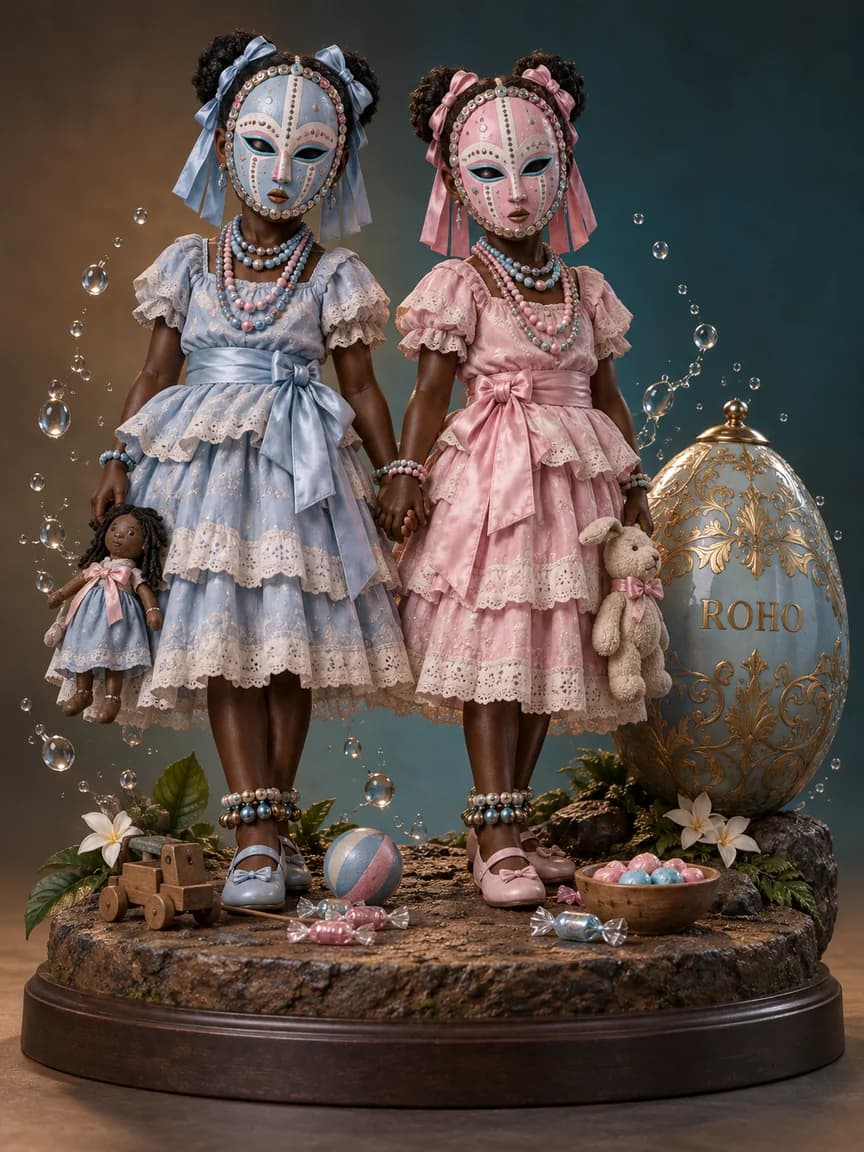
Marassa
allyDivine twins, childhood, abundance
The Marassa are the divine twins of Haitian Vodou, sometimes counted as three under the name Marassa Twa. Served very early in the ceremony, often right after Legba, they hold a place of their own: they are not ancestors but children, and their power is held to come precisely from that. Twinship, in the traditions of the Bight of Benin as in Haiti, is a sign: twins see double, they hold together what others keep apart, life and death, the visible and the invisible. They are served offerings in twos or threes, on twin plates or a divided dish, and the share of the third is never forgotten, for fear of jealousy. Their foods are those of childhood: syrup, cakes, rice pudding, fruit. They are said to be capricious, quick to sulk, and they must be appeased before the other lwa are served. Their colours are pale blue and pink. Their cult carries the Dahomean and Yoruba veneration of twins, the hohovi and the ibeji, all the way to the Caribbean.
Powers & Attributes
Role in the ROHO universe
Bound to one of the five elements of the cosmic balance. Its power springs from the energy proper to its tradition, and from no other.
Sacred Mask
A mask carved of ancient energy, a symbol of the cosmic force proper to its pantheon.
Era
1500 to 1800: Cycle of the Diaspora and Remembrance
Words of the Spirit
“What is double sees what the single one cannot see.”
Frequently asked questions
Who are the Marassa in Haitian Vodou?
The Marassa are the divine twins, sometimes counted as three under the name Marassa Twa. Served early in the ceremony, they are children and not ancestors, and their power is held to come from twinship itself.
Why are the Marassa served in pairs?
Because they are two, or three. Offerings are set out on twin plates or a divided dish, and the share of the third is never forgotten: tradition says the Marassa sulk and hold back their favours when they are miscounted.
Related spirits
Further reading
Sources and references
- Maya Deren, Divine Horsemen: The Living Gods of Haiti (1953)
- Alfred Métraux, Le Vaudou haïtien (1958)
- Leslie G. Desmangles, The Faces of the Gods: Vodou and Roman Catholicism in Haiti (1992)
- Anne M. Platoff, Drapo Vodou: Sacred Standards of Haitian Vodou (Flag Research Quarterly, n° 7, North American Vexillological Association, 2015), p. 5