Aberewa
allyGoddess
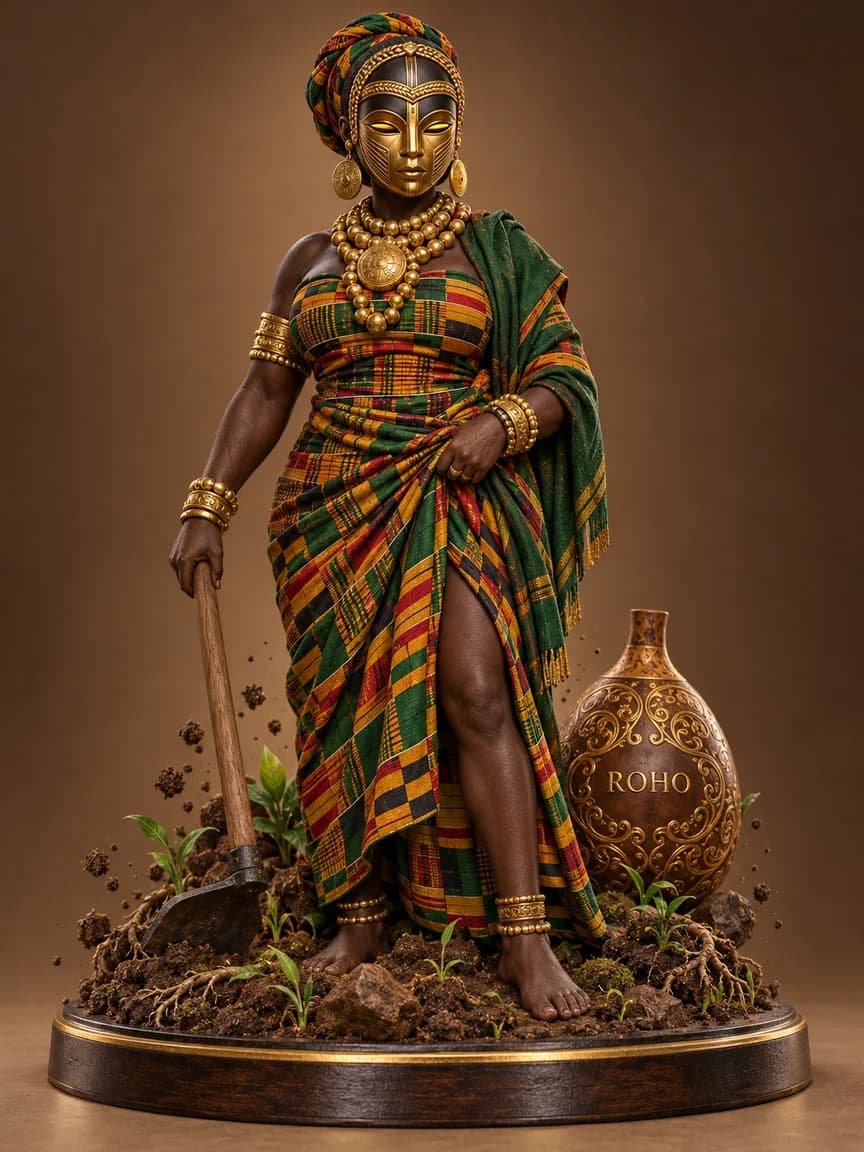
Aberewa, or Aberewaa, "the old woman", is one of the names of the great earth goddess of the Akan of Ghana and Côte d'Ivoire, better known as Asase Ya among the Asante and Asase Afua among the Fante. Goddess of fertility, truth, love and peace, she is the power of the nourishing earth, immediately after Nyame, the creator, in the Akan spiritual hierarchy. She is named Aberewa to underline her face as old mother of the soil and keeper of the world of the dead: she watches over the gate of Asamando, the realm of the ancestors, where she welcomes the souls of the departed. Her name is pronounced just after Nyame's in the libations that open every Akan ceremony and ritual act. She has neither temples nor a particular priesthood: she is honoured on the very soil of the fields, and on the day consecrated to her, Thursday among the Asante, it is forbidden to till the earth. She is associated with the adinkra symbol Asaase Ye Duru, "the earth has weight", which recalls the sacred value of the soil.
Powers & Attributes
Role in the ROHO universe
Mother of the soil. ABEREWA holds the fertility of the earth and blesses wombs and seeds. Bound to the Akan pantheon.
Sacred Mask
An ancient ritual mask of fired clay, bronze and fossilised roots, engraved with symbols of earth, embodiment of the power of Aberewa
Era
Ancient cycle
Frequently asked questions
Are Aberewa and Asase Ya the same goddess?
Yes. Aberewa, "the old woman", is one of the names of the Akan earth goddess, called Asase Ya among the Asante and Asase Afua among the Fante. It underlines her face as old mother of the soil.
What is Aberewa's role in Akan religion?
She is the power of the nourishing earth, goddess of fertility, truth and peace. Second after the creator Nyame, she also keeps the gate of Asamando, the realm of the dead.
How is Aberewa honoured?
Without temple or priesthood of her own, she is honoured on the very soil through libations, pronounced just after the name of Nyame. On the day consecrated to her, it is forbidden to till the earth.
Related spirits
Further reading
Sources and references
- Encyclopædia Britannica, entrée "Asase Yaa"
- Robert Sutherland Rattray, Ashanti (1923)
- Geoffrey Parrinder, West African Religion: A Study of the Beliefs and Practices of Akan, Ewe, Yoruba, Ibo and Kindred Peoples (1949)