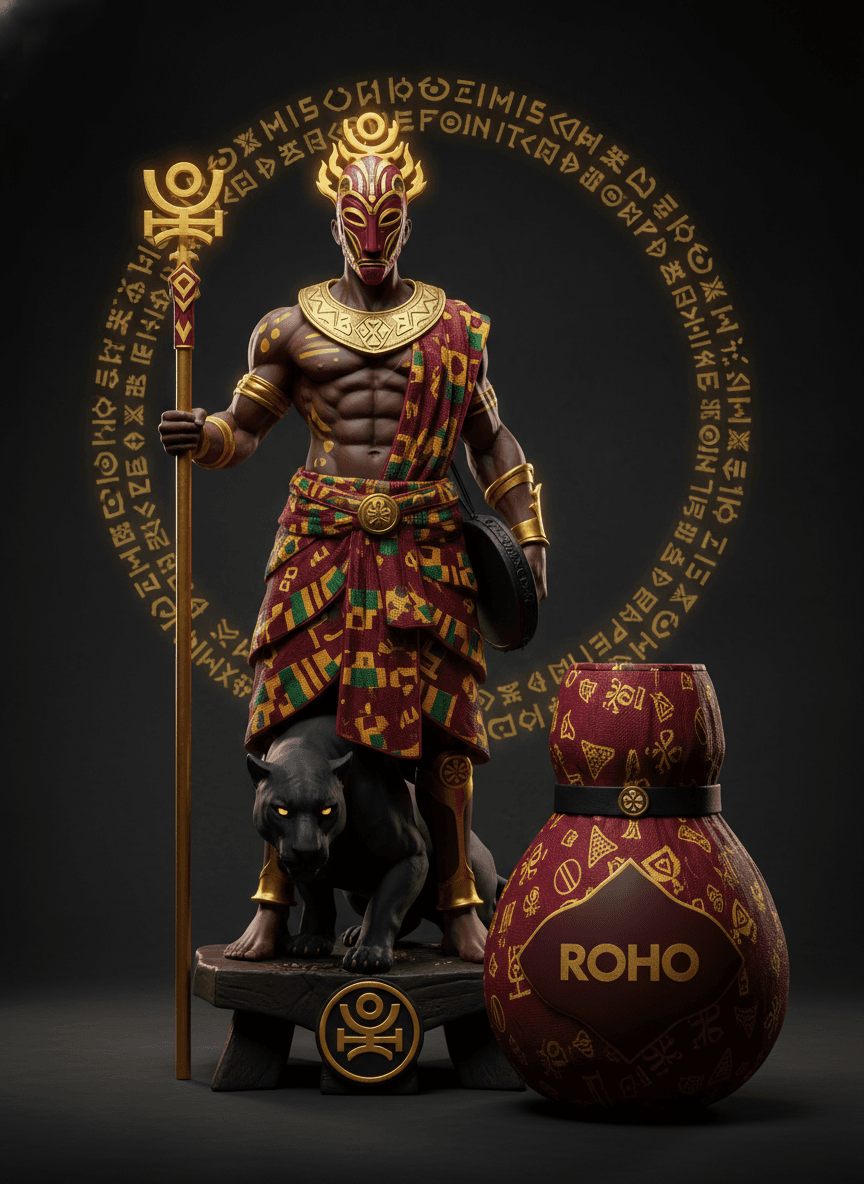
Abam Kofi
allyAbam Kofi is, in the Akan and Asante tradition of Ghana, presented as a protective deity associated with twins. Among several Akan peoples, the birth of twins carries a sacred value and gives rise to particular rites. According to accessible ethnographic sources, an annual festival, held at harvest time, gives thanks to this deity: the community's twins take part, enter trance and address the spirit to obtain its protection over the group. The name itself reflects the Akan use of day-names, in which Kofi designates a boy born on a Friday. This figure remains little documented in the academic reference sources, and the available information remains limited and to be confirmed.
Powers & Attributes
Role in the ROHO universe
A fragment of Onionkupón's Breath, bound to one of the five elements of the cosmic balance.
Sacred Mask
A mask carved of ancient energy: a symbol of the cosmic force proper to its pantheon.
Era
3,000 to 1,000 BCE: Cycle of Elemental Powers
Spiritual Lesson
To understand the nature of one's own balance and the wisdom hidden behind every trial.
Words of the Spirit
“The spirit crosses what the body cannot.”
Frequently asked questions
Who is Abam Kofi?
In the Akan and Asante tradition of Ghana, Abam Kofi is presented as a protective deity associated with twins, to whom a community gives thanks at an annual festival.
What bond does Abam Kofi have with twins?
Among the Akan, the birth of twins is sacred. At the festival dedicated to him, the twins take part in the rite and address the spirit to obtain its protection over the community.
Is this deity well documented?
No. The available information comes mostly from secondary ethnographic sources and remains limited. Abam Kofi has no dedicated encyclopaedic article nor established authority record.
Related spirits
Further reading
Sources and references
- Anthony Ephirim-Donkor, African Spirituality: On Becoming Ancestors (1997)