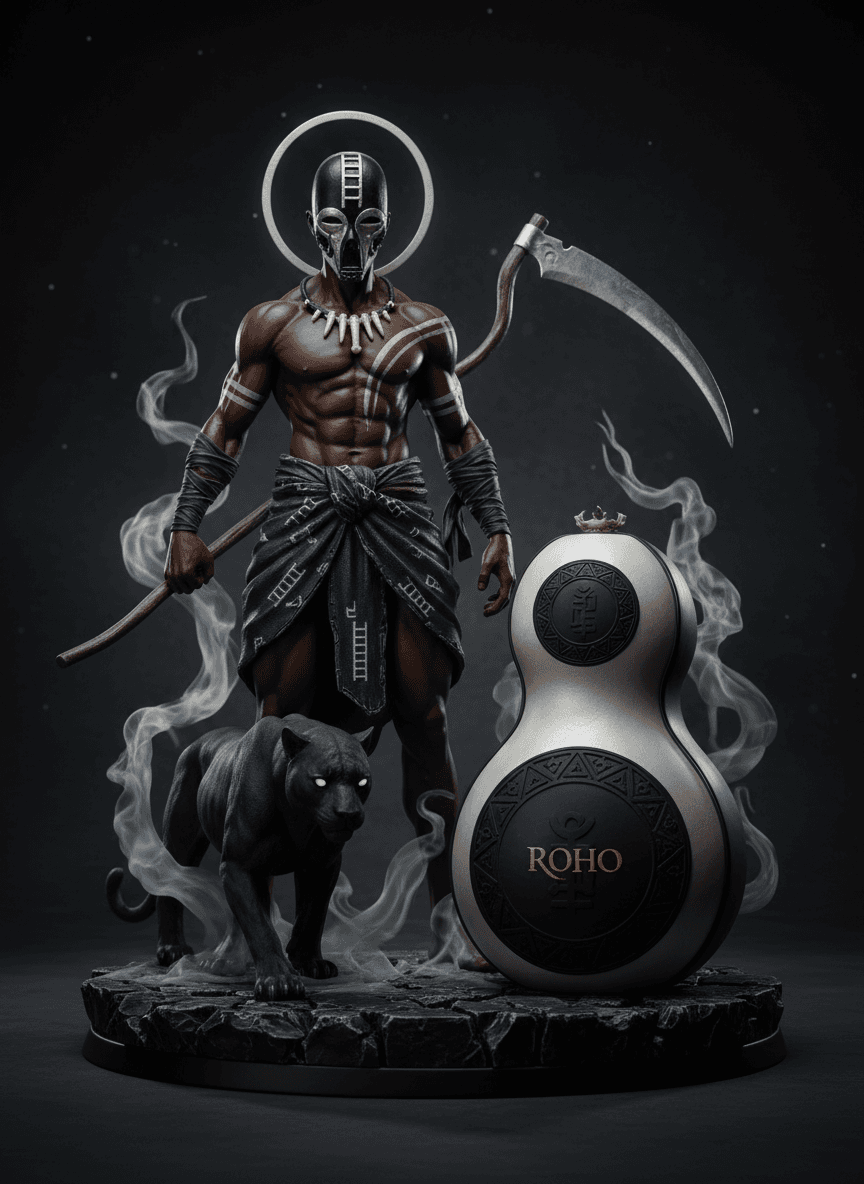
Owuo
allyDeath, fate
Owuo personifies death in the thought of the Akan of Ghana. He is not a deity to whom one prays: no sanctuary is dedicated to him, no offering can sway him, and it is precisely this inflexibility that the proverbs express. The most famous teaches that death's ladder is not climbed by one person alone: everyone will have to take it. This ladder, owuo atwedee, has become one of the adinkra symbols, the Akan graphic motifs printed notably on mourning cloth. In Akan anthropology, the person unites several principles: the okra, spark of life given by Nyame, the sunsum, spiritual personality, and the mogya, blood transmitted by the mother. At death, Owuo undoes this union: the okra returns to Nyame, while the deceased, become an ancestor if the funeral rites have been duly performed, joins asamando, the world of the dead. Far from a mere end, death is thus a passage, and Akan funerals, among the most elaborate in West Africa, organise this journey with care. Tales show Owuo outwitted for a time by cunning, but never defeated: they recall, sometimes with humour, that no bargain with death holds for long.
Powers & Attributes
Role in the ROHO universe
A fragment of Onionkupón's Breath, bound to one of the five elements of the cosmic balance.
Sacred Mask
A mask carved of ancient energy: a symbol of the cosmic force proper to its pantheon.
Era
3,000 to 1,000 BCE: Cycle of Elemental Powers
Spiritual Lesson
To understand the nature of one's own balance and the wisdom hidden behind every trial.
Words of the Spirit
“Between the worlds, the border is a breath.”
Frequently asked questions
Who is Owuo in Akan mythology?
Owuo is the personification of death among the Akan of Ghana. An inescapable power that none can defeat or corrupt, he undoes the union of the principles that make up the person: the soul returns to Nyame, and the deceased joins asamando, the world of the ancestors, if the funeral rites have been duly performed.
What does the adinkra symbol owuo atwedee mean?
Owuo atwedee means death's ladder. The symbol illustrates a famous Akan proverb: death's ladder is not climbed by one person alone: in other words, everyone will have to take it in turn. This adinkra motif, printed notably on mourning cloth, recalls the common mortal condition and calls for an upright life.
Is Owuo the object of a cult among the Akan?
No. No sanctuary is dedicated to him and no offering can sway him, for death is held to be inescapable. Akan piety concentrates instead on the funerals, among the most elaborate in West Africa, which secure the deceased's passage to asamando and their accession to the status of ancestor honoured by the living.
Related spirits
Further reading
Sources and references
- J.B. Danquah, The Akan Doctrine of God: A Fragment of Gold Coast Ethics and Religion (1944)
- Kofi Asare Opoku, West African Traditional Religion (1978)
- R.S. Rattray, Religion and Art in Ashanti (1927)