Akan gods and goddesses: Nyame, Asase Yaa, Anansi and the spirits of Ghana
The sky god who withdrew, the earth mother who rests on Thursdays, and the spider who bought every story in the world.
Long ago, the sky was so close to the earth that people could touch it. Then an old woman, pounding fufu with a long pestle, kept striking it, again and again, until the sky god drew back into the heights. That is how the Akan of Ghana explain why God feels far away, and yet never absent. Here are the gods and goddesses of the Akan, from the sky to the deep forest.
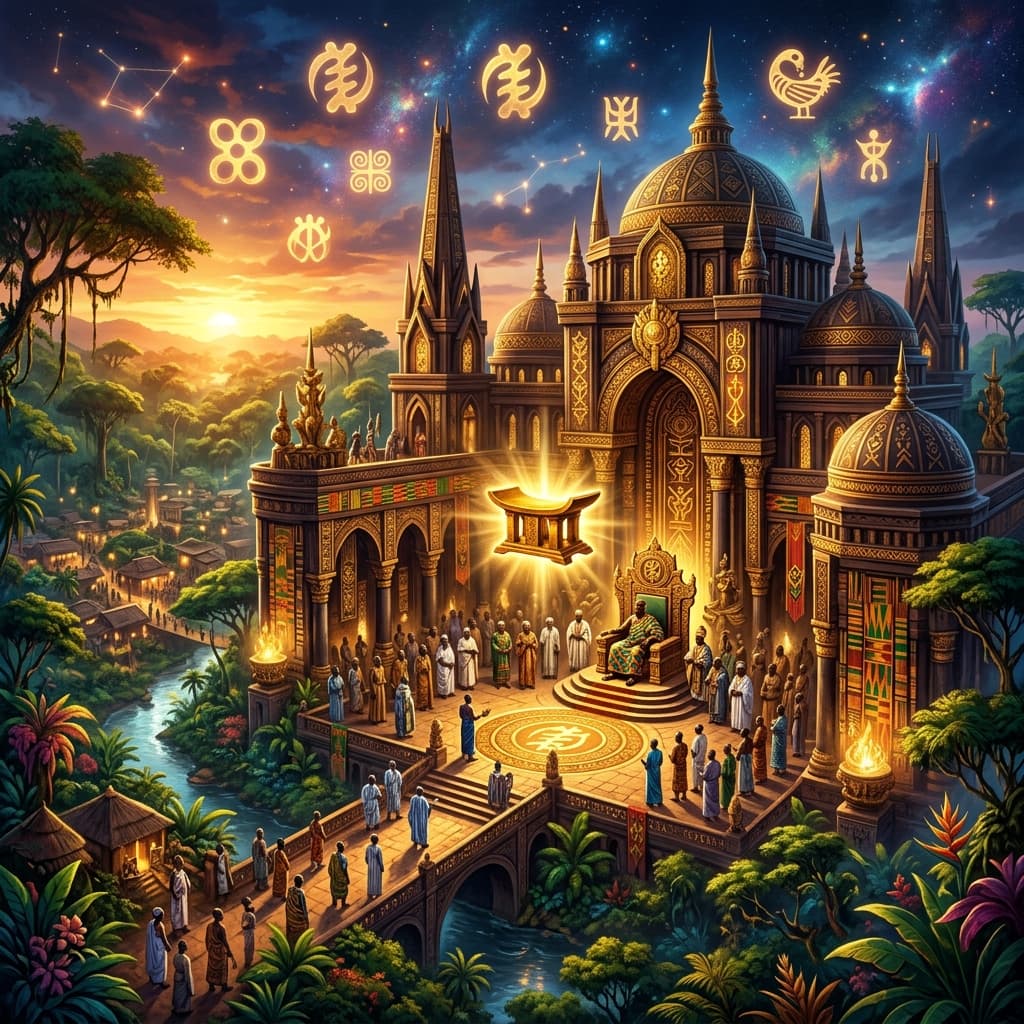
Who are the Akan?
The Akan are a family of peoples of Ghana and Côte d'Ivoire: among them the Asante (Ashanti), the Fante and the Baule. They share a language family, a calendar of day-names (Kofi for a boy born on Friday, Kwame for Saturday) and a religious tradition built on three levels: a supreme god in the sky, the earth beside him, and a multitude of deities, ancestors and spirits who handle the affairs of the living.
Nyame, the sky god who withdrew
Nyame stands at the summit of Akan cosmology. His praise-names describe him better than any portrait: Onyankopon, the Great One; Odomankoma, the Creator of all things; Twereduampon, the one you lean upon and never fall. He gives every human being a portion of himself, the okra, which returns to him after death.
Nyame has no organised clergy and needs no temple. Many Ashanti homes once raised the nyame dua, the tree of God, a forked altar holding a vessel where anyone could leave an offering. An Akan proverb says that no one shows Nyame to a child: the knowledge of God is innate. The adinkra symbol Gye Nyame, except God, expresses his absolute sovereignty.
« No one shows Nyame to a child. Akan proverb »
Authors differ on how Nyame, Onyankopon and Odomankoma relate: three names of one god for some, three faces of one power for others, the sky, the creator and the everlasting. Odomankoma is the one who shapes: the stories credit him with the making of things, the ordering of the world, and even the invention of death.
Asase Yaa, the earth mother
Asase Yaa is the Earth Mother, invoked immediately after Nyame in every libation. Her name means the Earth born on Thursday; on the coast the Fante call her Asase Afua, born on Friday. She has neither temples nor priests: her worship is made of everyday gestures. Before ploughing, sowing or digging a grave, people pour libations and ask her permission to open her womb.
On Thursday, her sacred day, working the land is traditionally forbidden so that she may rest. She is the guarantor of truth: to swear an oath, one touches the earth with a finger, then with the lips. She gives the harvest, and she is also the last dwelling, the one who receives the dead. Among her names is Aberewa, the old woman, keeper of the gate of the ancestors.
The abosom, the gods of rivers and forests
Nyame is too great to handle daily affairs. He delegates the government of the world to the abosom, the deities of rivers, the earth and the forest, who act in his name. In Akan and Guan country, on the Akwapim ridge, the sanctuary of Akonadi, oracle goddess of justice, stands at Larteh. For generations her sanctuary has served as a spiritual tribunal: the wronged come to consult her, and she speaks through her priestesses in trance. Her high priestess Nana Akua Oparebea carried her cult as far as the United States, where African-American communities founded affiliated shrines.
Owuo and death's ladder
Owuo is death itself. He is not a god one prays to: no shrine is dedicated to him and no offering can sway him. The most famous proverb says that death's ladder is not climbed by one person alone: everyone will have to take it. That ladder, owuo atwedee, has become an adinkra symbol printed on mourning cloth.
In Akan thought, a person unites the okra, the spark of life given by Nyame, the sunsum, the spiritual personality, and the mogya, the blood passed down by the mother. At death the okra returns to Nyame, and the deceased, if the funeral rites are properly performed, joins Asamando, the land of the ancestors. At the river that leads there waits Amokye, who welcomes the souls of women and receives as toll the beads and the small amoansie cloth they were buried with.
Anansi, the spider who bought the stories
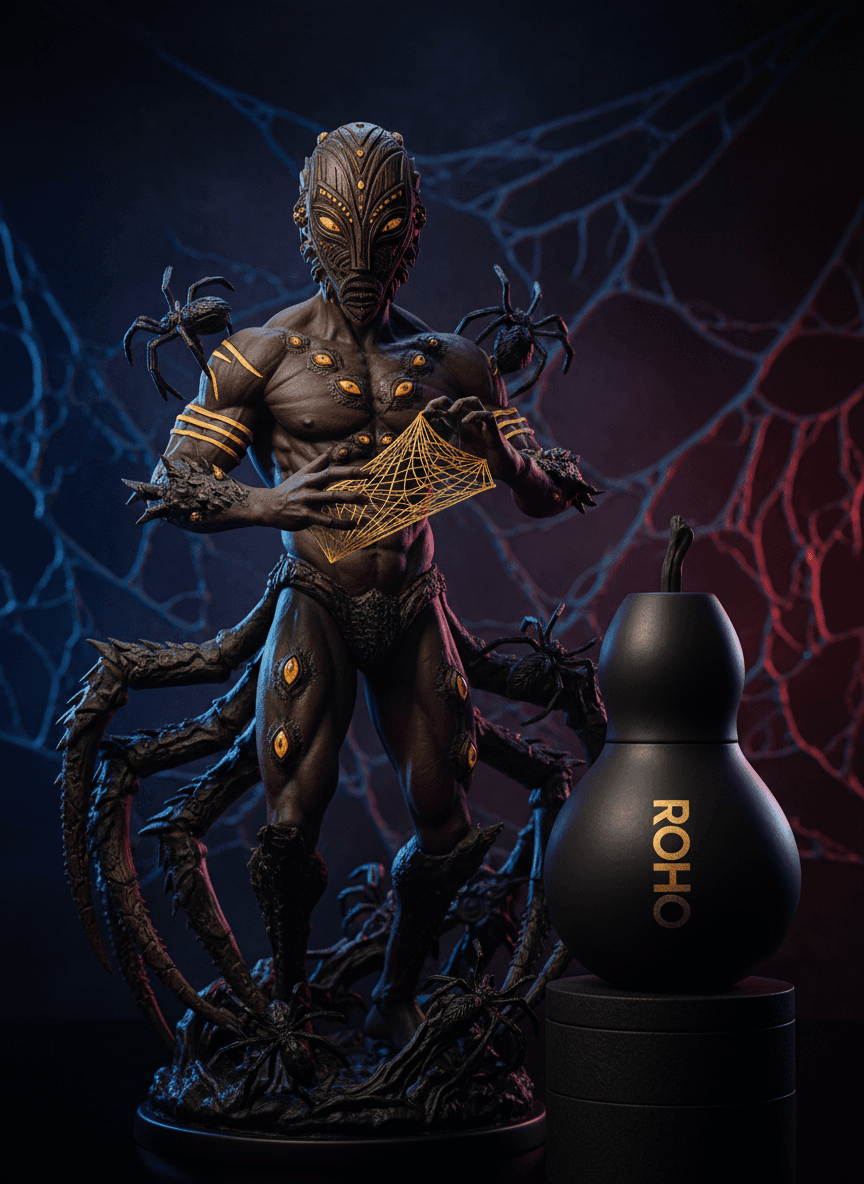
Anansi is the great trickster of Akan tales, so central that the Ashanti call the whole body of their stories anansesem, the spider's stories. The most famous tells how Anansi bought the stories from Nyame by capturing Onini the python, Osebo the leopard, the Mmoboro hornets and a forest spirit, an aboatia. Since then, every tale belongs to him.
With the Atlantic slave trade, his stories crossed the ocean in the memory of the captives. He became Anancy in Jamaica, the hero of the anansi-tori in Suriname, and Aunt Nancy in the Gullah tales of the southern United States. For the enslaved, the small spider who outwits the powerful became a figure of resistance and survival. Anansi is not worshipped: he lives in the tale, told in the evening, in Ghana as in Jamaica.
The mmoatia and the Sasabonsam, spirits of the deep forest
The mmoatia are the little beings of the forest, about thirty centimetres tall, with feet turned backwards, who whistle to one another and love bananas. They are masters of plants: they are said to carry off future healers for weeks to teach them the secrets of leaves and barks, and many Akan herbalists attribute their knowledge to them.
Deeper still lives the Sasabonsam, the monster of the hunters' tales. Seated high in the great trees, with iron teeth and immense legs hanging from the branches, it snatches those who walk beneath. Its role is clear: to embody the dangers of the bush against the order of the village, and to keep anyone from entering the great forest alone.
The Akan gods at a glance
| Name | Who they are | Remember |
|---|---|---|
| Nyame (Onyankopon, Odomankoma) | Supreme sky god and creator | Withdrew from the earth; adinkra Gye Nyame |
| Asase Yaa (Aberewa) | Earth mother | Thursday is her day of rest; witness of oaths |
| The abosom | Deities of rivers, earth and forest | Govern the world in Nyame's name |
| Akonadi | Oracle goddess of justice | Sanctuary at Larteh, Akwapim ridge |
| Owuo | Death | Owuo atwedee, death's ladder |
| Amokye | Keeper of the river of the dead | Welcomes the souls of women |
| Anansi | Spider trickster | Owner of all stories; Anancy in Jamaica |
| Mmoatia | Little forest spirits | Masters of plants |
| Sasabonsam | Forest monster | Iron teeth, legs hanging from the trees |
From Ghana to the Legend of ROHO
Two of these figures walk in the first book of La Légende de ROHO, the fantasy saga built on the mythologies of Africa and the Caribbean: Akonadi, the goddess of justice, as an ally, and the Sasabonsam as an adversary. The book is in French for now; the Codex, with every spirit of this article and their sources, is open to all in English.
Conseil de pro
This article describes a living religious tradition, practised today in Ghana, in Côte d'Ivoire and in their diasporas. Names, stories and rites vary from one region and one lineage to another: the Codex records the versions given by its sources.
Sources
- ◆R. S. Rattray, *Religion and Art in Ashanti*, Oxford, 1927.
- ◆R. S. Rattray, *Akan-Ashanti Folk-Tales*, Oxford, 1930.
- ◆J. B. Danquah, *The Akan Doctrine of God*, 1944.
- ◆Geoffrey Parrinder, *West African Religion*, 1949.
- ◆Kofi Asare Opoku, *West African Traditional Religion*, 1978.
- ◆Hans Werner Debrunner, *Witchcraft in Ghana*, 1959.
- ◆David Brokensha, *Social Change at Larteh, Ghana*, 1966.
- ◆Martha Warren Beckwith, *Jamaica Anansi Stories*, 1924.
Questions fréquentes
Who is the supreme god of the Akan?
Nyame, also called Onyankopon or Odomankoma, is the supreme sky god and creator of the Akan of Ghana and Côte d'Ivoire. He has no organised clergy, gives every person a portion of himself, the okra, and delegates the government of the world to the abosom.
Who is the Akan earth goddess?
Asase Yaa, the Earth born on Thursday, is the Akan earth mother, invoked right after Nyame in libations. Thursday is her day of rest, when working the land is traditionally forbidden. The Fante call her Asase Afua.
What are the abosom?
The abosom are the Akan deities of rivers, the earth and the forest. They govern the world in the name of Nyame, who is too great to handle the daily affairs of the living.
Is Anansi a god?
No. Anansi is the trickster hero of the Akan tales, not the object of a cult. He owns all the stories since he bought them from the sky god Nyame, and became Anancy in Jamaica and Aunt Nancy in the Gullah tales.