Asanbosam
neutralMonster
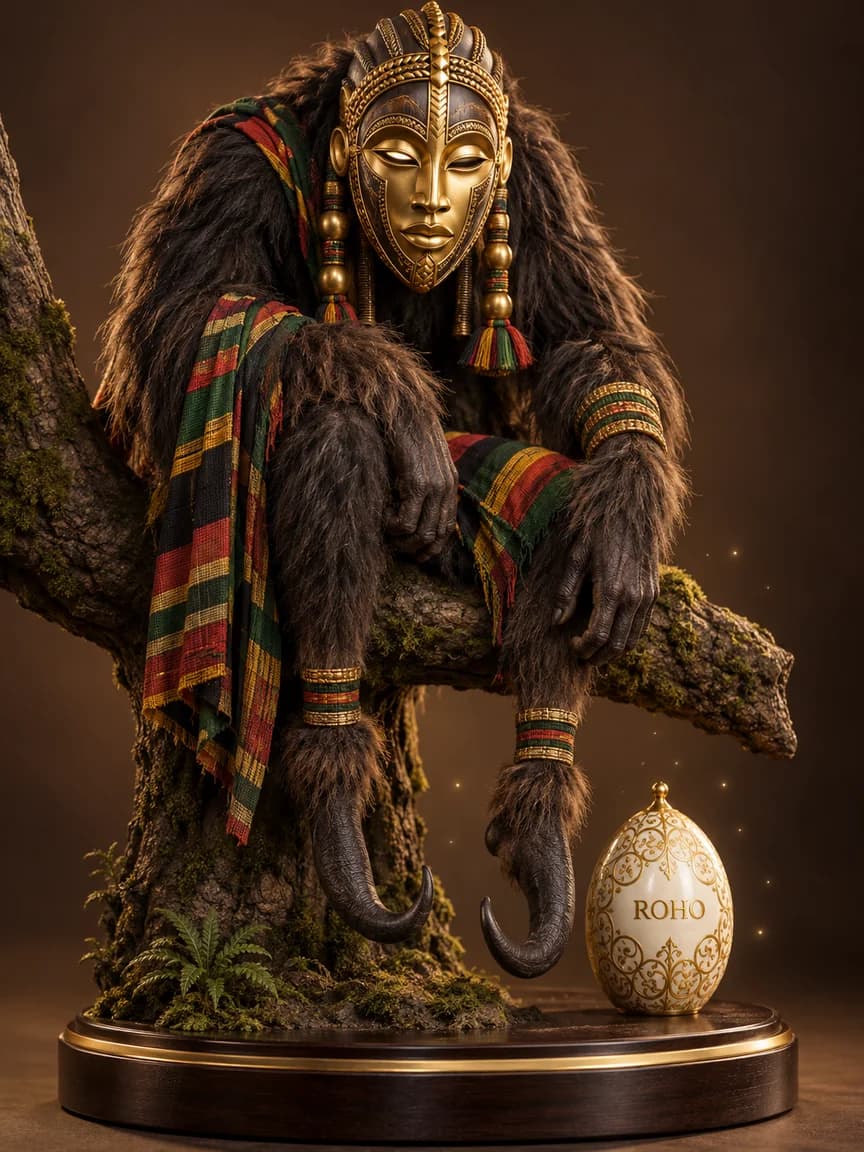
Asanbosam haunts the hunters' tales of the Akan, in Ghana and Côte d'Ivoire. The ethnographic literature uses the forms asanbosam, asasabonsam or sasabonsam to designate this family of creatures of the deep forest, with variants according to region and storyteller. R. S. Rattray described it as a monster with a hair-covered body, great bloodshot eyes and immense legs whose feet point both ways: seated on the high branches, it lets its legs hang down to snatch the careless who pass beneath. Popular tradition credits it with iron teeth and hooks, which for folklorists make it a figure close to the vampire. To cross its path in the forest is held to be a dire omen, and hunters out late at dusk tell of its apparitions. In the Akan representations of witchcraft, it is the ally of the sorcerers, the abayifo, and of the mmoatia, the little spirits of the forest, whose wild territory it shares. Its function in the imagination is clear: to embody the dangers of the bush against the ordered space of the village, and to deter anyone from going alone into the great forest. Its name remains alive in Ghana, where it still names the fear of the woods.
Powers & Attributes
Role in the ROHO universe
Blacksmith of the Cycle. ASANBOSAM transmutes matter through the sacred flame and keeps the tools of the thresholds. Bound to the Akan pantheon. Its alignment depends on the invoker's protocol.
Sacred Mask
An ancient ritual mask of sacred wood, old metal and black stone, engraved with symbols of vampire, embodiment of the power of Asanbosam
Era
Ancient cycle
Frequently asked questions
What is the asanbosam?
The asanbosam is a dreaded creature of Akan folklore, in Ghana and Côte d'Ivoire. A vampire-like ogre of the deep forest, it hangs from the branches of the great trees and seizes, with its hooked legs and iron teeth, the hunters and travellers who venture beneath it.
What is the difference between asanbosam and sasabonsam?
The two forms are variants of a single name: the ethnographic literature, including R. S. Rattray, uses mostly sasabonsam, while asanbosam is a common variant. Some storytellers and modern authors nevertheless make them two distinct creatures, one vampiric with iron teeth, the other a hairy forest monster, a sign of the great plasticity of the oral traditions.
Is the asanbosam linked to witchcraft?
Yes: in the Akan representations collected by R. S. Rattray and later Hans Debrunner, the monster is held to be the ally of the sorcerers, the abayifo, and of the mmoatia, the little spirits of the forest. Together they people the wild world of the bush, in opposition to the ordered space of the village, and embody the forces the rites seek to keep at bay.
Related spirits
Further reading
Sources and references
- R.S. Rattray, Religion and Art in Ashanti (1927)
- R.S. Rattray, Akan-Ashanti Folk-Tales (1930)
- Hans Werner Debrunner, Witchcraft in Ghana: A Study on the Belief in Destructive Witches and its Effect on the Akan Tribes (1959)