Ti Jean Petro: the one-legged lwa and his bond with Ezili Dantò
A small man in red at the top of a palm tree, a son who may also be a lover, and four explanations for one foot.
In Brooklyn, in the circle around the Vodou priestess Alourdes, people will tell you that several spirits are Ezili Dantò's lovers. Ogou gets named most often. But when the talk turns intimate and gossipy, wrote the anthropologist Karen McCarthy Brown, they point to someone else: Ti-Jan Petwo, her own son, as her favorite. So who is this spirit, the one the older books describe as a dwarf with one foot, living in the trees?
Who is Ti Jean Petro?
Ti Jean Petro is a lwa of Haitian Vodou, served in the Petro rite. Alfred Métraux calls him a tree-dwelling spirit represented as a dwarf with one foot. Maya Deren counts him among the major Petro divinities, the son of Dan Petro and the husband of Marinette.
The name simply means Little John, and Métraux flags the point: a lwa with a French name, rechristened, whose roots he traces to spirits of the African bush and whose appearance, he says, changed in Haiti. You will also see him as Jean Petro, and in the Creole spelling that the search engines keep offering you: Ti Jean Petwo, or Ti-Jan Petwo in Brown's book.
Ti Jean Petro, Petwo, Pied Sec: one spirit or several?
Authors don't agree. Some treat these as names of one lwa, while Métraux and Milo Rigaud list several Ti Jeans. Métraux's Ti-Jean-pied-sec, also Ti-Jean-pied-fin and Prince Zandor, is a little man dressed in red who jumps about on one leg and perches on the tops of palm trees, keeping an eye on the roads. Pye chèch, the Creole form of pied sec, means dry foot. The safest habit is to say who is speaking.
| Name | Found in | What's said |
|---|---|---|
| Ti-Jean Petro | Métraux, Deren | Tree spirit with one foot; son of Dan Petro in Deren |
| Ti-Jean-pied-sec, pied-fin, Prince Zandor | Métraux | Little man in red, one leg, top of the palm trees |
| Ti Jean Pied-chèche, Pye Chèch | Rigaud, Métraux | Listed by Métraux among the lwa he calls evil |
| Ti-Jean Dantò | Métraux, Cosentino | Linked to Ezili Dantò; a Petwo trickster |
| Ti-Jan Petwo | Brown | Ezili Dantò's son and, in gossip, her favorite lover |
Why does Ti Jean Petro have one leg?
Nobody has the one answer. These are the four readings we could check in the texts themselves.
- ◆A bush spirit. Métraux derives him from African bush spirits described as having only one leg, and compares him to the Joazinho of Brazilian folklore.
- ◆A serpent riddle. Deren notes that he is said to have one foot, or perhaps no feet at all, and yet climbs trees the moment he appears. What has no feet and always climbs trees? A snake. She reads this as an echo of Damballah.
- ◆A Kongo inheritance. Luc de Heusch points out that in Kongo tradition dwarfs and people with crooked feet hold a ritual rank among the nkita, the nature spirits. For him, Ti Jean the Lame is a Creole spirit who bears their mark, as does his wife Marinette.
- ◆A saint's picture. One informant quoted in Sacred Arts of Haitian Vodou recognizes him in an image of the young Saint John the Baptist, seated, his legs apparently missing: a little man with no feet, or one foot. Another informant sees a Rada lwa there instead.
The readings can sit side by side, and none stops at the missing leg: each asks what his body means. Poets have taken him up too. In a text reprinted by Laënnec Hurbon, the Haitian poet René Depestre speaks as Ti-Jean Sandor, the dry-footed Ti Jean perched on a palm, to exorcise his hatred of the American occupier and the colonial slaveowner.
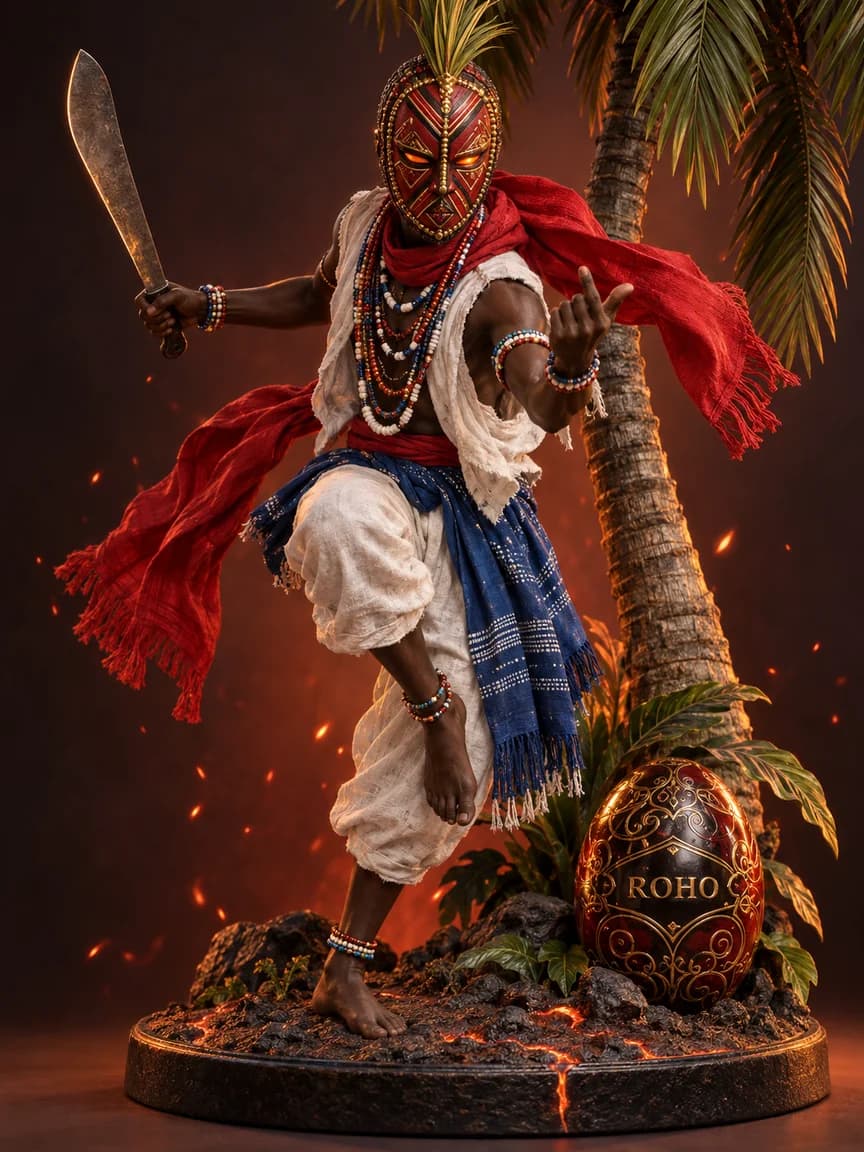
Ti Jean Petro and Ezili Dantò: son, lover, or both?
It depends on the house and the writer. Brown's account in Mama Lola is the one quoted above, and she is careful about how it circulates: as gossip, within one Haitian community in New York. She adds that Dantò has married none of the spirits who are her partners, and that raising her children alone is central to who she is. For more on her, see the Erzulie Dantor entry.
« Ogou is the one mentioned most frequently as her lover. But when people are talking in an intimate, gossipy way, they point to Ti-Jan Petwo (her own son) as her favorite lover. Karen McCarthy Brown, Mama Lola »
Note the word Brown chooses: gossip. She is not reporting doctrine, she is reporting what gets whispered in one Brooklyn house. And no other source we read makes Ti Jean Dantò's lover. Her son, yes, that turns up elsewhere. Her lover, no: it is juicy, but it is a rumour.
In Sacred Arts of Haitian Vodou, a devotee says simply that she has a son named Ti-Jean Dantò, and the glossary calls him a Petwo trickster linked with her. Deren, on the other hand, makes him Dan Petro's son and Marinette's husband, while Métraux adds that Marinette is also the mistress of Petro-é-rouge. There is no single official family tree. There are families of spirits, told differently from place to place.
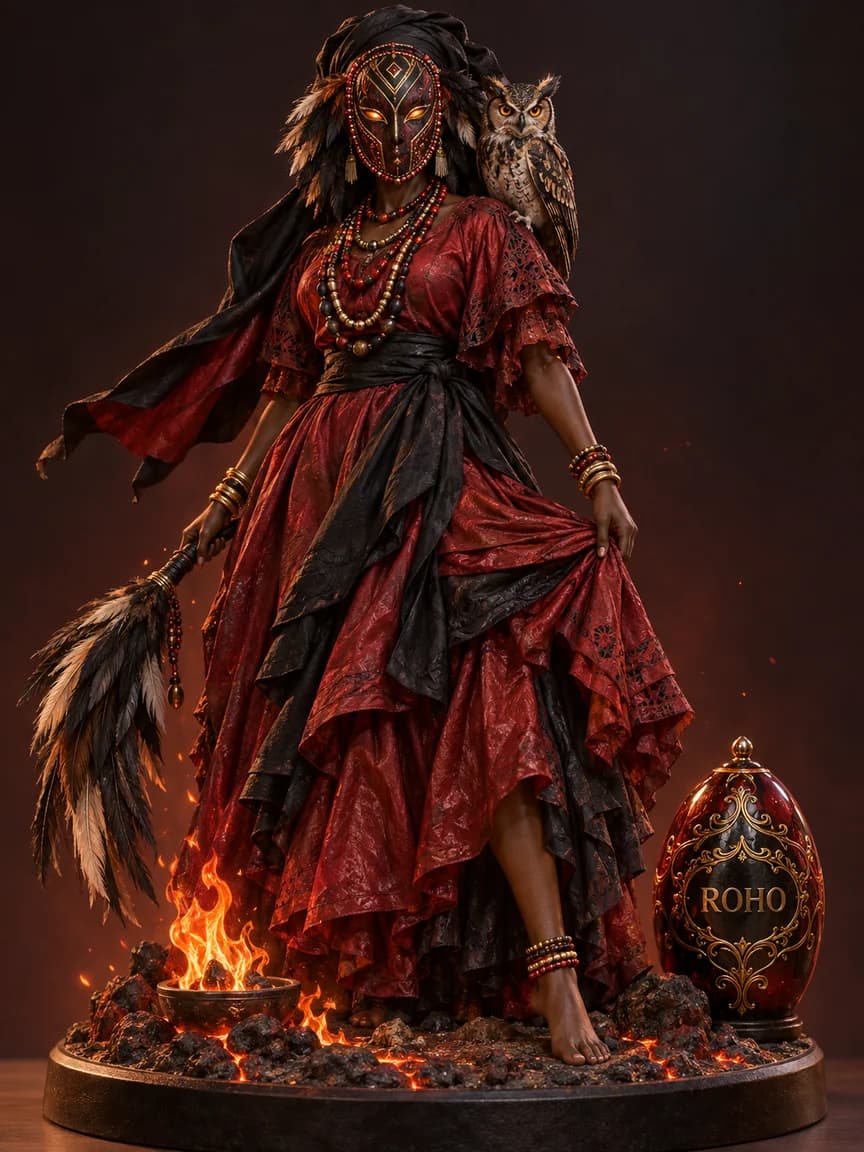
What is the Petro rite?
Petro, or Petwo, is the hot side of Haitian Vodou. Brown describes its spirits as hot-tempered and volatile, to be handled with care and precision: debts must be paid and promises kept. Their power lies in making things happen, and theirs, she writes, is the iconography of slavery. The earliest account we have, from Moreau de Saint-Méry, reports a dance in Petit-Goâve in 1768, similar to Vodou but with faster movements, tied to a man called Dom Pedro. Historians still argue over who he was.
Stories about Ti Jean can sound frightening. Métraux writes that the little man jumps on passers-by to eat them, lists him among the lwa he calls evil and says he protects sorcerers. Read that for what it is: a record of fear, set down by one ethnographer at one moment. Deren is plain on the larger point. Petro, she writes, is not "an evil cult as opposed to the good Rada". You will find the same heat in Danbala La Flambo and Mèt Kalfou.
Is he the Ti-Jean of Caribbean folktales?
Readers from the Caribbean may know another Ti-Jean: the small hero who outsmarts the Devil in the St Lucian folktale behind Derek Walcott's play Ti-Jean and His Brothers, or the hero of Simone Schwarz-Bart's Guadeloupean novel Ti Jean L'horizon. Same name. No source we read connects that hero with the lwa, so we keep them apart.
This article describes a living religion, practised today in Haiti and its diaspora. Lwa are served within an ounfò, under the guidance of an oungan or a mambo, and names, stories and family ties vary from one house to another.
Explore more lwa on the Haitian Vodou page, among the 389 spirits of the Codex.
Sources
- ◆Alfred Métraux, Voodoo in Haiti, translated by Hugo Charteris, 1959, especially pp. 88 and 118 (first published as Le Vaudou haïtien, Gallimard, 1958).
- ◆Maya Deren, Divine Horsemen: The Living Gods of Haiti, Thames & Hudson, 1953.
- ◆Karen McCarthy Brown, Mama Lola: A Vodou Priestess in Brooklyn, University of California Press, 1991.
- ◆Donald J. Cosentino (ed.), Sacred Arts of Haitian Vodou, UCLA Fowler Museum of Cultural History, 1995.
- ◆Luc de Heusch, "Kongo in Haiti: A New Approach to Religious Syncretism", Man, 1989; reprinted in Darién J. Davis (ed.), Slavery and Beyond, 1995.
- ◆Laënnec Hurbon, Voodoo: Search for the Spirit, 1995.
- ◆Milo Rigaud, La Tradition voudoo et le voudoo haïtien, Niclaus, 1953.
- ◆Moreau de Saint-Méry, Description topographique de la partie française de l'isle Saint-Domingue, 1797-1798, excerpt at Religion and Slavery, from David Geggus (ed.), The Haitian Revolution: A Documentary History, Hackett, 2014.
Questions fréquentes
Who is Ti Jean Petro in Haitian Vodou?
Ti Jean Petro, also written Ti Jean Petwo or Ti-Jan Petwo, is a lwa of the Petro rite. Alfred Métraux describes a tree-dwelling spirit represented as a dwarf with one foot, and Maya Deren calls him the son of Dan Petro and the husband of Marinette.
Why does Ti Jean Petro have one leg?
Writers offer several readings: descent from African bush spirits described with one leg (Métraux), a riddle pointing to the footless, tree-climbing serpent (Deren), and the ritual rank of dwarfs and the lame among Kongo nkita spirits (de Heusch). None is an official explanation.
Is Ti Jean Petro the son or the lover of Ezili Dantò?
Her son, according to several sources, including Karen McCarthy Brown and Sacred Arts of Haitian Vodou. Her lover only in the gossip Brown heard around the priestess Alourdes in Brooklyn, which she presents as gossip: no other source we read says so. Other writers make him the son of Dan Petro and the husband of Marinette.
Is Ti Jean Petro evil?
He has a fearsome reputation, and Alfred Métraux lists him among the lwa he calls evil. But the Petro rite is not a cult of evil: Maya Deren rejects the idea of an evil Petro set against a good Rada, and Karen McCarthy Brown describes volatile spirits who must be served with care.