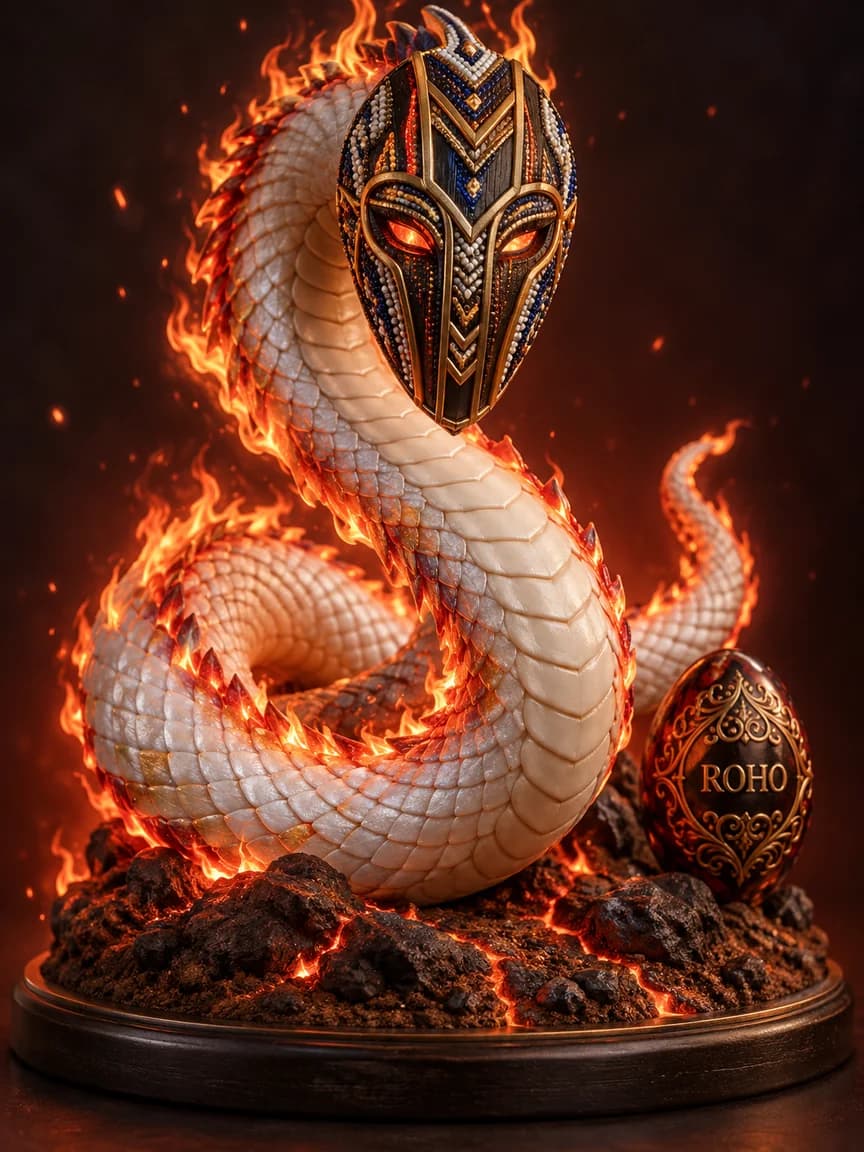
Danbala La Flambo
neutralSerpent of fire, Petro force
Danbala La Flambo is the Petro face of Damballa Wedo, the primordial serpent of Haitian Vodou. The principle is common in the cult: a single lwa can be served in the Rada rite, in its gentle form, and in the Petro rite, in its hot form, without there being two distinct spirits. The Rada Damballa is the white serpent that glides in silence, associated with water, wisdom and the patience of origins. La Flambo is that same serpent when it becomes fire: the creative power that no longer waits. He is served in circumstances where slowness is no longer a virtue. His servants mark the difference through colours, offerings and the rhythm of the drums, and one does not pass from one form to the other without knowing it. This duality sheds more light than anything else on what Vodou means by rite: not two religions or two camps, but two temperatures of a single force.
Powers & Attributes
Role in the ROHO universe
Bound to one of the five elements of the cosmic balance. Its power springs from the energy proper to its tradition, and from no other.
Sacred Mask
A mask carved of ancient energy, a symbol of the cosmic force proper to its pantheon.
Era
1500 to 1900: Cycle of the Rebels
Words of the Spirit
“The same serpent that holds up the sky can burn the hand that grasps it wrongly.”
Frequently asked questions
Who is Danbala La Flambo?
Danbala La Flambo is the Petro face of Damballa Wedo, the primordial serpent. It is the same lwa served in its hot form: the creative power that no longer waits, where the Rada Damballa is patience and silence.
Can the same lwa be both Rada and Petro?
Yes, and it is common in Haitian Vodou. A single spirit can be served in its gentle form in the Rada rite and in its hot form in the Petro rite. Colours, offerings and the rhythm of the drums mark the difference.
Related spirits
Further reading
Sources and references
- Maya Deren, Divine Horsemen: The Living Gods of Haiti (1953)
- Alfred Métraux, Le Vaudou haïtien (1958)
- Leslie G. Desmangles, The Faces of the Gods: Vodou and Roman Catholicism in Haiti (1992)