Baron La Croix: who is the Baron of the cross in Haitian Vodou?
A name that is also a place, three Barons nobody can quite count, and crosses that would not burn.
"Do you really think you can get rid of us like this? All you are burning is wood. Us, you will never burn." The words came from women in trance, standing before a great heap of crosses about to be set on fire. The people lighting it knew that Haitian peasants saw those crosses as the symbol of Baron Samdi, King of the Dead. The anthropologist Alfred Métraux, who records the scene, names the spirits who spoke that day: Baron Samdi, Baron La Croix and other members of the Gede family. You may have searched for that second name, Baron La Croix or Baron Lacroix. Here is who he is, and why the books cannot always tell him apart from Baron Samdi.
Who is Baron La Croix?
Baron La Croix is a lwa of Haitian Vodou, one of the Barons of the Gede, the family of the spirits of the dead. With Baron Samdi and Baron Cimetière, he rules the cemetery and the passage from the living to the dead. His name says what he is: the Baron of the cross, the one that stands in every Haitian cemetery.
You will find several spellings: Baron-la-Croix in Métraux, Baron La Croix in Maya Deren, Baron Lacroix elsewhere. In Haitian Creole the cross is lakwa, and the name is written Bawon Lakwa. Deren also knows him as Azagon La Croix, from azadón, a Spanish word she glosses as spade or digger.
One Baron or three?
That is the question everyone asks, and the writers do not answer it the same way. Métraux, who did fieldwork in Haiti in the 1940s and 1950s, admits his doubt:
« The 'barons' form a sort of triad, so closely united it is difficult to say whether they are three distinct spirits or three aspects of the same spirit. Alfred Métraux, Voodoo in Haiti, 1959 »
Maya Deren, in 1953, makes Baron La Croix another name for Baron Cimetière, brother to Ghede and Samdi. The Haitian scholar Laënnec Hurbon folds all three into one spirit: "Baron Samdi, also called Baron Cimetière or Baron La Croix, is the leader of the Gede." The Haitian writer Déita, in La Légende des Loa (1993), pulls them apart again. In her account each of the dead has a place: the first man buried in a cemetery becomes Baron Samdi, the first woman Grande Brigitte, the second man Baron Cimetière, the third Baron La Croix.
| Source | What it says about the Barons |
|---|---|
| Maya Deren, 1953 | Baron La Croix is also Baron Cimetière; also called Azagon La Croix |
| Alfred Métraux, 1958 | A triad: three spirits, or three aspects of one, he will not decide |
| Laënnec Hurbon, 1993 | One spirit: Baron Samdi, also called Baron Cimetière or Baron La Croix |
| Déita, 1993 | Three distinct Barons: Samdi the first man buried, Cimetière the second, La Croix the third |
These versions don't cancel each other out. Métraux, a Swiss ethnographer, and Deren, an American filmmaker, were looking in from outside; Hurbon and Déita are Haitian. And in Vodou each house has its own way of naming and serving its lwa. The fairest habit is to say who is speaking. If you like that kind of puzzle, read how the books disagree about Ti Jean Petro.
Why "La Croix"?
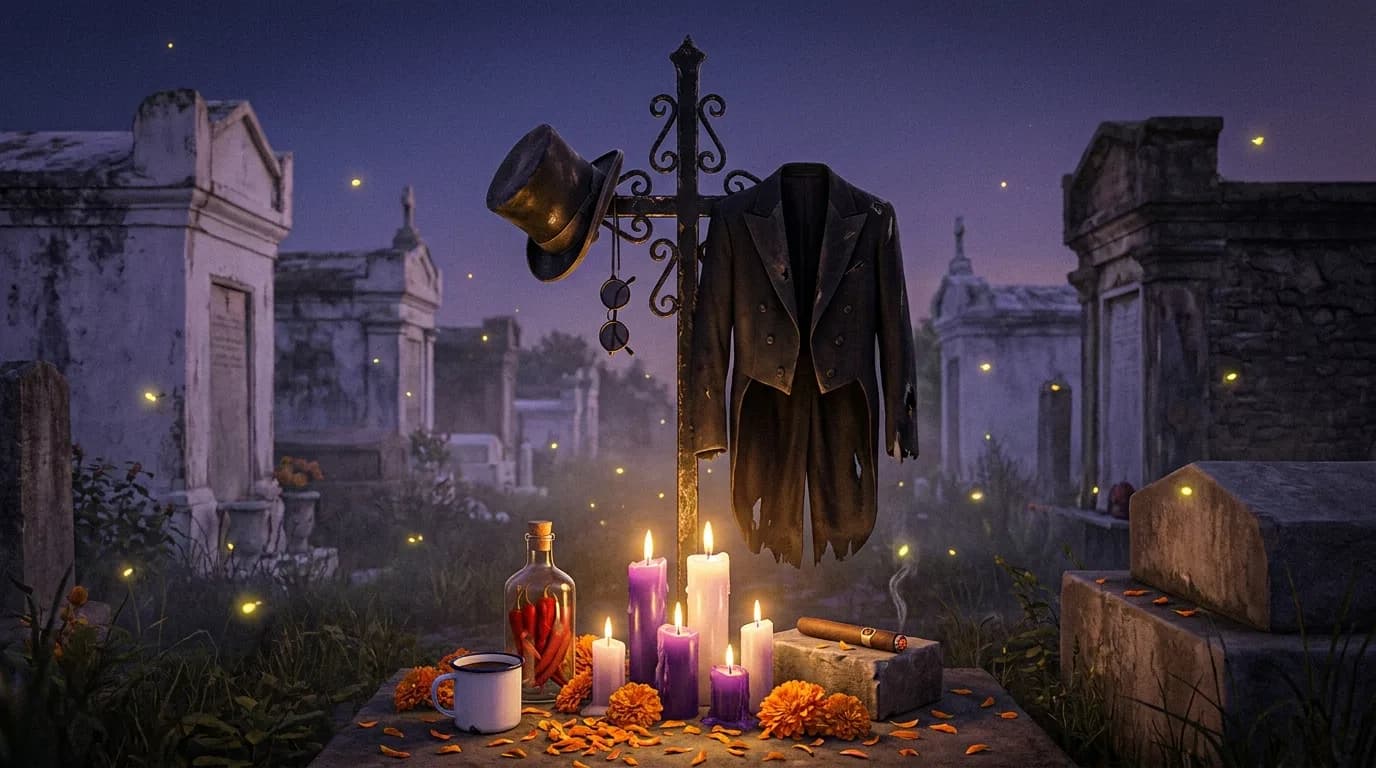
Because the cross is the Barons' home. Karen McCarthy Brown describes the rural Haitian cemetery this way:
« In the cemetery, at a point where two paths intersect, the kwa Baron (Baron Samdi's cross) is located. Karen McCarthy Brown, Mama Lola, 1991 »
With the grave of the first man buried there, that cross is the focus of cemetery rituals: coffee and rum are poured at its foot, bread and cassava left beside it. In shrines, Métraux notes, Baron's emblem is a black cross standing on a false tomb. Déita completes the picture: a tomb with three steps in the temple yard, Samdi's cross in the middle, Baron Cimetière on one side and Baron La Croix on the other.
That cross is hard to get rid of. In Port-au-Prince, Brown tells how a large cement cross, put up by the Catholic Church to mark the burial ground of priests and nuns, was being used as the kwa Baron. Church officials fenced it off, people climbed over and broke down each new fence, and in the end the Church demolished the cross. Another one, a little further away, took over its role. All you are burning is wood, as the spirits said in Métraux's account.
Brown also gives a name one Gede gave himself in Brooklyn, among a string of others: Ti Malis Kache Bo Lakwa, Little Mischief Hidden Near the Cross. The cross, lakwa, runs right through the family of the dead.
The Baron who takes rude children away
In La Légende des Loa, Déita lets the lwa speak in the first person, somewhere between visits to temples and a writer's storytelling. Her Baron Samdi quotes a song: "Children who show no respect to their elders, Baron, lead them to the cemetery." That leading Baron, he adds, is La Croix: he is the one who teaches them the lesson. The same passage quotes a Creole proverb that can be translated like this: the cheeky child walks with his coffin under his arm.
Déita doesn't make him a sage, either. In another story, Baron La Croix tries to take the gros bon ange, one of a person's souls, from a servant of Baron Samdi to sell to a bokor in Miragoâne. Samdi resists, the dead on both sides get ready to fight, and Guédé Jean-Simon settles the matter against La Croix, who has to apologise to Samdi, his chief. That is one author's story, not doctrine. But it shows a Baron with a temper, and a family of the dead that quarrels like a family of the living.
Elegant and philosophical? What we could not find
Online you will often read that Baron La Croix is the most elegant and philosophical of the Barons, the one who looks at death with detachment. You will also read that his day is Monday, that he takes two coffees or rum steeped with twenty-one peppers, and that he matches Saint Expeditus. We found none of these traits in Métraux, Deren, Hurbon, Brown or Déita. They may come from particular houses or from recent books; without a source, we don't present them as settled.
What is certain is what he shares with the whole family: the cemetery, the cross, Fèt Gede on 1 and 2 November, and the raw humour that refuses to give death the last word.
Baron La Croix in literature
The name made it into fiction. Alejo Carpentier slips it into The Kingdom of This World (1949), his novel of colonial Saint-Domingue in the time of Mackandal: objects are laid out in the shape of a cross to keep away Baron Samdi, Baron Piquant, Baron La Croix and the other masters of the cemeteries.
In 1974 the Haitian playwright Franck Fouché published Général Baron-la-Croix ou le Silence masqué in Montreal, a "modern tragedy in 2 calvaries, 28 stations and a mass in black and red". It was staged at Avignon. Hurbon reprints an extract under the heading "Baron-la-Croix and the Dictator", and reads in it a clear allusion to bloody events. No accident: François Duvalier liked to appear in a black suit and dark glasses, mimicking Baron Samdi, as Karen McCarthy Brown recalls.
This article describes a living religion, practised today in Haiti and its diaspora. Lwa are served within an ounfò, under the guidance of an oungan or a mambo, and names, stories and offerings vary from one house to another.
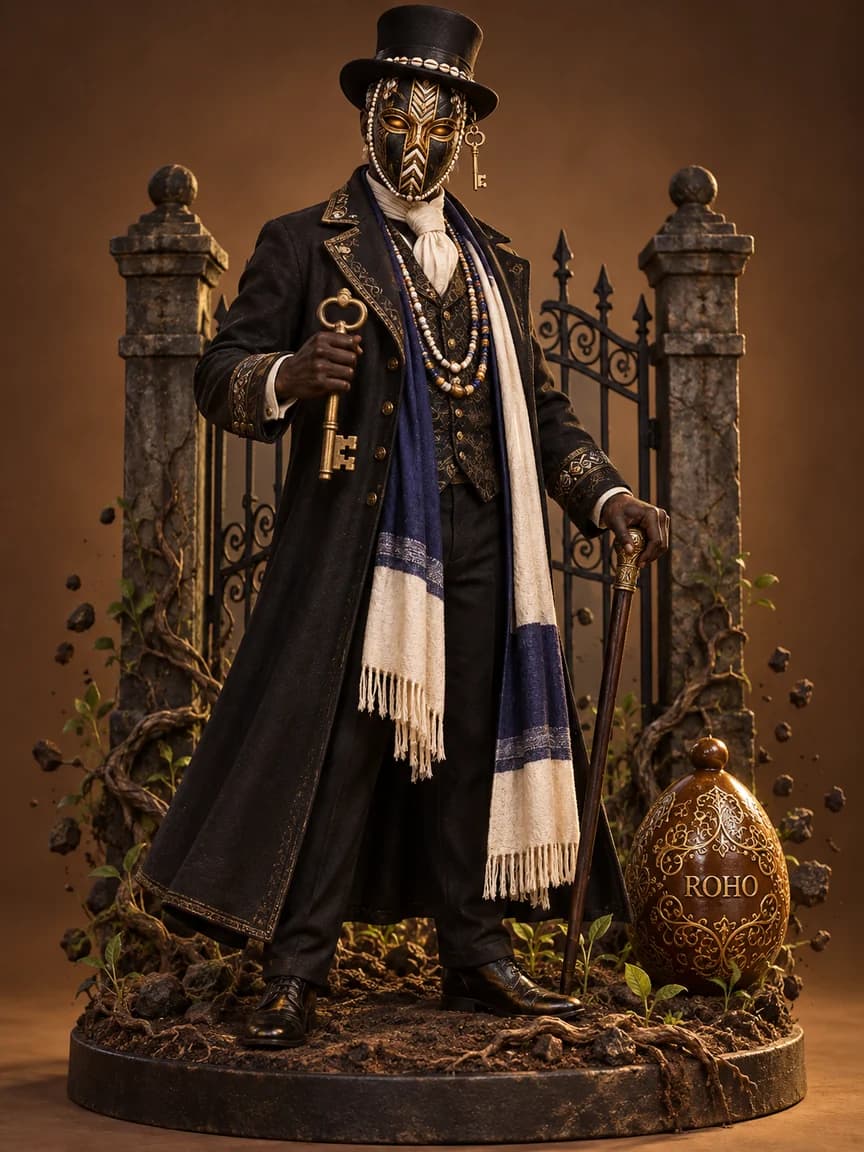
Baron La Croix is not a character in Ebandeli, the first volume of the fantasy saga La Légende de ROHO, and neither are the other Gede. We asked Loudvic Salcède, who is writing the saga, whether they will ever have a place in it.
« For now they are not in the first volume, but they will be in the saga, that's for sure. Loudvic Salcède, translated from French »
Go further
Until then, Baron La Croix lives in the Kunda Codex, alongside Baron Samdi, Baron Cimetière, Maman Brigitte, Guédé Nibo and Brav Gede, among the Codex's 389 spirits. More lwa are waiting on the Haitian Vodou page.
The book is in French for now, and its premise is simple enough: "The last Guardian is an old man at the end of his watch." A curse returns the spirits to infancy, and "He has to return each mask to a spirit who is now a child." Find it on the book page.
Sources
- ◆Maya Deren, Divine Horsemen: The Living Gods of Haiti, Thames & Hudson, 1953.
- ◆Alfred Métraux, Voodoo in Haiti, translated by Hugo Charteris, 1959, especially p. 114 (first published as Le Vaudou haïtien, Gallimard, 1958).
- ◆Milo Rigaud, La Tradition voudoo et le voudoo haïtien, Niclaus, 1953.
- ◆Karen McCarthy Brown, Mama Lola: A Vodou Priestess in Brooklyn, University of California Press, 1991.
- ◆Laënnec Hurbon, Voodoo: Search for the Spirit, 1995 (first published as Les Mystères du vaudou, Gallimard, 1993).
- ◆Déita (Mercédès Foucard Guignard), La Légende des Loa du vodou haïtien, 1993.
- ◆Alejo Carpentier, El reino de este mundo, 1949; in English, The Kingdom of This World.
- ◆Franck Fouché, Général Baron-la-Croix ou le Silence masqué, Leméac, 1974.
Questions fréquentes
Who is Baron La Croix in Haitian Vodou?
Baron La Croix, Bawon Lakwa in Haitian Creole, is a lwa of the Gede, the family of the spirits of the dead. With Baron Samdi and Baron Cimetière he forms the group of Barons who rule the cemetery. His name refers to the Baron's cross that stands in every Haitian cemetery.
Are Baron La Croix and Baron Samdi the same spirit?
The sources disagree. Alfred Métraux describes a triad so closely united that he cannot say whether it is three spirits or three aspects of one. Laënnec Hurbon makes La Croix another name for Baron Samdi, Maya Deren another name for Baron Cimetière, and the Haitian writer Déita treats them as three distinct Barons.
Why is he called La Croix?
Because of the kwa Baron, the Baron's cross, which stands in Haitian cemeteries, often where two paths cross. It is the focus of cemetery rituals, and in shrines Baron's emblem is a black cross on a false tomb.
Is it Baron La Croix or Baron Lacroix?
Both spellings are used, as is Baron-la-Croix in Alfred Métraux. In Haitian Creole the name is written Bawon Lakwa, lakwa meaning the cross. Maya Deren also calls him Azagon La Croix.