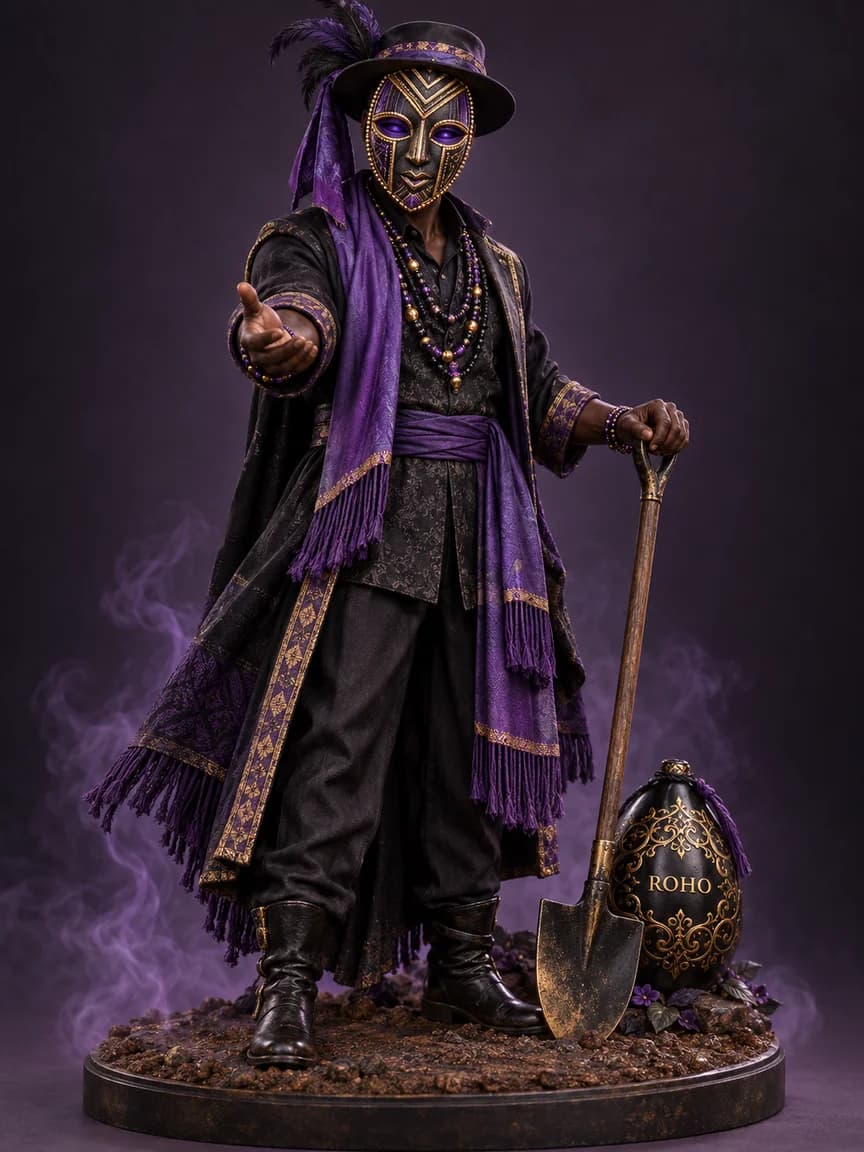
Brav Gede
neutralFirst of the dead, memory of the departed
Brav Gede holds a singular place among the lwa of the dead in Haitian Vodou. Tradition holds that the first person buried in a cemetery becomes its guardian, and Brav is the name given to this role as much as to the spirit who fills it. He is therefore not a lwa who came from Africa but a figure born of Haitian soil itself, which sets him apart from the great spirits of the Rada rite. Like all the Gede, he appears in black and purple, he jokes, he drinks clairin steeped with hot peppers and he practises an obscenity that makes the gathering laugh. This laughter is not irreverence: in Vodou, mockery is the right way to approach death, because it puts death in its place and refuses to let it alone decide what is serious. Brav is invoked at funerals and during the festival of the dead, in November, when the Gede take over the cemeteries and the streets.
Powers & Attributes
Role in the ROHO universe
Bound to one of the five elements of the cosmic balance. Its power springs from the energy proper to its tradition, and from no other.
Sacred Mask
A mask carved of ancient energy, a symbol of the cosmic force proper to its pantheon.
Era
1700 to 1900: Cycle of the Joyful Death
Words of the Spirit
“The first to arrive keeps the door for all who will follow.”
Frequently asked questions
Who is Brav Gede?
Brav Gede embodies the first of the dead buried in a cemetery, who became its guardian. He is a figure born of Haitian soil, not a lwa who came from Africa, which sets him apart from the great spirits of the Rada rite.
Why do the Gede make people laugh?
Because in Vodou mockery is the right way to approach death: it puts death in its place and refuses to let it alone decide what is serious. The obscenity of the Gede is not irreverence but a philosophical stance.
Related spirits
Further reading
Sources and references
- Maya Deren, Divine Horsemen: The Living Gods of Haiti (1953)
- Alfred Métraux, Le Vaudou haïtien (1958)
- Karen McCarthy Brown, Mama Lola: A Vodou Priestess in Brooklyn (1991)