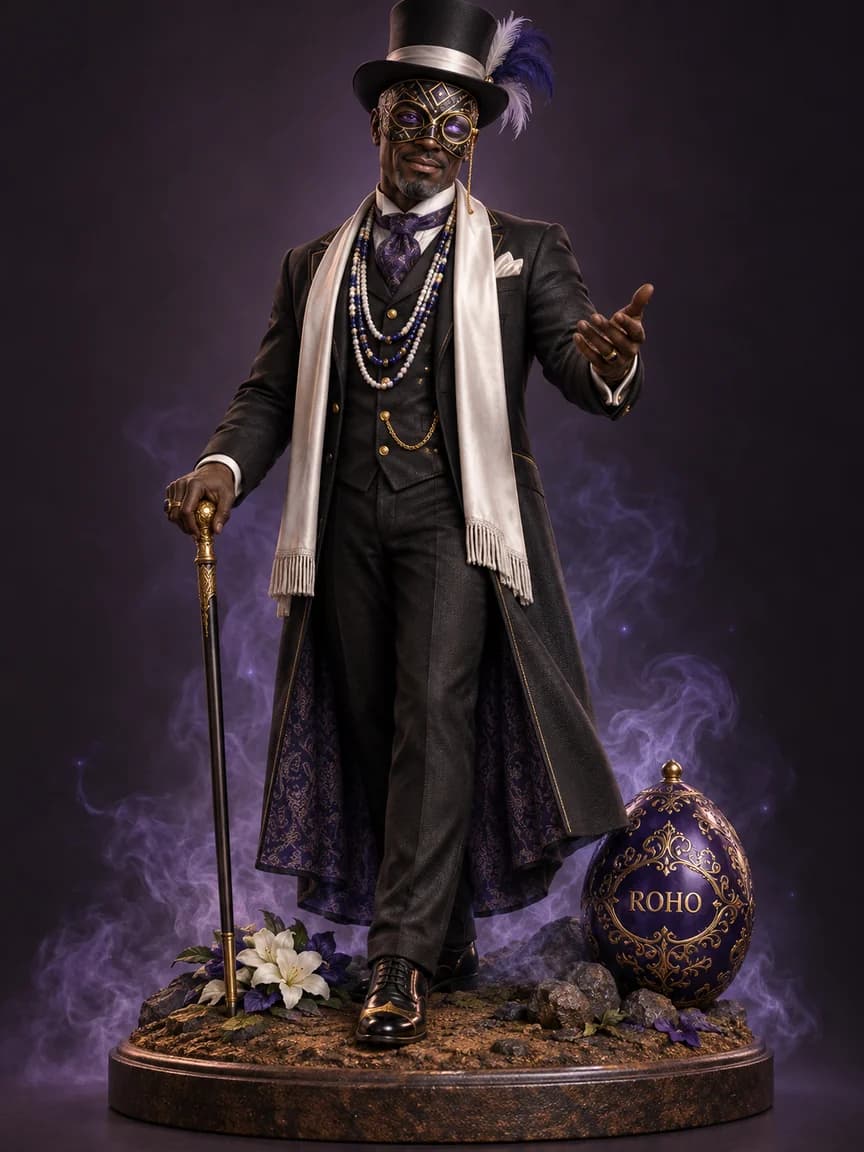
Baron La Croix
neutralDeath, elegance, philosophy
Baron La Croix is one of the three Barons of Haitian Vodou, alongside Baron Samdi and Baron Cimetière. The three share authority over death and differ in manner: where Samdi is boisterous and Cimetière a guardian, La Croix is the most elegant and the most detached. He is represented in a black suit, top hat and glasses, with a displayed distinction, and he is credited with a philosophical relationship to death. He is neither frightened nor saddened by it: he considers it. This detachment makes him the lwa invoked to accept the inevitable rather than to push it back. Like all the Gede, he practises mockery and obscenity, but with a drier irony than his brothers. His cross marks both the grave and the crossroads, and that is no accident: in Vodou thought, dying is a passage, and every passage is a crossing. He is served at the cemetery, mainly in November.
Powers & Attributes
Role in the ROHO universe
Bound to one of the five elements of the cosmic balance. Its power springs from the energy proper to its tradition, and from no other.
Sacred Mask
A mask carved of ancient energy, a symbol of the cosmic force proper to its pantheon.
Era
1700 to 1900: Cycle of the Joyful Death
Words of the Spirit
“To laugh at death is to refuse to let it alone decide what is serious.”
Frequently asked questions
Who is Baron La Croix?
Baron La Croix is one of the three Barons of Haitian Vodou, with Baron Samdi and Baron Cimetière. The most elegant and detached, he holds a philosophical relationship to death: he is not frightened by it, he considers it.
What is the difference between the three Barons?
They share authority over death and differ in manner. Samdi is boisterous and loud, Cimetière guards the place and the graves, La Croix is the most elegant, the one of detachment and dry irony.
Related spirits
Further reading
Sources and references
- Maya Deren, Divine Horsemen: The Living Gods of Haiti (1953)
- Alfred Métraux, Le Vaudou haïtien (1958)
- Leslie G. Desmangles, The Faces of the Gods: Vodou and Roman Catholicism in Haiti (1992)