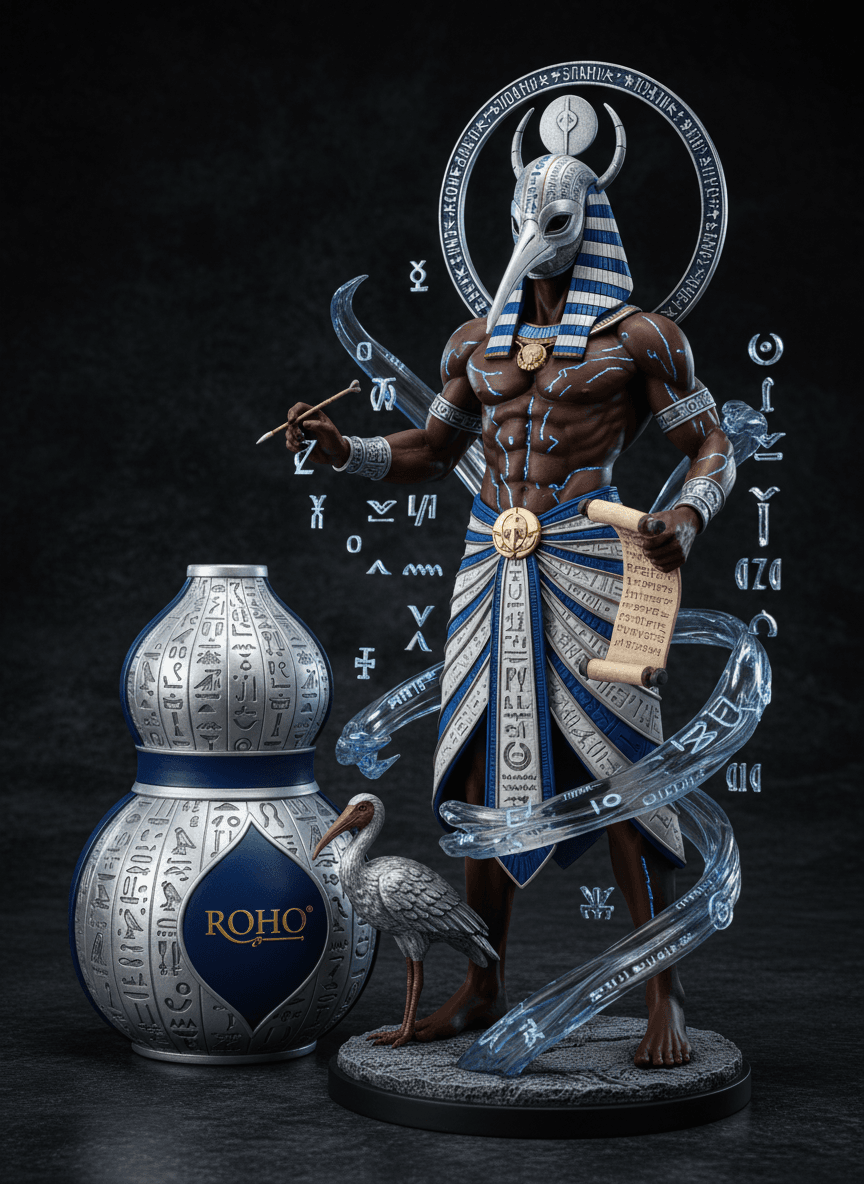
Thot
allyKnowledge, writing, magic
Thoth is the god of writing, of knowledge and of the moon in ancient Egypt, the African civilisation of the Nile valley. His great cult centre is Hermopolis, in Middle Egypt, ancient Khemenu, where he presides over the Ogdoad of the eight primordial deities. He is represented as a man with an ibis's head, often holding the scribe's palette, or in the form of a baboon. Scribe and messenger of the gods, he is held to be the inventor of the hieroglyphs, called divine words, and the patron of scribes, archives and libraries. Master of calculation and of the calendar, he measures time and regulates the cycles of the moon, of which he is one of the principal deities. In the Osirian myth, he assists Isis with his magic and heals the wounded eye of Horus, the udjat. At the weighing of the heart, he records the verdict before the tribunal of Osiris, beside Anubis and Maat, of whom he is sometimes presented as the husband. At Hermopolis and in the neighbouring necropolis of Tuna el-Gebel, thousands of mummified ibises and baboons were consecrated to him. In the Graeco-Roman period, his assimilation to Hermes gave birth to the figure of Hermes Trismegistus, legendary ancestor of the hermetic literature.
Powers & Attributes
Role in the ROHO universe
A fragment of Onionkupón's Breath, bound to one of the five elements of the cosmic balance.
Sacred Mask
A mask carved of ancient energy: a symbol of the cosmic force proper to its pantheon.
Era
3,000 to 1,000 BCE: Cycle of Elemental Powers
Spiritual Lesson
To understand the nature of one's own balance and the wisdom hidden behind every trial.
Words of the Spirit
“The spirit crosses what the body cannot.”
Frequently asked questions
Who is Thoth?
Thoth is the god of writing, of knowledge and of the moon in ancient Egypt. Scribe and messenger of the gods, reputed inventor of the hieroglyphs, he is the patron of scribes, archives and the sciences of calculation and the calendar. He is represented as a man with an ibis's head or as a baboon, and his great cult centre is Hermopolis, in Middle Egypt.
Why is Thoth represented with an ibis's head?
The ibis and the baboon are Thoth's two sacred animals. The long curved beak of the ibis evokes the crescent moon, the heavenly body of which Thoth is one of the masters, and perhaps the scribe's reed pen. Thousands of mummified ibises and baboons, offered by pilgrims, have been found in the galleries of Tuna el-Gebel, near Hermopolis, testifying to the fervour of his cult.
What is the link between Thoth and Hermes Trismegistus?
In the Graeco-Roman period, the Greeks identified Thoth with their god Hermes, divine messenger and patron of knowledge. From this assimilation was born Hermes Trismegistus, the thrice-greatest, a legendary figure credited with the hermetic literature, a corpus of philosophical and esoteric treatises written in Greek. Thoth thus became, for posterity, a universal symbol of Egyptian wisdom.
Related spirits
Further reading
Sources and references
- Richard H. Wilkinson, The Complete Gods and Goddesses of Ancient Egypt (2003)
- Patrick Boylan, Thoth, the Hermes of Egypt (1922)
- Erik Hornung, Conceptions of God in Ancient Egypt: The One and the Many (1982)