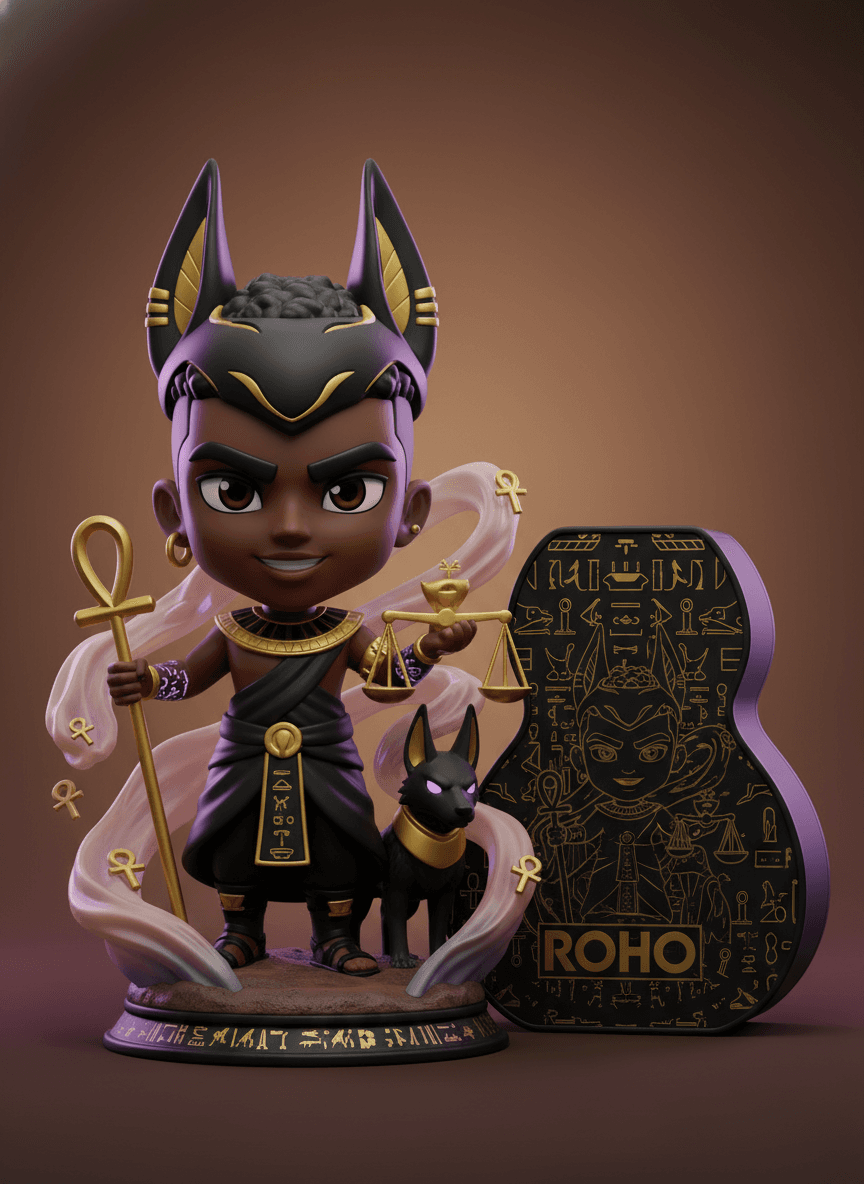
Anubis
allyEmbalming, passage of souls
Anubis is the god of mummification and of the necropolises in ancient Egypt, the African civilisation of the Nile valley. Attested from the Pyramid Texts of the Old Kingdom, he counts among the most ancient Egyptian funerary deities. His cult centres lay mainly in Middle Egypt, notably at Cynopolis, the city of the dog of the Greeks, and he was honoured in every necropolis of the land. He is represented as a black canid lying upon funerary chapels or as a man with a jackal's head. The black of his coat is not naturalistic: it evokes the fertile silt of the Nile and rebirth. His epithets designate him as He who is upon his mountain and Lord of the sacred land. In the Osirian myth, Anubis embalms the body of Osiris and thus invents mummification. Guide of the dead, he leads the deceased before the tribunal of Osiris and oversees the weighing of the heart against the feather of Maat, the central scene of the Book of the Dead, where Thoth records the verdict. In the Graeco-Roman period he merges with Hermes under the name Hermanubis. Anubis remains today one of the most recognisable figures of the ancient African mythologies.
Powers & Attributes
Role in the ROHO universe
A fragment of Onionkupón's Breath, bound to one of the five elements of the cosmic balance.
Sacred Mask
A mask carved of ancient energy: a symbol of the cosmic force proper to its pantheon.
Era
3,000 to 1,000 BCE: Cycle of Elemental Powers
Spiritual Lesson
To understand the nature of one's own balance and the wisdom hidden behind every trial.
Words of the Spirit
“The spirit crosses what the body cannot.”
Frequently asked questions
Who is Anubis?
Anubis is the god of mummification and of the necropolises in ancient Egypt, represented as a man with a black jackal's head or as a recumbent canid. Guardian of the dead, he presides over embalming, guides the deceased and watches over the weighing of the heart before the tribunal of Osiris. His cult is attested from the Old Kingdom, in the Pyramid Texts.
Why does Anubis have a jackal's head?
Canids prowled around Egyptian cemeteries and threatened the graves. By deifying the jackal, the Egyptians turned this danger into a protector of tombs. Anubis's black colour does not imitate the animal's real coat: it symbolises the fertile silt of the Nile and the rebirth promised to the deceased, black being in Egypt the colour of regeneration.
What role does Anubis play in the weighing of the heart?
In chapter 125 of the Book of the Dead, Anubis leads the deceased into the hall of judgement and oversees the scales where the heart is weighed against the feather of Maat, symbol of justice. Thoth records the result. If the heart is heavier than the feather, the devourer Ammit swallows it; if not, the deceased is declared true of voice and joins the kingdom of Osiris.
Related spirits
Further reading
Sources and references
- Richard H. Wilkinson, The Complete Gods and Goddesses of Ancient Egypt (2003)
- Jan Assmann, Death and Salvation in Ancient Egypt (2005)
- Erik Hornung, Conceptions of God in Ancient Egypt: The One and the Many (1982)