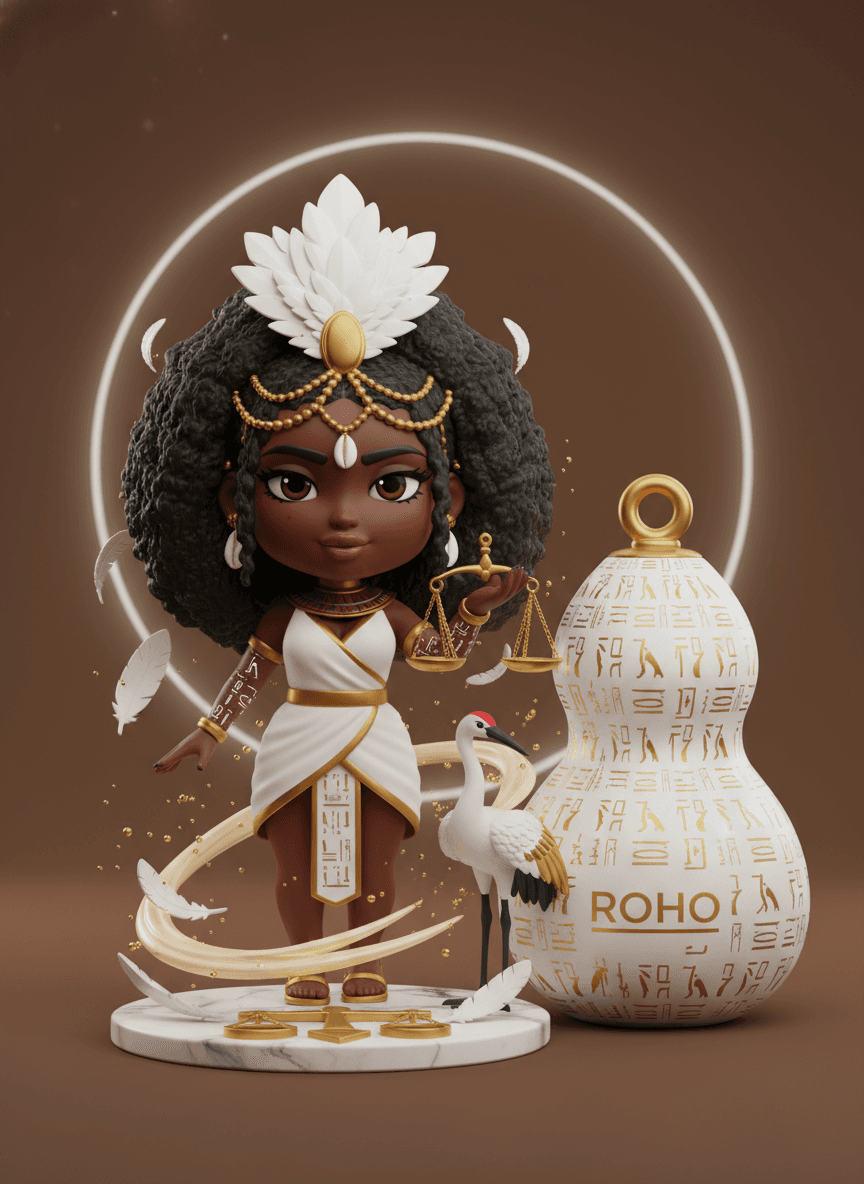
Maât
allyTruth, justice, universal order
Maat designates, in ancient Egypt, both a goddess and the fundamental principle that orders the cosmos: truth, justice, balance and the harmony of the world. Daughter of Ra, she is represented as a woman wearing on her head the ostrich feather, her hieroglyph. Maat is born with creation: she is the order the demiurge institutes against isfet, chaos and injustice. The pharaoh's first mission is to realise Maat, and the ritual of the offering of Maat, in which the king presents the gods with an effigy of the goddess, condenses the whole of Egyptian royal ideology. Viziers and judges claimed her as priests of Maat. In Egyptian moral thought, studied notably by Jan Assmann, Maat grounds a true idea of social justice: to speak Maat and to do Maat is to be truthful toward the gods and loyal toward others. At the tribunal of Osiris, her feather serves as counterweight in the weighing of the heart, the central scene of chapter 125 of the Book of the Dead: the deceased enters the afterlife only if their life conformed to Maat. Honoured notably at Karnak, where she possesses a temple, Maat remains one of the deepest concepts of ancient African religious thought.
Powers & Attributes
Role in the ROHO universe
A fragment of Onionkupón's Breath, bound to one of the five elements of the cosmic balance.
Sacred Mask
A mask carved of ancient energy: a symbol of the cosmic force proper to its pantheon.
Era
3,000 to 1,000 BCE: Cycle of Elemental Powers
Spiritual Lesson
To understand the nature of one's own balance and the wisdom hidden behind every trial.
Words of the Spirit
“Truth weighs more than all the crowns.”
Frequently asked questions
Who is Maat?
Maat is the goddess of truth, justice and cosmic order in ancient Egypt. Daughter of Ra, represented as a woman crowned with an ostrich feather, she embodies the balance instituted at the creation of the world. The pharaoh's mission is to realise her on earth, and the dead are judged by her at the tribunal of Osiris, at the weighing of the heart.
What does the feather of Maat symbolise?
The ostrich feather is the hieroglyph that writes Maat's name and her best-known symbol. At the weighing of the heart, described in chapter 125 of the Book of the Dead, the deceased's heart is placed on the scales against this feather: if it is as light as she is, the dead person lived according to truth and justice, and enters the kingdom of Osiris.
Is Maat a goddess or a concept?
Both at once. Maat is an abstract principle, the order of the world willed at creation, opposed to isfet, chaos and injustice. But the Egyptians also personified her as a goddess, daughter of Ra, endowed with temples and a clergy. This double nature explains her presence everywhere: in the royal ritual, in daily ethics and in the judgement of the dead.
Related spirits
Further reading
Sources and references
- Richard H. Wilkinson, The Complete Gods and Goddesses of Ancient Egypt (2003)
- Jan Assmann, Maât, l'Égypte pharaonique et l'idée de justice sociale (1989)
- Erik Hornung, Conceptions of God in Ancient Egypt: The One and the Many (1982)