Sobo
allyThunder, storm, discipline
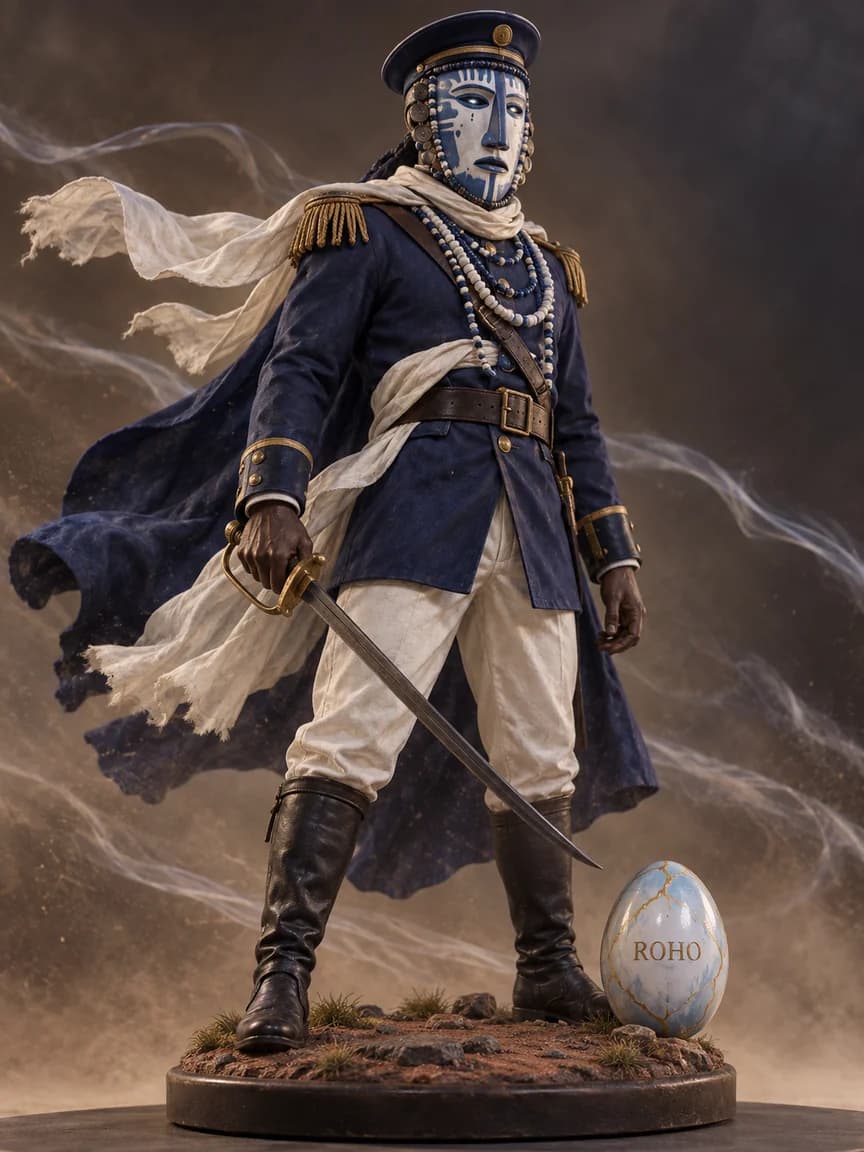
Sobo is the lwa of thunder and storms in Haitian Vodou. Served in the Rada rite, he forms with Badè, lwa of the wind, a pair of weather spirits who are invoked together: one raises the gust, the other makes the sky burst. He is represented as a soldier, strapped into a uniform, and this martial imagery speaks of his rigour more than of his violence: Sobo is a lwa of discipline, attached to order and to the word that is kept. His name ties Haitian practice to Dahomey, where Sogbo belongs to the thunder pantheon alongside Hevioso, and the kinship with the Yoruba Shango is plain, even if the two figures are not merged in the rite. He is offered sober dishes and, his servants say, one avoids calling him lightly. The thunderstone, the smooth pebble found after a storm, is sometimes kept on the altar as a fragment of his presence.
Powers & Attributes
Role in the ROHO universe
Bound to one of the five elements of the cosmic balance. Its power springs from the energy proper to its tradition, and from no other.
Sacred Mask
A mask carved of ancient energy, a symbol of the cosmic force proper to its pantheon.
Era
1500 to 1800: Cycle of the Diaspora and Remembrance
Words of the Spirit
“Thunder does not warn, it reminds.”
Frequently asked questions
Who is Sobo in Haitian Vodou?
Sobo is the lwa of thunder and storms, served in the Rada rite. He forms a pair with Badè, lwa of the wind, and is represented in military uniform, an image of his rigour and of his attachment to the word that is kept.
What links Sobo to Dahomey?
His name ties Haitian practice to Dahomey, present-day Benin, where Sogbo belongs to the thunder pantheon alongside Hevioso. The kinship with the Yoruba orisha Shango is visible, though the figures are not merged in the rite.
Related spirits
Further reading
Sources and references
- Alfred Métraux, Le Vaudou haïtien (1958)
- Maya Deren, Divine Horsemen: The Living Gods of Haiti (1953)
- Milo Rigaud, La Tradition voudoo et le voudoo haïtien (1953)