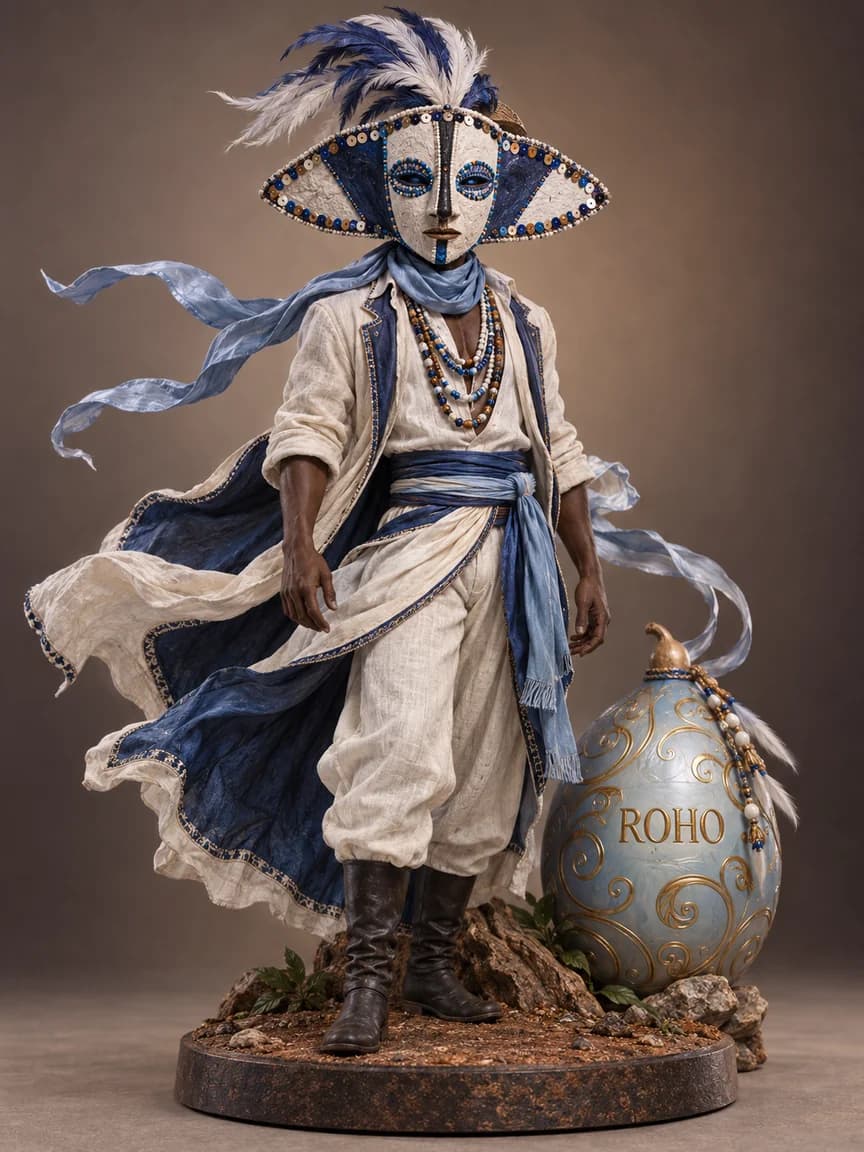
Badè
allyWind, breath, messages
Badè is the lwa of the wind in Haitian Vodou. Served in the Rada rite, he is almost always named with Sobo, lwa of thunder: the two go together, and one is hardly served without the other being greeted. Where Sobo strikes, Badè announces and moves. He is the breath that comes before the storm, the one that bends the trees and snaps the banners of the peristyle, and by extension the bearer of messages and changes. His servants see in him a spirit of announcement more than of destruction: what he brings may be good news as well as a torment, and wisdom lies in listening to what is coming before judging it. His cult is less developed today than that of the great lwa, and he appears mostly in the litanies where the names of the Rada rite are recited one by one. This very discretion says something about his nature: the wind is noticed by what it moves, rarely for itself.
Powers & Attributes
Role in the ROHO universe
Bound to one of the five elements of the cosmic balance. Its power springs from the energy proper to its tradition, and from no other.
Sacred Mask
A mask carved of ancient energy, a symbol of the cosmic force proper to its pantheon.
Era
1500 to 1800: Cycle of the Diaspora and Remembrance
Words of the Spirit
“The wind carries not only dust, it carries news.”
Frequently asked questions
Who is Badè in Haitian Vodou?
Badè is the lwa of the wind, served in the Rada rite. He is almost always named with Sobo, lwa of thunder: Badè is the breath that comes before the storm, bearer of messages and changes.
Why are Badè and Sobo invoked together?
Because they form a weather pair: one raises the wind, the other makes the sky burst. In the litanies of the Rada rite their names follow each other, and one is hardly served without the other being greeted.
Related spirits
Further reading
Sources and references
- Alfred Métraux, Le Vaudou haïtien (1958)
- Maya Deren, Divine Horsemen: The Living Gods of Haiti (1953)
- Milo Rigaud, La Tradition voudoo et le voudoo haïtien (1953)