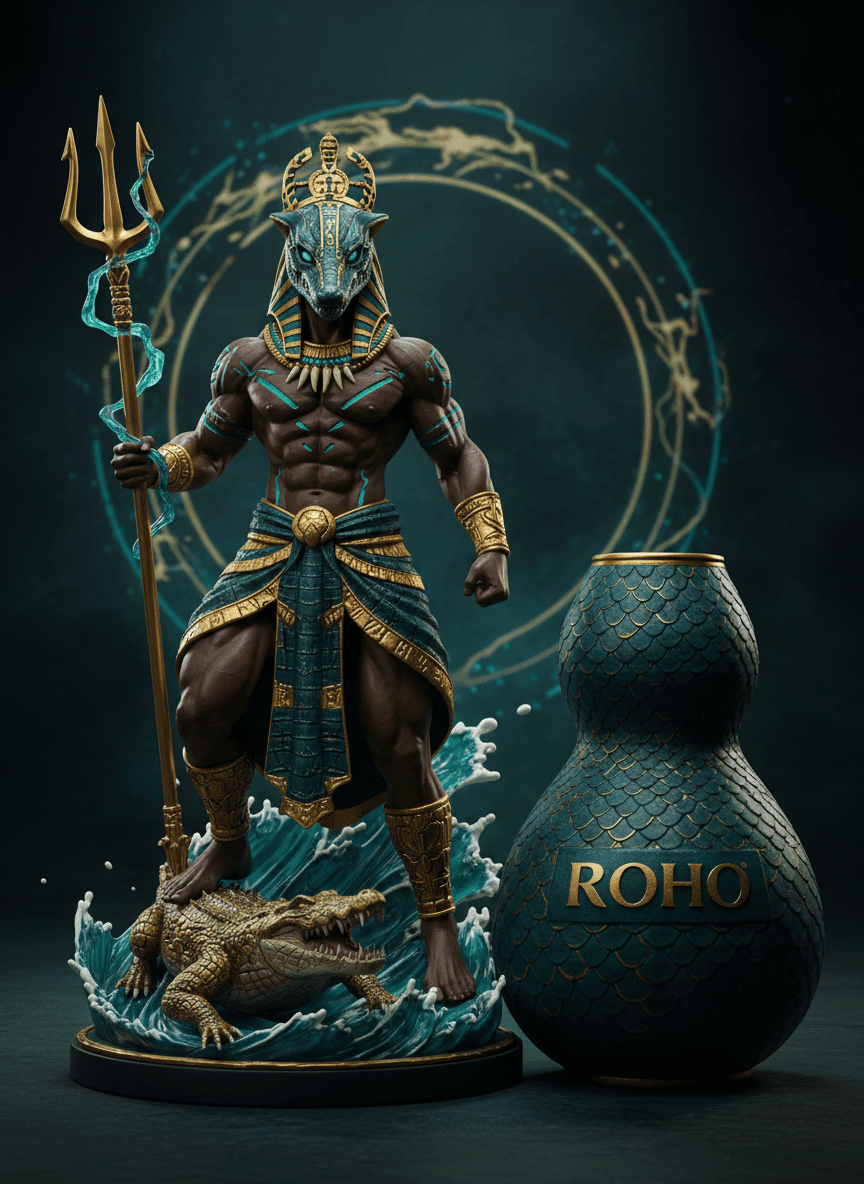
Sobek
neutralPrimordial Force of the Waters
Sobek is the crocodile god of ancient Egypt, associated with the waters of the Nile, with fertility and with the raw power of nature. Attested from the Old Kingdom in the Pyramid Texts, he is depicted as a crocodile or as a man with a crocodile's head, sometimes crowned with plumes and the solar disc. Son of the goddess Neith, he is said to have emerged from the primordial waters of the Nun, and one tradition has the Nile born of his sweat. Master of the waters that irrigate the fields, he is both protector and predator, invoked for protection against the dangers of the river. His great cult centres were the Fayum and Kom Ombo, where he was worshipped alongside Horus, and mummified crocodiles were consecrated to him. Aboard the solar barque, he fights Apophis, the serpent of chaos. His name enters the titulary of several pharaohs, such as Sobekhotep.
Powers & Attributes
Role in the ROHO universe
Guardian of the depths of the aquatic NZA. His territory marks the border between the living waters and the abysses of the NZI.
Sacred Mask
A crocodile mask of ancient bronze, with an articulated jaw and amber eyes.
Era
3,000 to 1,000 BCE: Cycle of Elemental Powers
Words of the Spirit
“Where he awakens, life and destruction coexist.”
Frequently asked questions
What does Sobek represent?
The crocodile god of the waters of the Nile, at once a source of fertility and a destructive force, a protector against the dangers of the river.
Where was he worshipped?
Above all in the Fayum region and at Kom Ombo, where he shared the temple with Horus. Crocodiles were mummified there in his honour.
What is his mythic origin?
Son of the goddess Neith, he is said to have emerged from the primordial waters of the Nun, and one tradition has the Nile born of his sweat.
Related spirits
Further reading
Sources and references
- Wikipedia (FR/EN), Sobek
- Marco Zecchi, Sobek of Shedet: The Crocodile God in the Fayyum in the Dynastic Period, Todi, Tau Editrice (2010)
- Edda Bresciani, Sobek, Lord of the Land of the Lake, dans Divine Creatures: Animal Mummies in Ancient Egypt, dir. Salima Ikram, Le Caire, American University in Cairo Press, p. 199-206 (2005)