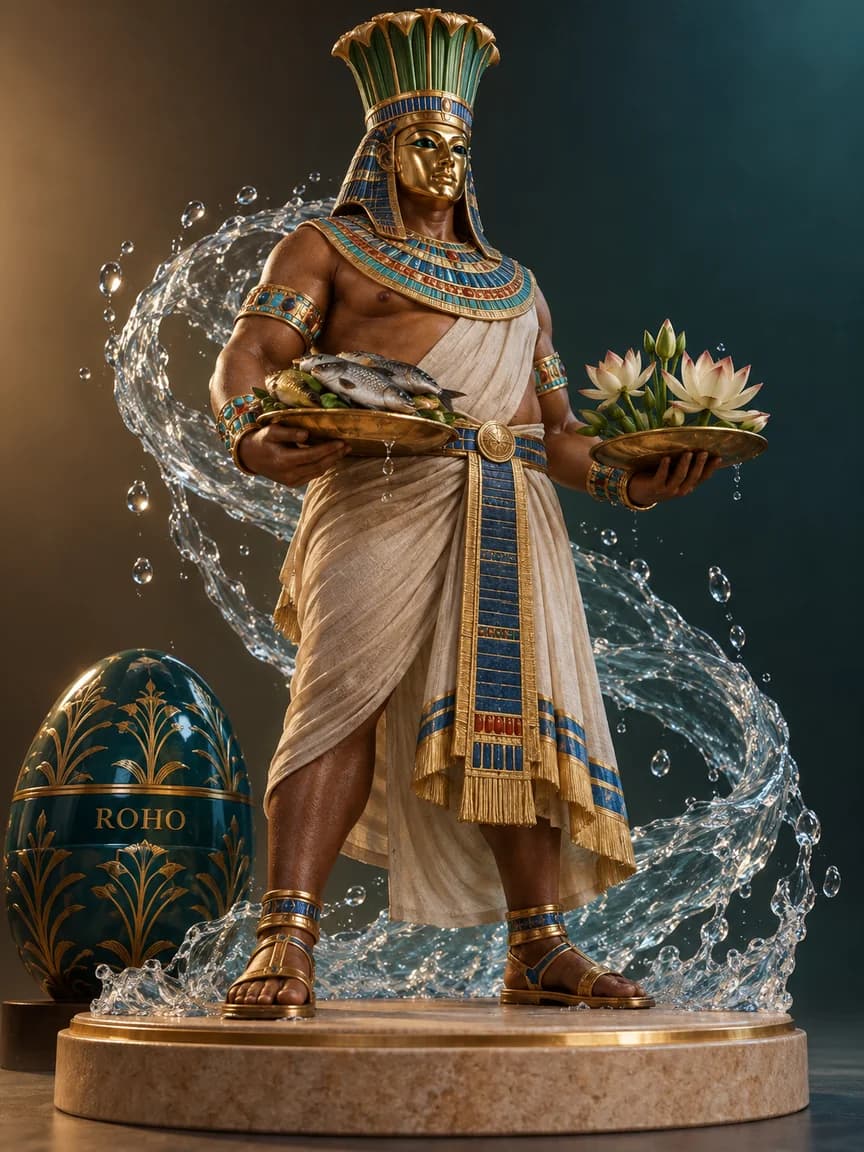
Hapy
neutralGod of the Nile flood
Hapy is the god of the Nile flood in the religion of ancient Egypt. He does not personify the river itself but the vital phenomenon of the annual inundation, which deposited fertile silt on the lands and made agriculture possible in the heart of the desert. As such, Hapy is a power of fecundity and abundance, sometimes qualified as father of the gods and likened to Osiris. His iconography is androgynous: although masculine and wearing the false beard, he is represented with hanging breasts and a prominent belly, signs of prosperity, and blue or green skin evoking water. In Lower Egypt he is associated with the papyrus, in Upper Egypt with the lotus. Doubled, he knots together the stems of these two plants in the sema-tawy motif, the symbol of the union of the Two Lands. His cult, present wherever the Nile flowed, had an important centre at Elephantine, near the nilometers that measured the rising of the waters.
Era
3,000 to 30 BCE
Frequently asked questions
Of what is Hapy the god?
Hapy is the god of the Nile flood, the annual inundation that fertilised the lands. He does not embody the river but the nourishing phenomenon of the rising waters.
Why is Hapy represented with breasts?
His androgynous body, with hanging breasts and a round belly, expresses the abundance and fecundity brought by the flood. The blue or green skin recalls the water of the Nile.
What does the motif of Hapy knotting two plants mean?
Doubled, Hapy knots the stems of the papyrus and the lotus, the plants of Lower and Upper Egypt, in the sema-tawy, the emblem of the union of the Two Lands under royal authority.
Related spirits
Further reading
Sources and references
- Richard H. Wilkinson, The Complete Gods and Goddesses of Ancient Egypt (2003)
- George Hart, The Routledge Dictionary of Egyptian Gods and Goddesses (2005)
- , Wikipedia (FR/EN)