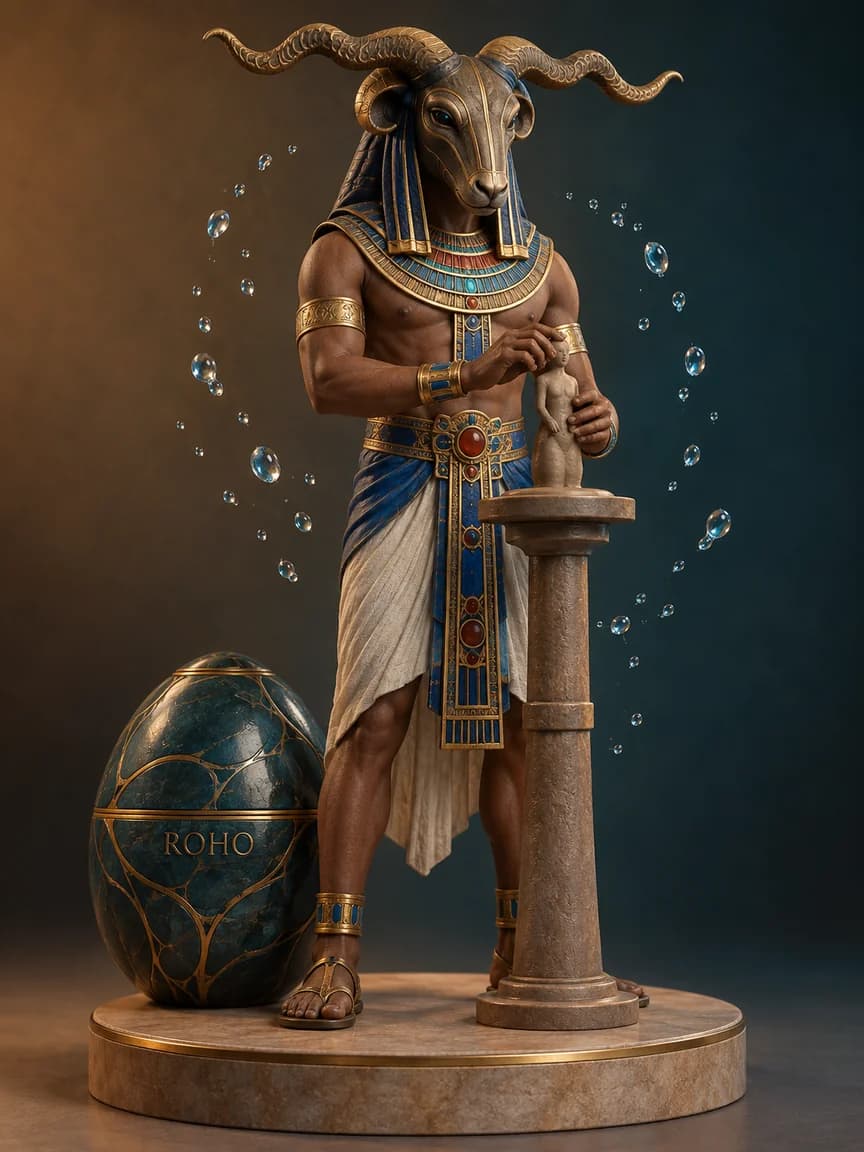
Khnoum
neutralPotter god, source of the Nile
Khnum is a deity of ancient Egypt, venerated from the Old Kingdom and above all in the region of Elephantine, at the first cataract of the Nile. His name is linked to the idea of the freshness of the waters, and he passes for the master of the river's annual flood, which he releases from the subterranean caverns of Hapy. He is represented as a man with the head of a ram with horizontal horns, sometimes crowned with the atef crown or a vase, holding the ankh sign. His most famous function is that of the potter demiurge: he shapes on his wheel the bodies of living beings, humans and gods, as well as their ka, from the silt of the Nile. At Elephantine, he forms a triad with the goddesses Satis and Anukis. His temple of Esna, built in the Graeco-Roman era, preserves long inscriptions describing his cosmogonic role and his festivals. Associated with the vital power of the ram, he is also likened to the notion of the ba, the soul, several great gods such as Ra being held to be his manifestations. Protector of fertility and of birth, Khnum remains one of the major creator gods of the Egyptian pantheon.
Era
3,000 to 30 BCE
Frequently asked questions
Why is Khnum figured with a ram's head?
The ram symbolises creative power and vital force, the ba. Khnum is modelled on this fecund animal, which underlines his role as demiurge and guarantor of fertility.
Where were his principal places of cult?
At Elephantine, near Aswan, at the first cataract of the Nile, and at Esna, where a Graeco-Roman temple rich in theological inscriptions concerning him survives.
Which myth best sums up his role?
That of the potter god: Khnum shapes on his wheel the bodies and the ka of humans and gods from the silt of the Nile, before giving them life.
Related spirits
Further reading
Sources and references
- Richard H. Wilkinson, The Complete Gods and Goddesses of Ancient Egypt (2003)
- Claude Traunecker, Les dieux de l'Égypte (2001)
- , Wikipedia (FR/EN)