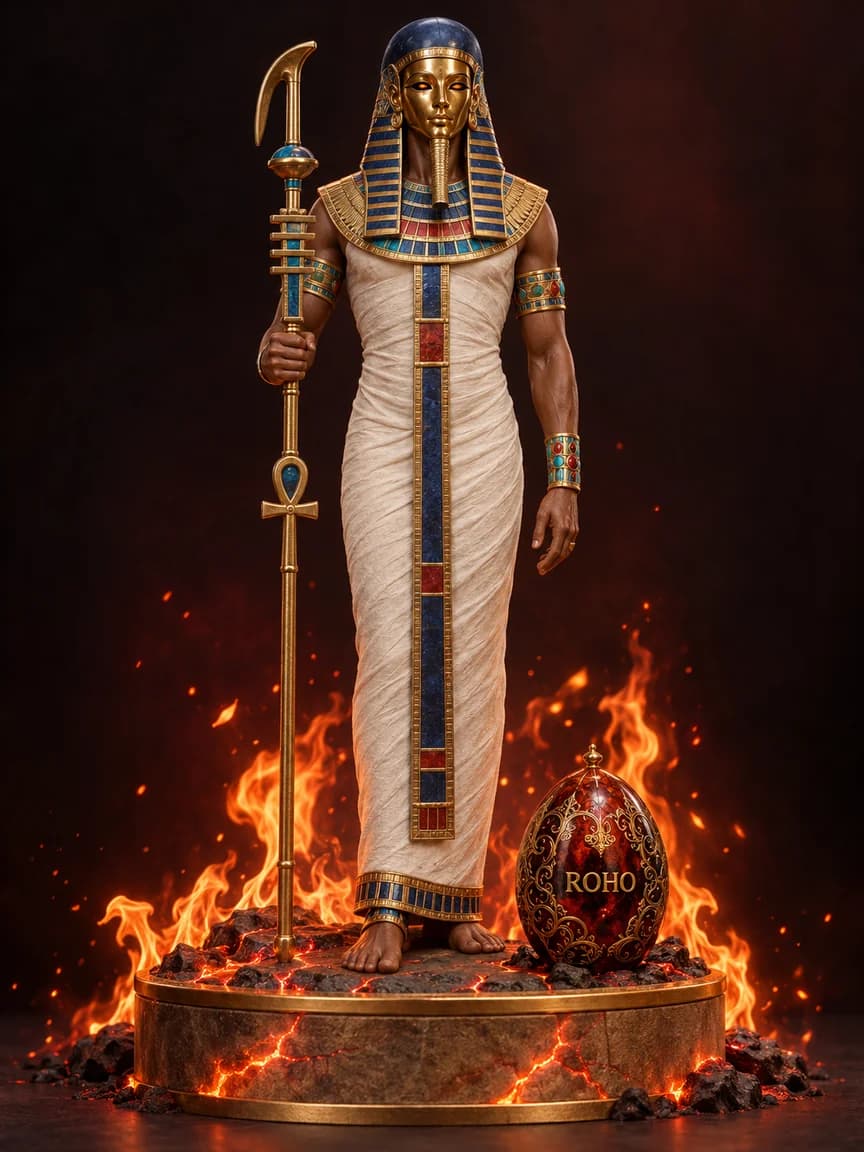
Ptah
neutralCreator god of the craftsmen of Memphis
Ptah is the great creator god of Memphis, patron of craftsmen, architects and sculptors. He is represented as a man whose body is wrapped in a close-fitting shroud, his skin often green, wearing a skullcap, holding a composite sceptre that unites the was of power, the ankh of life and the djed pillar of stability. According to the Memphite theology, transmitted by the Shabaka stone, Ptah conceives the world through the thought of his heart and gives it existence through the speech of his tongue, a creation by the Word that distinguishes his cosmogony from that of Heliopolis. A demiurge, he is also the god of the working of matter, associated with the forge and with metals. He unites with other deities in the forms of Ptah-Sokar-Osiris, bound to the funerary world, and of Tatenen, the primordial emerged earth. Husband of the lioness Sekhmet and father of Nefertum, he was honoured from the Old Kingdom. His great temple of Memphis, the Hut-ka-Ptah, is said to have given, through Greek, its name to Egypt. The Apis bull was his sacred animal.
Era
3,000 to 30 BCE
Frequently asked questions
How does Ptah create the world?
According to the Memphite theology, Ptah conceives all things in his heart, the seat of thought, then gives them existence by naming them with his tongue, thus creating the world by the Word.
Why is Ptah the patron of craftsmen?
A demiurge who shapes matter, he was venerated as the master of craftsmen, sculptors, architects and metalworkers. His high priest at Memphis bore the title of chief of craftsmen.
What link exists between Ptah and the name of Egypt?
The Greek name Aigyptos is said to derive from Hut-ka-Ptah, the dwelling of the ka of Ptah, the designation of his great temple of Memphis.
Related spirits
Further reading
Sources and references
- Richard H. Wilkinson, The Complete Gods and Goddesses of Ancient Egypt (2003)
- Erik Hornung, Conceptions of God in Ancient Egypt: The One and the Many (1982)
- , Wikipedia (FR/EN)