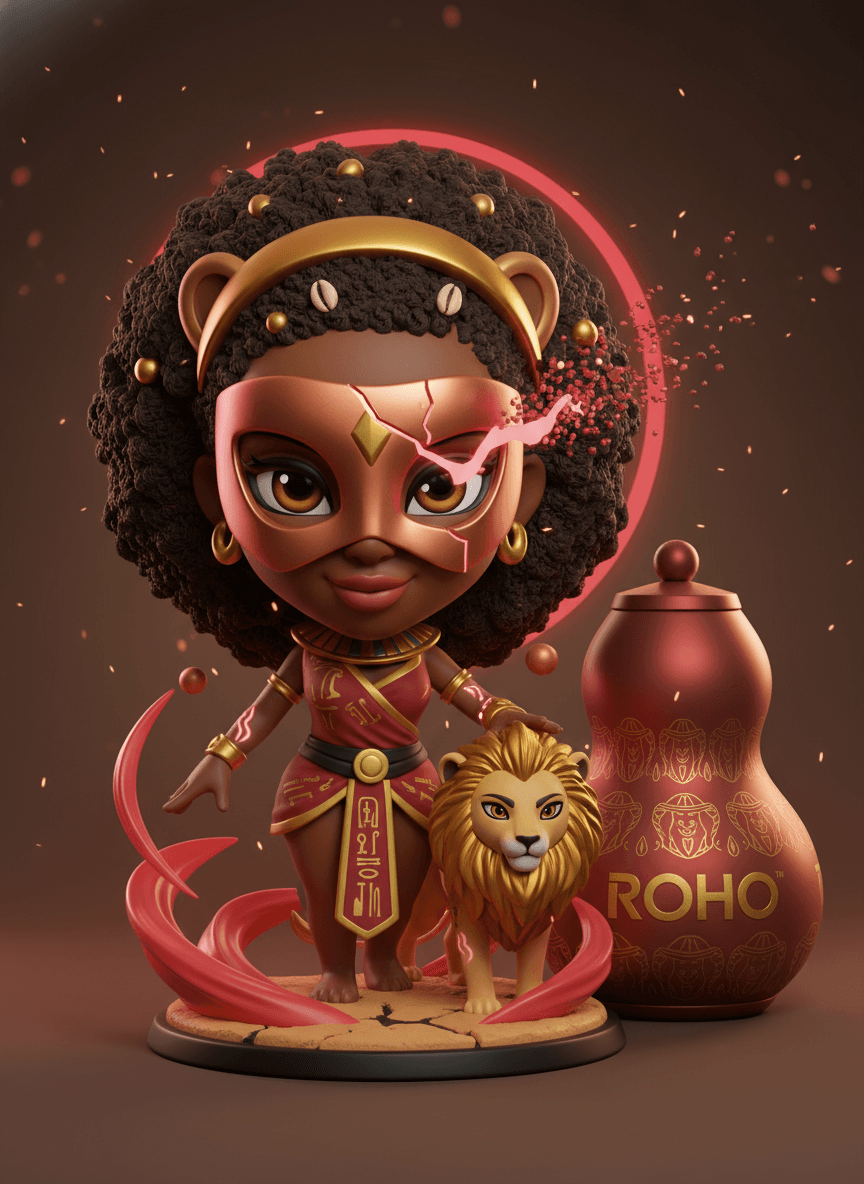
Sekhmet
allyThe Protecting Lioness
Sekhmet is the lioness goddess of war, plague and healing in ancient Egypt, the African civilisation of the Nile valley. Her name, derived from the word sekhem, means the Powerful One. She is depicted as a woman with a lioness's head, crowned with the solar disc and the uraeus. Daughter of Ra, she is the eye of the sun, its avenging power: in the myth of the Destruction of Mankind, told in the Book of the Heavenly Cow, Ra sends her to punish rebellious humanity, and only a stratagem, beer dyed red, which she drinks as blood, halts the slaughter. This ambivalence defines the goddess: she sends plagues through her messengers, dreaded at the turning of the year, but she can also hold them back, and her priests were among the first physicians attested in Egypt. Her principal cult was at Memphis, where she forms the Memphite triad with Ptah and their son Nefertum. Under Amenhotep III, several hundred granodiorite statues of her were erected at the temple of Mut at Karnak and at the king's mortuary temple at Kom el-Hettan, most likely to appease the goddess. Bastet, the peaceable cat, is regarded as her pacified form.
Powers & Attributes
Role in the ROHO universe
Guardian of the Cycle of Fire. She protects the southern passage of the Mabioni and consumes all that threatens the sacred balance.
Sacred Mask
A lioness mask of gold and obsidian, its mane of frozen flames.
Era
3,000 to 1,000 BCE: Cycle of Elemental Powers
Words of the Spirit
“She consumes whatever threatens the balance.”
Frequently asked questions
Who is Sekhmet?
Sekhmet is the lioness goddess of war, plague and healing in ancient Egypt. Her name means the Powerful One. Daughter of Ra and avenging eye of the sun, consort of Ptah at Memphis, she is depicted as a woman with a lioness's head crowned with the solar disc. Her fury protects the order of the world when properly appeased by the rites.
Why is Sekhmet both destroyer and healer?
For the Egyptians, the power that sends evil is also the only one able to withdraw it. Sekhmet unleashes plagues through her messengers, but litanies and rites of appeasement turn her into a protector. Her priests were among the first physicians attested in ancient Egypt. Destruction and healing are the two faces of a single force: sekhem, power itself.
Why are there hundreds of statues of Sekhmet?
Pharaoh Amenhotep III had several hundred granodiorite statues of Sekhmet erected at the temple of Mut at Karnak and at his mortuary temple at Kom el-Hettan. Egyptologists read them as a great litany in stone meant to appease the goddess: perhaps one statue for each day of the year. Many are now scattered across the world's museums.
Related spirits
Further reading
Sources and references
- Richard H. Wilkinson, The Complete Gods and Goddesses of Ancient Egypt (2003)
- Philippe Germond, Sekhmet et la protection du monde (1981)
- Erik Hornung, Conceptions of God in Ancient Egypt: The One and the Many (1982)