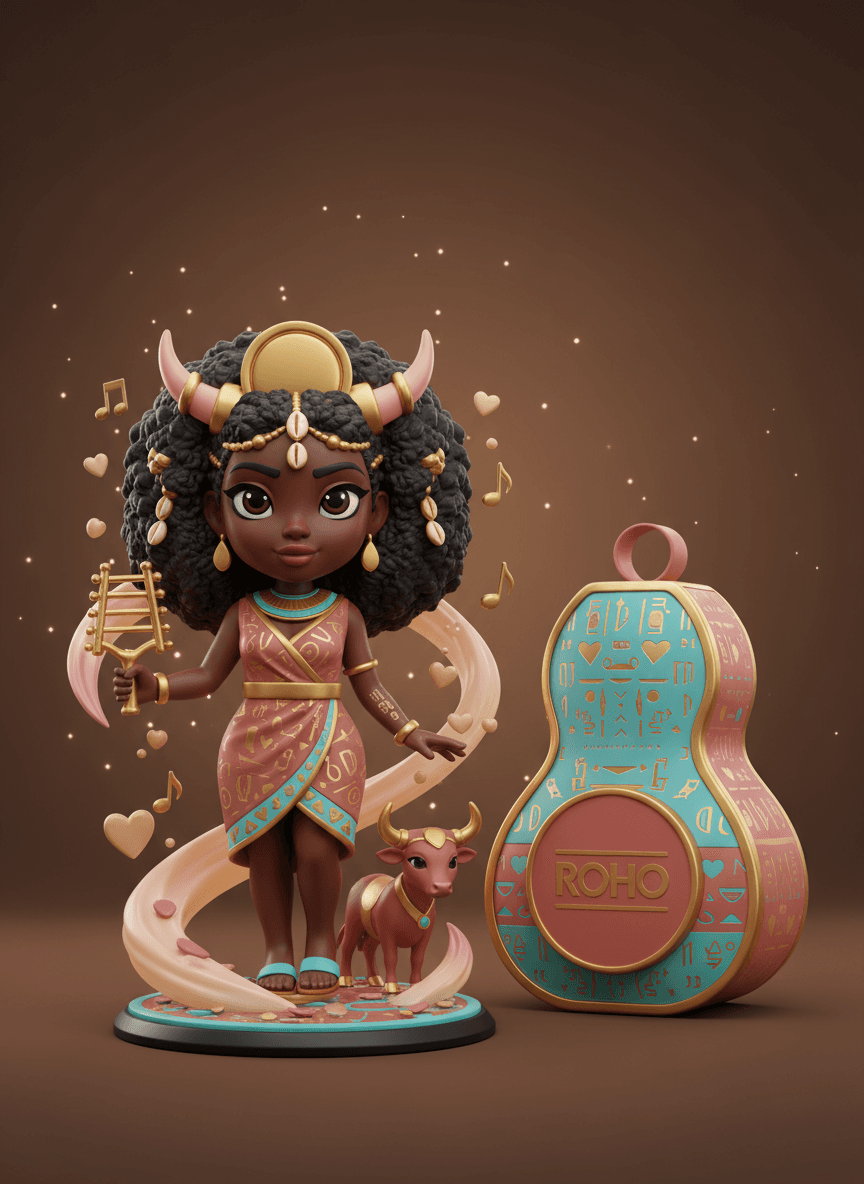
Hathor
allyLove, music, fertility
Hathor is one of the most ancient and best-loved goddesses of ancient Egypt, the African civilisation of the Nile valley. Goddess of the sky, of love, of music, of dance and of fecundity, she embodies joy and beauty. Daughter of the solar god Ra, whose eye she also is, and associated with Horus, her name means dwelling of Horus, she is represented as a celestial cow, as a woman crowned with cow horns framing the solar disc, or as a woman with bovine ears. The sistrum and the menat, sacred musical instruments, are consecrated to her and accompany her cult. Hathor protects women, presides over births and watches over love and feminine beauty. She is also the mistress of the West who welcomes the dead into the afterlife, and the lady of turquoise honoured as far as the mines of Sinai. Her great temple, remarkably preserved, stands at Dendera, in Upper Egypt, home of joyful festivals such as that of the beautiful reunion, which celebrated her union with Horus of Edfu. The myth of the distant goddess tells how, in the guise of the raging lioness Sekhmet, she nearly annihilated humanity before being appeased and returned to her benevolent form: an illustration of the double nature of the great Egyptian solar goddesses.
Powers & Attributes
Role in the ROHO universe
A fragment of Onionkupón's Breath, bound to one of the five elements of the cosmic balance.
Sacred Mask
A mask carved of ancient energy: a symbol of the cosmic force proper to its pantheon.
Era
3,000 to 1,000 BCE: Cycle of Elemental Powers
Spiritual Lesson
To understand the nature of one's own balance and the wisdom hidden behind every trial.
Words of the Spirit
“What is rooted does not fear the storm.”
Frequently asked questions
Who is Hathor?
Hathor is the goddess of love, joy, music and beauty in ancient Egypt. A celestial and nourishing goddess, daughter of the solar god Ra, she watches over women, births and love. She is represented as a cow, as a woman crowned with horns framing the solar disc, or with bovine ears. Her great temple, magnificently preserved, stands at Dendera.
Why is Hathor represented as a cow?
The cow, the nourishing animal par excellence, symbolises fecundity, motherhood and protection: Hathor's essential functions. A celestial goddess, she is also imagined as the great cow of the sky whose body shelters the stars. From this image derive her best-known attributes: the cow horns framing the solar disc that she wears on her head, sign of her bond with her father, the sun Ra.
What role does music play in the cult of Hathor?
Music and dance stand at the heart of the cult of Hathor, goddess of joy. The sistrum, a kind of sacred rattle, and the menat, a counterweighted necklace shaken like an instrument, are consecrated to her and serve to appease her. Her priestesses and her faithful honoured her with songs and dances, notably at the festivals celebrated in her temple at Dendera, in Upper Egypt.
Related spirits
Further reading
Sources and references
- Richard H. Wilkinson, The Complete Gods and Goddesses of Ancient Egypt (2003)
- Geraldine Pinch, Egyptian Mythology: A Guide to the Gods, Goddesses, and Traditions of Ancient Egypt (2002)
- Erik Hornung, Conceptions of God in Ancient Egypt: The One and the Many (1982)