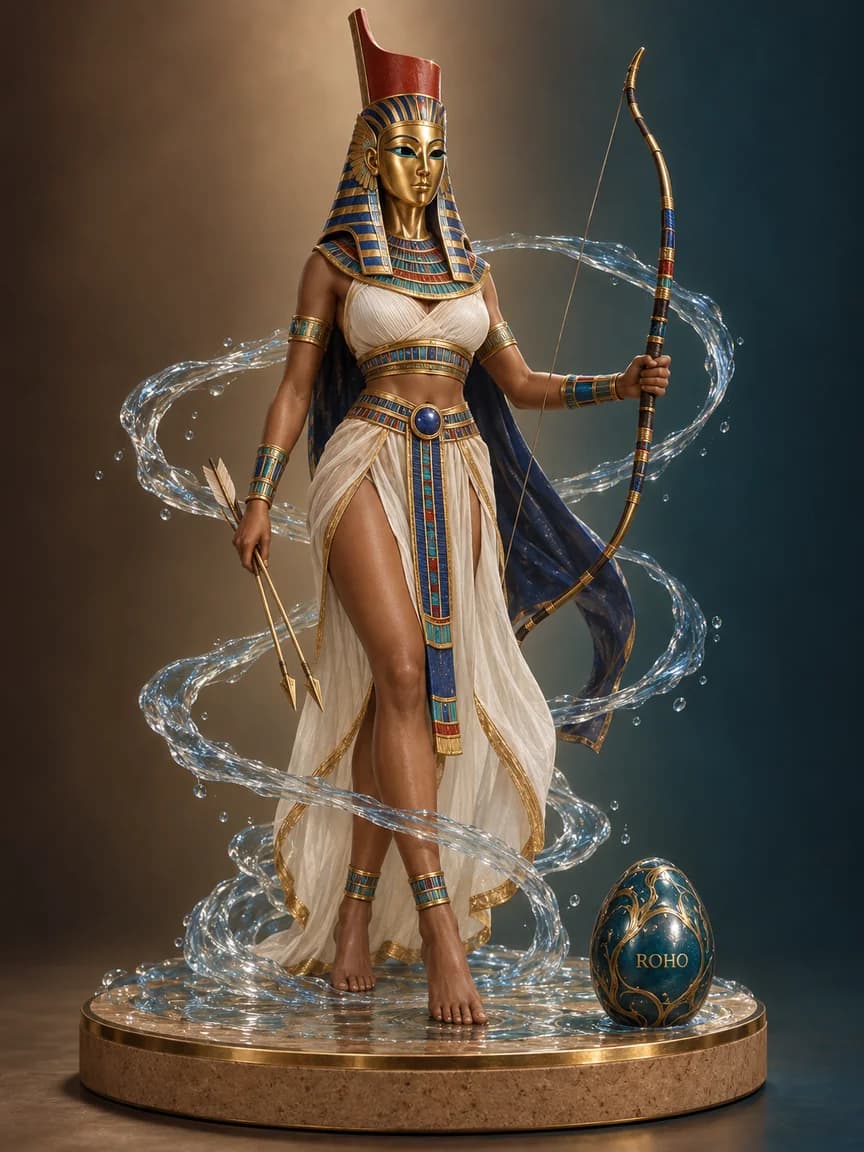
Neith
neutralWarrior and creator goddess
Neith is one of the most ancient Egyptian deities, whose principal cult was at Sais, in the western delta of the Nile. A complex figure, she unites several domains: war and the hunt, symbolised by crossed bows and arrows, as well as weaving, the art of which she is the patron and which links her to the linen bandages of mummies. Tradition also presents her as a primordial creator goddess, sometimes qualified as mother and father of all things, issued from the original waters of the Nun. She is represented crowned with the red crown of Lower Egypt, holding bow and arrows or the was sceptre. According to the texts, she is the mother of Ra and of the crocodile god Sobek, and intervenes as arbiter in the conflict opposing Horus and Seth, recommending that Horus receive the throne. Her clergy knew a considerable influence under the Twenty-sixth Dynasty, when Sais became capital. The Greeks assimilated her to Athena on account of her warlike character. Protector of the deceased, she also watches over certain organs kept in the canopic jars.
Era
3,000 to 30 BCE
Frequently asked questions
What was Neith's principal place of cult?
Sais, in the western delta of the Nile, where her sanctuary flourished above all under the Twenty-sixth Dynasty, when the city became the capital of Egypt.
Why is Neith associated at once with war and with weaving?
Her emblem unites crossed bows and arrows, warlike signs, while a weaver's instrument figures in her name, which makes her the patron of weavers and of funerary linen.
What role does Neith play in the conflict between Horus and Seth?
Consulted as arbiter by the gods, she counsels awarding the throne to Horus while proposing compensations for Seth, helping to appease the quarrel.
Related spirits
Further reading
Sources and references
- Richard H. Wilkinson, The Complete Gods and Goddesses of Ancient Egypt (2003)
- George Hart, The Routledge Dictionary of Egyptian Gods and Goddesses (2005)
- , Wikipedia (FR/EN)