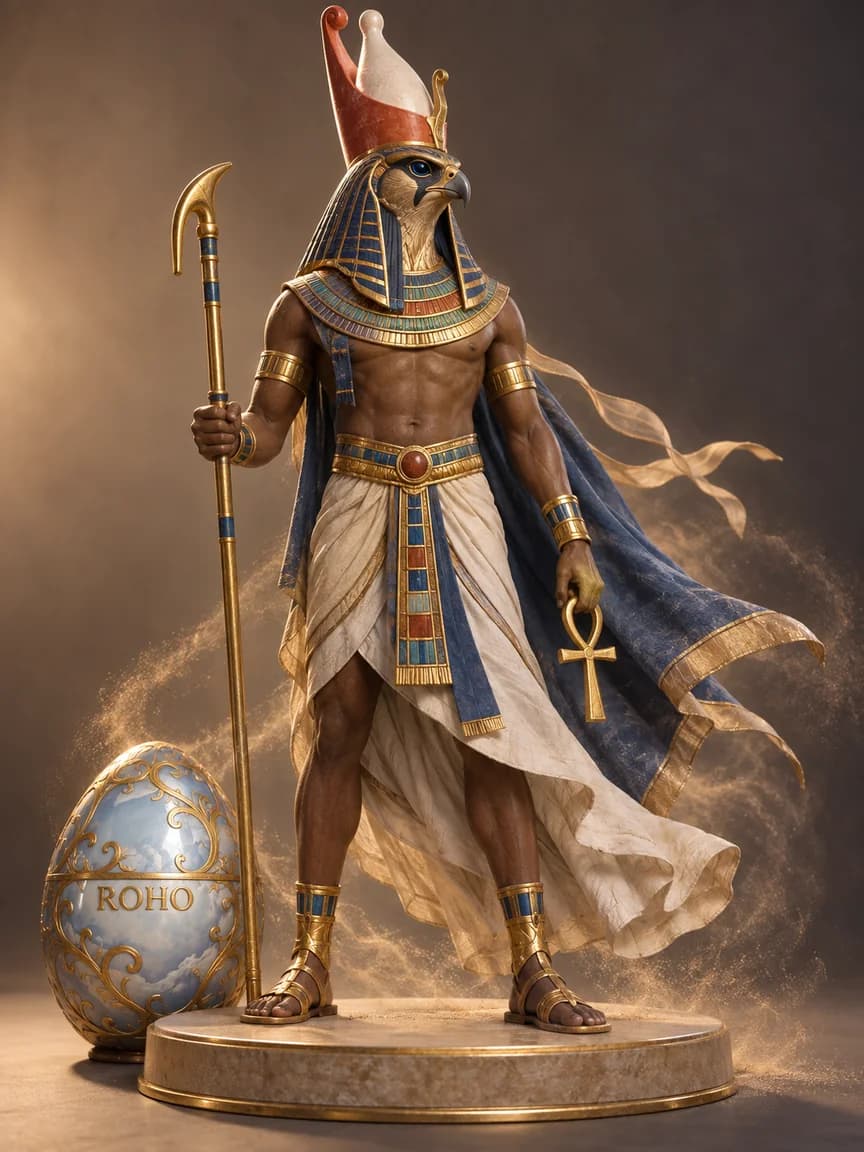
Horus
neutralFalcon god of the sky and kingship
Horus is one of the most ancient deities of ancient Egypt, venerated from the predynastic period. Represented as a falcon or as a man with a falcon's head wearing the pschent, the double crown, he embodies the sky, of which the sun and the moon form the two eyes. His name, drawn from the Egyptian Hor, evokes the distant one and the majestic flight of the raptor. Horus is closely bound to kingship: the living pharaoh was considered his earthly incarnation, and the first sovereigns bore the title of Followers of Horus. In the Osirian myth, he becomes the posthumous son of Osiris and Isis. Under the name of Harendotes, the one who protects his father, he confronts his uncle Seth to avenge the murder of Osiris and reconquer the throne, a conflict in the course of which he loses then recovers his eye, the wedjat, a symbol of integrity and healing. One distinguishes Horus the Elder, the cosmic falcon, and Horus son of Isis. His principal sanctuaries were at Hierakonpolis, Edfu and Kom Ombo, from which his cult radiated throughout the Nile valley.
Era
3,000 to 30 BCE
Frequently asked questions
Why is Horus represented as a falcon?
The falcon, a raptor of majestic flight, symbolised the sky and sovereign power. Its two eyes were associated with the sun and the moon, making Horus a celestial god watching over Egypt.
What is the eye of Horus, the wedjat?
It is the eye that Horus loses then recovers in his battle against Seth. Become a very widespread amulet, it symbolises protection, wholeness and healing.
What link unites Horus to the pharaoh?
The living king was considered the incarnation of Horus on earth, guarantor of order. At his death, he joined Osiris while his successor became the new Horus.
Related spirits
Further reading
Sources and references
- Richard H. Wilkinson, The Complete Gods and Goddesses of Ancient Egypt (2003)
- Claude Traunecker, Les Dieux de l'Égypte (2001)
- , Wikipedia (FR/EN)