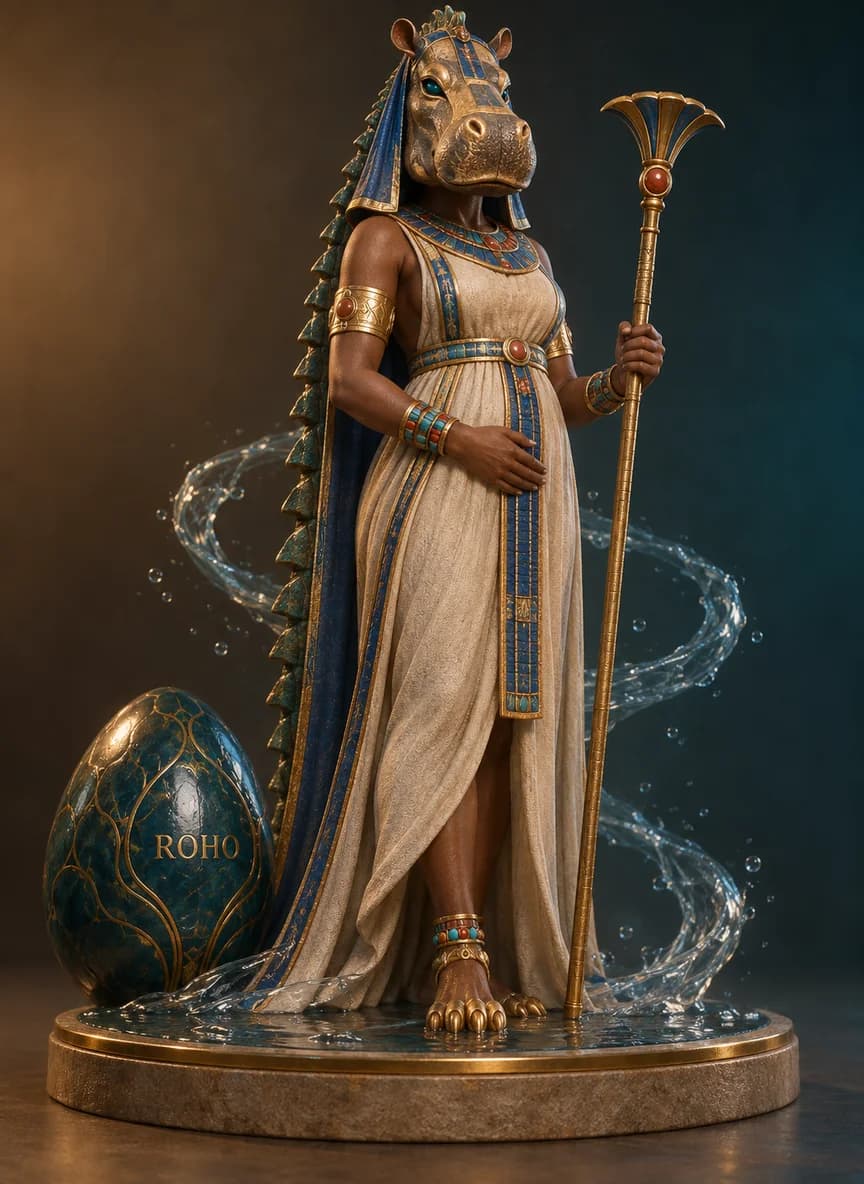
Taouret
neutralHippopotamus goddess of childbirth
Taweret, whose name means the Great One, is a protective goddess of ancient Egypt, guardian of pregnancy, childbirth and infants. She presents herself in a hybrid form: the body of a standing female hippopotamus, with a swollen belly and hanging breasts, the paws of a lion, the back and tail of a crocodile. She often wears the wig and the Hathoric crown, and holds the protective sa sign or a knife. Her fearsome appearance is meant to frighten the malevolent spirits and demons that threaten mother and child at birth. The female hippopotamus, reputed a fierce defender of its young, embodied this maternal protection, while her bonds with the Nile referred to fecundity and the life-giving waters. Very present in popular piety, she shares with the god Bes the protection of the home and of childbirth. Women wore her amulets and invoked her on domestic objects, notably magic knives and milk vases. A temple of hers is known at Karnak. According to the traditions, she is sometimes likened to Seth, whose violence she tempers in the form of a benevolent hippopotamus.
Era
3,000 to 30 BCE
Frequently asked questions
Why does Taweret have the appearance of a hippopotamus?
The female hippopotamus fiercely defends its young. This image embodies maternal protection, and the goddess's frightening aspect serves to repel the demons threatening the birth.
What was her principal role?
To protect pregnant women, women in childbirth and newborns. She was invoked through amulets and magical objects to guarantee a safe birth and good lactation.
With which other gods is she associated?
Above all Bes, another protector of the home and of childbirth, and Hathor, whose crown she borrows. She is also bound to Seth through the figure of the hippopotamus.
Related spirits
Further reading
Sources and references
- Richard H. Wilkinson, The Complete Gods and Goddesses of Ancient Egypt (2003)
- Françoise Dunand, Christiane Zivie-Coche, Gods and Men in Egypt: 3000 BCE to 395 CE (2004)
- , Wikipedia (FR/EN)